

The phrase “large families” has been part of the Singapore lexicon since last year. During Budget 2025, Prime Minister Lawrence Wong announced the Large Families Scheme (LFS) to provide more support for couples with three or more children. In this year’s Budget 2026 debate, however, Member of Parliament (MP) David Hoe took it a step further. He suggested a new type of BTO flat – a “jumbo BTO flat” that had additional bedroom space for large families.
Read Also: Guide To All The Benefits For The Large Families Scheme
In his speech, MP Hoe noted that Singapore’s total fertility rate (TFR) remains at a “historical low” of 0.97 in 2024. He acknowledged that HDB flats have become “more compact” over time. In “land-scarce” Singapore, he said, “we have to use our space efficiently”. Smaller HDB flats are “part of our reality today”. He therefore raised the possibility that encouraging couples planning to have children, or more children, could start with giving them opportunities to secure homes that are more conducive to larger families.
Setting aside MP Hoe’s subsequent suggestion of getting couples to commit to having two or more children to qualify for these flats, he does raise an important point. Larger flats are more conducive to larger families, and the current rate of making our flats more compact does appear to have contributed to the low TFR.
What Are The Current Housing Policies For Larger Families
In a written answer to MP David Hoe’s Parliamentary question, the Ministry of National Development responded that HDB is already offering 5-room and 3Gen flats to cater to the housing needs of larger and multi-generation families. They also pointed out that flat owners can apply to combine two-adjoining 3-room or smaller flats under the HDB Conversion Scheme.
Read Also: What Are HDB Jumbo Flats And How You Can Buy One In Singapore
Furthermore, the response noted that the Third Child Priority Scheme means that eligible families with three or more children will be given priority allocation in BTO and Sale of Balance Flats (SBF) exercises to enhance their chances of securing flats.
This response reinforces what HDB has said previously: that HDB continues to build 5-room flats as part of its commitment to offer a wide range of flat types across various locations to meet demand. In the latest BTO launch in February 2026, there was a total of 662 5-room flats across two projects in Sembawang. In 2025, 3,993 of the 19,723 BTO flats launched were 5-room flats. That’s slightly more than 20%.
Furthermore, the average size of 5-room HDB flats has remained at a constant 110 square metres since 1997. This is despite the average household size of resident households decreasing from 3.77 in 1997 to 3.06 in 2025, according to the Department of Statistics.
Read Also: 5S, 5I, 5A: The Different Types Of HDB 5-Room Flats In Singapore
The Statistics Appear To Support HDB’s Decision
Singapore’s population, based on the latest data dated June 2025, is 6.11 million. Residents, defined as both Singapore Citizens and Permanent Residents, number 4.20 million. This represents a 0.7% increase year-on-year in the citizen population, with the Permanent Resident population remaining stable at 0.54 million.
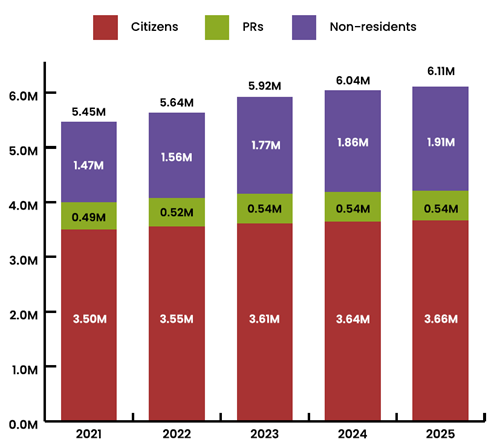
Source: Department of Statistics
Yet during the same period, the number of resident households has increased by 1.6%, from 1.46 million in 2024 to 1.48 million in 2025. This implies that the number of households is growing faster than the resident population, which is what is causing the average household size among resident households to shrink.
Read Also: 10 Key Differences Between Singapore Families With Young Children And Those Without
Is Average Resident Household Size Truly Decreasing
However, here is where it gets interesting. Over the past five years, the average resident household size has dropped from 3.15 in 2021 to 3.06 in 2025, a drop of almost 2.9%. However, what is interesting is how the number of resident households with 5 or more people has changed, or more accurately, not changed over the same period.
| 5-Person Households | 6-Person Households Or Larger | |
| 2021 | 160,900 | 104,400 |
| 2022 | 147,500 | 87,100 |
| 2023 | 156,500 | 99,200 |
| 2024 | 161,800 | 91,900 |
| 2025 | 161,600 | 91,000 |
According to data from the Singapore Department of Statistics, the number of 5-person households has remained largely unchanged during this period, while the number of households with 6 or more persons has decreased from 104,400 in 2021 to 91,000 in 2025, a drop of about 12.8%.
If we extend the data back to 1980, we can see that the actual number of 5-person households and households with 6 or more persons has remained relatively steady over the past three decades, from 1995 to 2025. In contrast, the number of smaller households has increased dramatically over the same period.
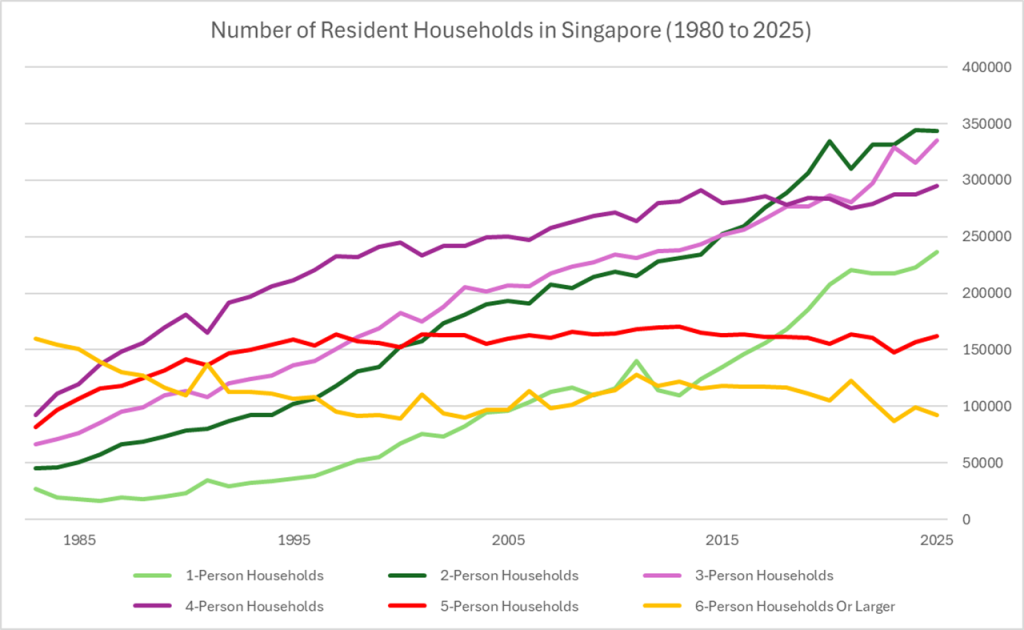
Data Source: Singapore Department of Statistics
What the data suggests is that while the average household size among resident households is decreasing, it is not because the absolute number of large families in Singapore is decreasing.
Why Large Families Need Bigger Flats
Based on the Census of Population 2020, we obtained the following data regarding resident households and the floor area of residence.
| Household Size | 100 sqm or less | 100 to 120 sq m | 120 sqm or more |
| 1 Person | 159,967 | 33,219 | 24,812 |
| 2 Persons | 188,563 | 68,058 | 51,714 |
| 3 Persons | 139,757 | 76,573 | 63,365 |
| 4 Persons | 111,038 | 85,346 | 78,778 |
| 5 Persons | 53,804 | 49,881 | 59,368 |
| 6 Persons | 22,663 | 21,851 | 30,306 |
| 7 Persons | 7,748 | 8,341 | 14,367 |
| 8 or More Persons | 3,850 | 3,693 | 9,826 |
| TOTAL | 687,386 | 346,968 | 332.536 |
Source: Census of Population 2020
Based on the Census data, larger households gravitate towards residences with larger floor areas. This might be an obvious statement at first, but what’s notable is how the numbers change when there are 5 persons or more in the household.
Households with 4 persons or less tend to live in residences with a floor area of 120 square metres or less. However, once there are 5 or more persons in the household, they are more likely to live in residences with floor areas of at least 120 square metres.
Notably, 5-room flats built by HDB since 1997 have remained the same constant average size of 100 square metres. Even 3Gen flat sizes are no larger than 115 square metres.
Let’s take another perspective from the same set of Census data.
This table shows the mean and median floor areas for each household member in 2020.
| Household Size | Mean Floor Area per Person (sq m) | Median Floor Area per Person (sq m) |
| 1 Person | 83 | 75 |
| 2 Persons | 47 | 46 |
| 3 Persons | 35 | 34 |
| 4 Persons | 28 | 26 |
| 5 Persons | 25 | 22 |
| 6 Persons | 22 | 19 |
| 7 Persons | 21 | 17 |
| 8 or More Persons | 21 | 15 |
| TOTAL | 42 |
Source: Census of Population 2020
This data shows that the median floor area per person in a resident household in Singapore is 33 square metres. However, households with 4 or more people are living below this median.
To put it in context, a single person living in a 2-Room Flexi BTO unit has an estimated floor area of 40 square metres per person. A large family of 5 people in a 5-room BTO unit, with an estimated floor area of 110 square metres, would have a floor area per person of only 22 square metres, almost half that a single person in a 2-Room unit.
All this is to say that MP David Hoe does bring up a relevant point in Parliament. If we are to encourage large families, we need to start by building larger residences.


Street Smart
Singapore Gym Membership Price Guide (2026 Edition)


