

For many durian lovers in Singapore, good Mao Shan Wang still feels tied to the season. During peak harvest, durians are everywhere and prices become more affordable. But once the season ends, choices shrink quickly, prices go up, and finding a genuinely good box becomes a lot harder.
That was something Christopher Quek kept coming back to even before starting Spike Durian. What began as a personal frustration slowly turned into a bigger question: why should good durian disappear for many months at a time?
Today, Spike Durian works directly with Mao Shan Wang from Pahang and uses Agrifreeze technology to “fresh-lock” the fruit during peak harvest, before releasing it gradually throughout the year.
From Durian Cravings To Business Opportunity
Christopher describes himself first and foremost as a durian lover. His “aha” moment came back in March 2011, when he had an intense craving for high-quality Malaysian durian, only to realise that Malaysian Mao Shan Wang was effectively unavailable for much of the year.
Looking at the problem through the lens of a venture capitalist, he saw more than a consumer inconvenience. He saw a supply-and-demand mismatch. Singapore consumes an estimated 10 to 15 million kg of durian annually, but when premium Malaysian supply drops by 80% to 90% in the off-season, the market becomes volatile and inconsistent.
That made him wonder whether seasonality was simply an accepted market reality, or a solvable business problem.
Christopher spent years searching for a preservation method that could withstand the taste test. It was only in 2023, when he encountered Agrifreeze, that he felt the technology had finally caught up with the idea.

Above: Left – Liquid nitrogen MSW which turns the colour of MSW to pale. Right – is Spike Durian’s MSW after defrosting.
Building A Stock-And-Release Model For Durian
At the heart of Spike Durian is what Christopher calls a “stock-and-release” model.
The company sources premium Mao Shan Wang in high volumes during the middle of the peak season, when the fruit is at its best. The durians are then preserved using Agrifreeze and held as inventory for release later in the year.
In financial terms, Christopher sees this as a form of temporal arbitrage: buy when supply is high and prices are stable, then serve demand when supply disappears, but interest remains.
Of course, that model only works if the durian still tastes right months later.
More Than Just Another Frozen Durian
Frozen durian already exists in the market, but Christopher believed the real issue was never the word “frozen” itself. It was the quality of the experience.
Conventional blast freezing allows large, jagged ice crystals to form, which can puncture the fruit’s cell walls and leave the flesh watery or mushy when thawed. Christopher also points to liquid nitrogen as another method that can fall short, saying it may alter the colour to a pale yellow and affect taste.
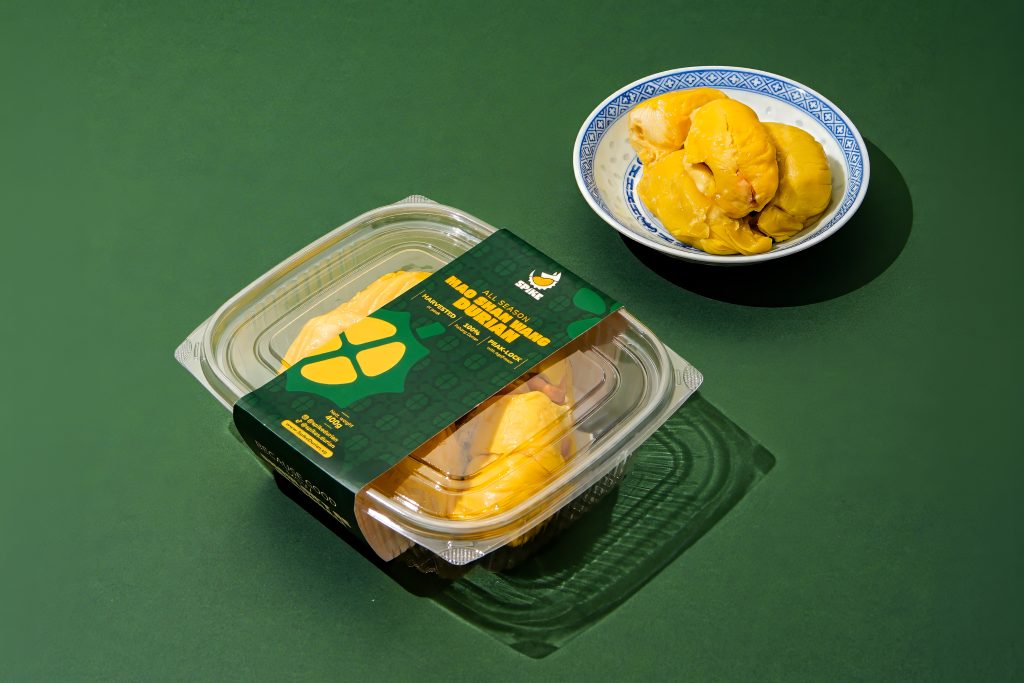
Above: Spike Durian Packaging
Agrifreeze, by contrast, uses advanced electromagnetic waves to control the freezing process. This creates much smaller, circular ice crystals that are gentler on the fruit’s structure.
For Spike Durian, that difference is critical. The goal is to preserve the creaminess and mouthfeel of freshly fallen durian, so that customers get the same premium experience in January that they would expect in July.
Selling A Premium Product In A Category Built On Habit
Technology alone was not enough. Spike also had to rethink how premium durian is bought and experienced.
Christopher felt that the traditional durian-buying process did not match the price tag of premium Mao Shan Wang. The experience often came with aggressive selling, hot market conditions, and simple styrofoam boxes wrapped in cling film and placed in plastic bags.
So Spike positioned itself differently. The brand focused not only on year-round availability but also on presentation, convenience and a more polished consumer experience.
That shift appears to be resonating with a slightly different customer profile than Christopher initially expected.
While one might assume die-hard enthusiasts would dominate demand, Spike says its core buyers are often people hosting gatherings for family, friends, or overseas guests. Christopher calls this the “house party” demographic. He has also found traction among English-speaking customers who feel intimidated by the more aggressive, Mandarin-speaking roadside stall experience and prefer a digital-first ordering process.
Interestingly, Spike has also observed a shift in taste preferences. According to Christopher, 70% of the brand’s customers prefer sweeter durians over the more traditionally prized bitter varieties.
So far, the early signs of trust are encouraging. After five months, 22% of Spike’s customers are repeat buyers, while 95% of reviewers reportedly could not tell that the durians had been previously frozen.

Above: Right – Christopher Quek, Founder of Spike Durian visiting the next season of durians in Pahang with one of durian farmers.
Challenges Aplenty, But Built Around Consistency
Getting the supply side right was one of the hardest parts of building the business.
Christopher says it took 12 months of regular visits to Pahang to find the right partners. Spike now sources from old trees aged 20 to 30 years, grown on high mountains. The company also applies strict quality control standards, with farmers selecting only the top 60% of their harvest for Spike.
The durians are dehusked and packed under clean room conditions, then sent quickly to the Agrifreeze facility to be preserved during what Christopher calls the “golden window” of the season.
That operational discipline is what allows the company to position itself as a premium, reliable alternative rather than just another online durian seller.
Beyond Durian Season
Fresh durian will always have its place during the on-season. Christopher is not trying to replace that. Instead, he sees Spike as filling the gap for the rest of the year.
If the model works at scale, the company believes it could reshape how premium durian is priced, accessed, and enjoyed in Singapore, turning it from a lucky seasonal find into a more dependable indulgence.
But Christopher sees an even bigger possibility beyond the fruit itself. For him, durian is the proof of concept for Agrifreeze. The technology has already been trialled on seafood, meats, and ready-to-eat meals.
In that sense, Spike Durian may be starting with Mao Shan Wang, but the longer-term idea is much larger: using food preservation technology to make peak-quality food available well beyond the harvest or production window.
This article was shared to us by Alpha Story


Street Smart
Singapore Gym Membership Price Guide (2026 Edition)


