
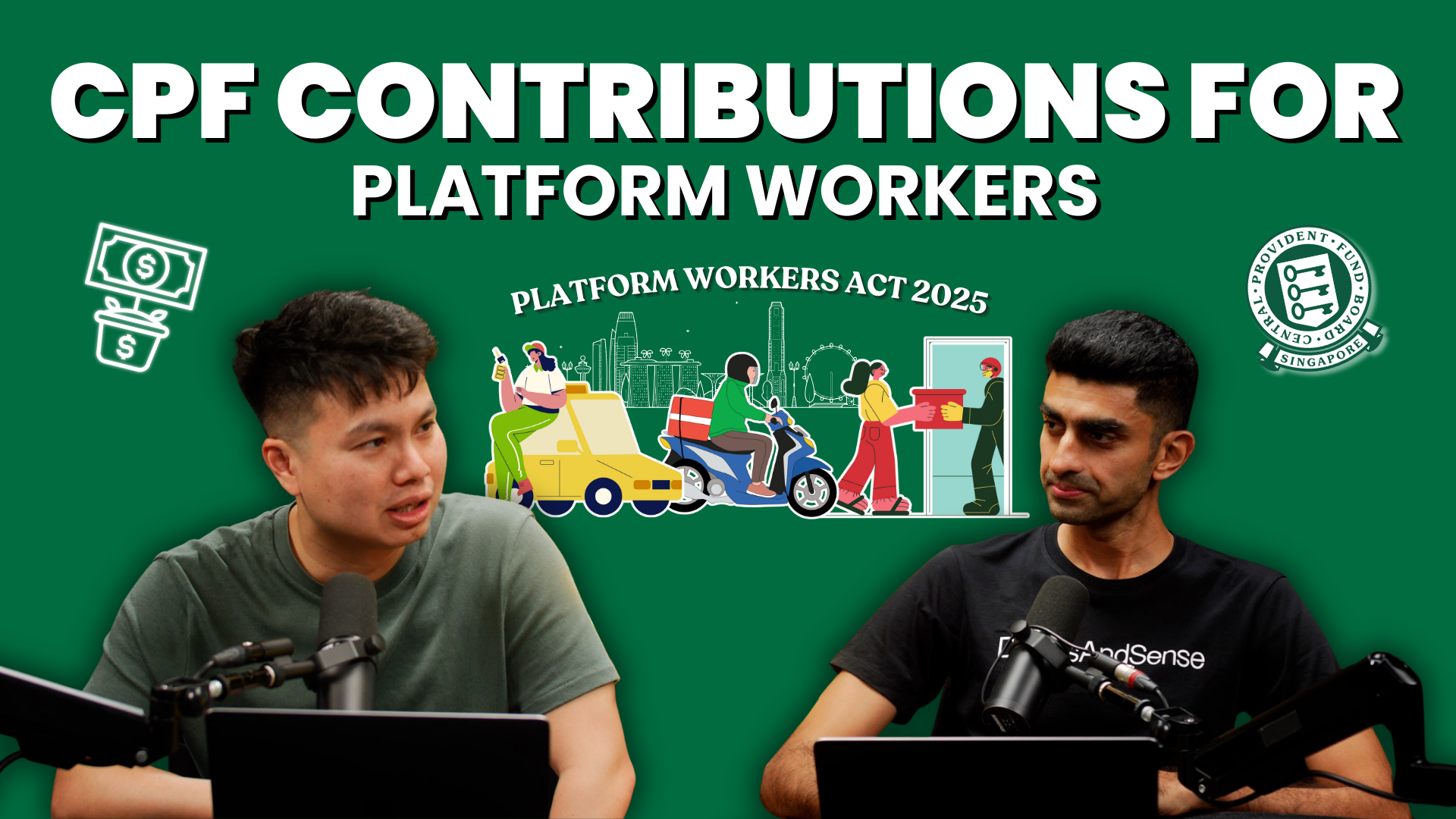
Singapore’s platform economy has expanded rapidly over the past decade. Some workers now rely on ride-hailing or delivery app-based work with a platform operator as a source of income. While this model offers flexibility, it also makes long-term financial planning more complicated.
One major difference lies in structure. Salaried employees automatically contribute to CPF every month. From their first pay cheque, savings are set aside fairly automatically for housing, healthcare, and retirement through their CPF accounts, without requiring much effort. Prior to 1 January 2025, platform workers had to make their own mandatory contributions to their MediSave Accounts manually once a year. This means saving for housing, healthcare, and retirement requires active planning and some administrative effort.
Without CPF contributions happening by default, the tendency is to delay long-term planning. Even workers who intend to save may struggle to do so consistently, especially when day-to-day needs compete for attention.
The Challenge Of Irregular Income
Income volatility is another key obstacle. Salaried employees usually know exactly how much they will earn each month, making it easier to budget and commit to savings goals. Platform workers often face income that fluctuates daily—depending on demand, hours worked and other external factors.
This uncertainty makes budgeting far more difficult. When earnings are unpredictable, essential expenses naturally take priority. Savings for long-term goals like retirement are often postponed, not because they are unimportant, but because immediate cash flow feels more pressing.
There is also the absence of paid leave. When platform workers fall sick or take time off, income typically stops. Holidays, rest days and recovery periods all come with an opportunity cost. This reality increases the need for short-term buffers and emergency funds, further reducing the sense of urgency for long-term savings.
What CPF Provides That Cash Alone Does Not
CPF exists to address these exact challenges by creating structure and long-term discipline. For employees below 55, CPF contributions from both employee and employer amount to a significant portion of monthly income. These contributions are allocated across three accounts: the Ordinary Account for housing and approved uses, the Special Account for retirement, and MediSave Account for healthcare.
Beyond discipline, one of CPF’s strengths lies in compounding. With base interest rates of at least 2.5% to 4%, and additional bonus interest on the first portion of balances, contributions made early have decades to grow. Missing out on CPF contributions when young not only reduces savings, but it also reduces the time those savings have to compound.
This is why reference points to guide your retirement savings, such as the Full Retirement Sum, can look intimidating at the start of one’s career. However, CPF is designed to be built gradually. Consistent contributions over time, combined with compound interest, make these amounts far more reachable than they initially appear.
What Changed In 2025 For Platform Workers
Since 1 January 2025, new rules under the Platform Workers Act significantly changed how CPF applies to platform workers. Younger workers, those born in 1995 or later, are now required to contribute to all three CPF accounts. They will also receive the platform operator’s share of CPF contributions in addition to their own share of CPF contributions. These contributions will be phased in gradually and are intended to match salaried employers-employees’ contribution rates by 2029.
For older platform workers born before 1995, platform operators facilitate the monthly deduction and payment of their mandatory MediSave contributions. However, these workers, similar to those born in 1995 or later, can also choose to contribute to all three CPF accounts, including their Ordinary Account and Special/Retirement Account. By opting in, they can benefit from the additional CPF contributions from all their platform operators, similar to employer contributions for salaried employees. This turns CPF from a purely self-funded effort into a shared one.
In practical terms, this means that platform workers who opt in are no longer saving alone. Each contribution includes additional money from their platform operators, accelerating the growth of their CPF balances.
Why Lower Take-Home Pay Is Not The Whole Story
A common concern is that CPF contributions reduce take-home income. While this is technically true, the comparison is often incomplete.
First, platform workers already make mandatory MediSave contributions. As a result, the additional out-of-pocket contribution required when opting in for increased CPF contributions may be smaller than it appears at first glance.
Second, during the transition period, an increase in platform workers’ CPF contributions is offset by the Platform Workers CPF Transition Support scheme, with support levels tapering from 100% in 2025 to 25% by 2028. Additionally, eligible lower-income workers can benefit from the Workfare Income Supplement, which provides cash payments and CPF contributions to supplement their income. For many workers, this means a modest increase in personal contributions alongside a meaningful increase in total CPF savings.
Short-Term Trade-Offs Versus Long-Term Security
That said, the trade-off should not be dismissed. Lower cash-in-hand can feel uncomfortable, especially for those managing irregular income. However, CPF savings are not saved without purpose.
For workers with housing loans, CPF Ordinary Account savings can be used to pay mortgages. This can reduce monthly cash expenses and, in some cases, offset the impact of lower take-home pay entirely.
Even for older workers who no longer need CPF for housing, retirement remains a compelling reason to opt in for increased CPF savings. There is still a long runway between one’s 30s, 40s, or early 50s and retirement age. CPF balances can compound meaningfully over this period, particularly in savings being able to benefit from CPF risk-free interest rate.
A Practical Mindset Shift
One useful way to approach CPF as a platform worker is to treat yourself like an employee. Employees are not burdened with retirement saving decisions monthly as this happens automatically. By opting into CPF, platform workers can recreate this structure for themselves.
Starting earlier allows compounding to work longer. Making use of platform contributions and government support ensures savings grow faster for your future. And for those who feel they started late, voluntary top-ups and other CPF schemes can help close the gap over time.
[Watch the full discussion that we have on the DollarsAndSense Podcast]


Street Smart
Singapore Gym Membership Price Guide (2026 Edition)


