

This article is sponsored by UOB Asset Management (UOBAM). All views expressed in this article are the independent opinion of DollarsAndSense.sg based on our research, are purely for informational purposes, and should not be relied upon as financial advice. DollarsAndSense.sg is not liable for any financial losses that may arise from any transactions, and readers are encouraged to do their own due diligence. You can view our full editorial policy here. This advertisement has not been reviewed by the Monetary Authority of Singapore.
When building an investment portfolio, one of the first questions investors often ask is whether they should focus on growth or income.
Growth investors typically look for companies and markets that can increase in value over time, while income investors may prefer established businesses that pay regular dividends. For many Singapore investors, this can translate into holding Singapore blue-chip stocks and REITs for income, while looking to markets such as the US for growth.
However, if we are intending to invest in Asia, we don’t necessarily need to choose between the two.
This is because Asia is made up of very different markets. China, India, Taiwan, South Korea and the ASEAN economies are at different stages of development and driven by different industries, demographics and economic trends. This creates opportunities for investors to capture both long-term capital growth and dividend income across the region.
Asia Offers Both Growth & Income Opportunities
To begin, there is no single “Asia investment story”, so expecting any single country or industry to be a proxy for the Asia growth story isn’t realistic in our view.
Over the past decade, China has developed significant capabilities in electric vehicles, advanced manufacturing and artificial intelligence. Taiwan and South Korea are important parts of the global semiconductor ecosystem, while India is supported by domestic consumption, infrastructure investment and its growing manufacturing sector.
ASEAN offers a different mix. Markets such as Singapore, Malaysia, Indonesia, Thailand and the Philippines are supported by growing consumption, supply-chain diversification and many established dividend-paying businesses.
This means investors should not expect every Asian investment to serve the same purpose. Some parts of Asia may offer stronger growth opportunities, while others can provide stable income. Investors can combine both depending on what they already own.
Diversified Asia Exposure Can Provide Long-Term Growth
Asia makes up a large part of the emerging-market investment universe, giving investors exposure to economies and companies that may be at different stages of growth from developed markets such as the US.
However, investing across Asia is not easy.
Unlike the US, which is a relatively homogeneous economy, Asian countries operate under different economic conditions and regulatory environments. Market leadership can also move quickly between countries and sectors, making individual stock picking difficult and possibly risky for investors trying to follow multiple Asian markets at once.
One way to gain broader exposure is through the United Asia Fund, which invests across different growth opportunities in Asia.
Currently, the fund invests in areas such as semiconductor leadership in Taiwan and South Korea, technology and industrial development in China, and other growth themes across the region. As an actively managed fund, it also gives the fund manager flexibility to adjust country, sector and investment-style exposure as market conditions change.
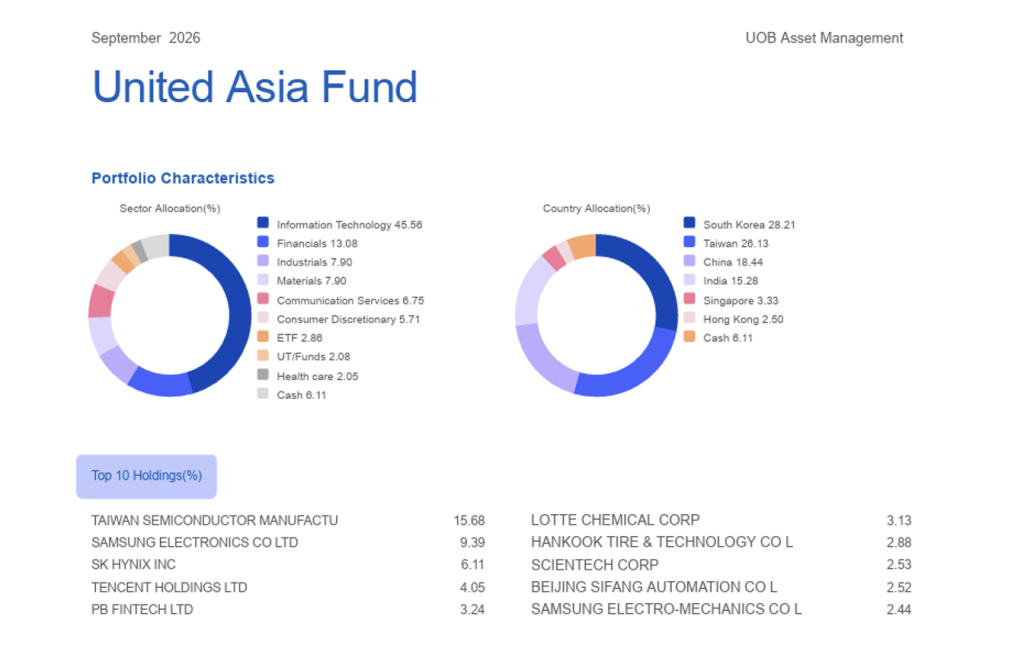
Source: UOBAM
For investors who want Asian exposure but do not want to decide for themselves whether China, Taiwan, South Korea or another market will outperform next, a diversified regional fund can provide a straightforward starting point.
United Greater China Fund Provides More Targeted Growth Exposure
Investors with a stronger conviction in Greater China’s growth story may want more targeted exposure.
This is where the United Greater China Fund comes into play. The fund invests across China, Hong Kong and Taiwan, giving investors access to several different parts of the Greater China investment landscape rather than focusing only on mainland Chinese stocks.
China provides exposure to industries such as technology, advanced manufacturing, electric vehicles and artificial intelligence. Hong Kong remains an important financial and listing hub, while Taiwan is home to globally competitive semiconductor companies.
The United Greater China Fund serves a different role from a broader Asian fund. Investors can potentially use a diversified Asia fund as a core regional holding, while adding Greater China exposure if they want a larger allocation to these markets and are comfortable with the additional concentration and volatility.
ASEAN Can Be A Source Of Dividend Income
Not every Asian investment has to be about finding the next high-growth company.
For income-seeking investors, ASEAN is also home to established businesses in sectors such as banking, telecommunications, energy and consumer industries that can provide dividend income. For Singapore investors already familiar with dividend investing, this creates an opportunity to generate additional passive income beyond our local bourse.
The UOBAM Ping An FTSE ASEAN Dividend Index ETF provides exposure to large- and mid-cap dividend-paying companies across Singapore, Malaysia, Indonesia, Thailand and the Philippines, while excluding REITs. This lets investors diversify dividend exposure across ASEAN without having to buy and monitor stocks listed on several different exchanges.
Importantly, dividend investing should not simply mean buying the stocks with the highest yields. A high dividend yield can sometimes result from a falling share price or an unsustainable payout. The UOBAM Ping An FTSE ASEAN Dividend Index ETF incorporates measures to manage concentration risk, liquidity, and potential yield traps.
For investors who have traditionally relied on Singapore stocks and REITs for dividends, this provides another way to generate income while gaining exposure to the broader ASEAN region.
How Growth & Income Can Complement Each Other
Many Singapore investors may already have something resembling a two-part portfolio: Singapore blue-chip companies and REITs for dividends, and US investments such as an S&P 500 ETF for growth. That approach provides exposure to two major markets, but it can also leave investors heavily dependent on Singapore for income and the US for growth.
Adding Asian investments can broaden both sides of the portfolio.
The United Asia Fund provides diversified exposure across Asian markets, while the United Greater China Fund offers more targeted exposure to China, Hong Kong and Taiwan. The UOBAM Ping An FTSE ASEAN Dividend Index ETF, meanwhile, can broaden an investor’s sources of dividend income beyond Singapore.
| Investment | Potential Role In A Portfolio |
|---|---|
| United Asia Fund | Broad Asian exposure and long-term growth |
| United Greater China Fund | More targeted Greater China exposure |
| UOBAM Ping An FTSE ASEAN Dividend Index ETF | ASEAN exposure and dividend income |
Growth and income also do not have to be mutually exclusive. For Singapore investors who rely mainly on local stocks and REITs for passive income, ASEAN dividend-paying companies can broaden their sources of income. At the same time, growth-oriented Asian investments can diversify a portfolio whose growth exposure is largely concentrated in US stocks.
Start With What Is Missing From Your Portfolio
Instead of wondering whether you should invest in Asia for growth or income, investors can first look at what they already own.
If most of our investments are concentrated in Singapore, we may want greater geographical diversification. If most of our growth exposure comes from the US, we may want exposure to different markets and industries in Asia. And if most of our dividend income comes from Singapore-listed companies and REITs, ASEAN can provide another potential source of income.
The United Asia Fund, United Greater China Fund and UOBAM Ping An FTSE ASEAN Dividend Index ETF offer different ways to gain Asian exposure. Rather than seeing them as competing choices, investors can consider the role each one could play alongside their existing investments.
Ultimately, the question is not simply whether we should choose growth or income, but whether the investments we add make our overall portfolio more diversified and better suited to our financial goals.
Please visit the following for more details, including important notices and disclaimers –
United Asia Fund: www.uobam.com.sg/uaf
United Greater China Fund: www.uobam.com.sg/greaterchina
UOBAM Ping An FTSE ASEAN Dividend Index ETF: www.uobam.com.sg/upd
Photo Credit: iStock/pakornkrit
Important Notice and Disclaimers
Distributions will be made in respect of the Distribution Classes of the Fund. Distributions are based on the NAV per unit of the relevant Distribution Class as at the last business day of the calendar month or quarter. The making of distributions is at the absolute discretion of UOB Asset Management Ltd’s (“UOBAM”) and that distributions are not guaranteed. The making of any distribution shall not be taken to imply that further distributions will be made. UOBAM reserves the right to vary the frequency and/or amount of distributions. Distributions from a fund may be made out of income and/or capital gains and (if income and/or capital gains are insufficient) out of capital. Investors should also note that the declaration and/or payment of distributions (whether out of income, capital gains, capital or otherwise) may have the effect of lowering the net asset value (NAV) of the relevant fund. Moreover, distributions out of capital may amount to a reduction of part of your original investment and may result in reduced future returns. Please refer to the Fund’s prospectus for more information.
This document is for general information only. It does not constitute an offer or solicitation to deal in units in the Fund (“Units”) or investment advice or recommendation and was prepared without regard to the specific objectives, financial situation or needs of any particular person who may receive it.
The information contained in this document, including any data, projections and underlying assumptions, are based upon certain assumptions, management forecasts and analysis of information available and reflects prevailing conditions and UOBAM views as of the date of the document, all of which are subject to change at any time without notice. In preparing this document, UOBAM has relied upon and assumed, without independent verification, the accuracy and completeness of all information available from public sources or which was otherwise reviewed by UOBAM. While the information provided herein is believed to be reliable, UOBAM makes no representation or warranty whether express or implied, and accepts no responsibility or liability for its completeness or accuracy. Nothing in this document shall, under any circumstances constitute a continuing representation or give rise to any implication that there has not been or there will not be any change affecting the Fund. No representation or promise as to the performance of the Fund or the return on your investment is made. Past performance of the Fund or UOBAM and any past performance or prediction, projection or forecast of the economic trends or securities market are not necessarily indicative of the future or likely performance of the Fund or UOBAM. The value of Units and the income from them, if any, may fall as well as rise, and is likely to have high volatility due to the investment policies and/or portfolio management techniques employed by the Fund. Investments in Units involve risks, including the possible loss of the principal amount invested, and are not obligations of, deposits in, or guaranteed or insured by United Overseas Bank Limited (“UOB”), UOBAM, or any of their subsidiary, associate or affiliate (“UOB Group”) or distributors of the Fund. The Fund may use or invest in financial derivative instruments and you should be aware of the risks associated with investments in financial derivative instruments which are described in the Fund’s prospectus. The UOB Group may have interests in the Units and may also perform or seek to perform brokering and other investment or securities-related services for the Fund.
Investors should note that the Fund is not like a conventional unit trust in that an investor cannot redeem his Units directly with UOBAM and can only do so through the participating dealers if his redemption amount satisfies a prescribed minimum that will be comparatively larger than that required for redemptions of units in a conventional unit trust. An investor may therefore only be able to realise the value of his Units by selling the Units on the Singapore Exchange Limited (“SGX”). Investors should also note that any listing and quotation of Units on the SGX does not guarantee a liquid market for the Units.
An investment in unit trusts is subject to investment risks and foreign exchange risks, including the possible loss of all or part of the principal amount invested. Investors should read the Fund’s prospectus and product highlights sheet, which are available and may be obtained from UOBAM or any of its appointed agents or distributors, before deciding whether to subscribe for or purchase any Units. You are responsible for your own investment decisions. You may wish to seek advice from a financial adviser before making a commitment to invest in any Units, and in the event that you choose not to do so, you should consider carefully whether the Fund is suitable for you.
This advertisement has not been reviewed by the Monetary Authority of Singapore.
UOB Asset Management Ltd Co. Reg. No. 198600120Z


