

This article is sponsored by UOB Asset Management (UOBAM). All views expressed in this article are the independent opinion of DollarsAndSense.sg based on our research, are purely for informational purposes, and should not be relied upon as financial advice. DollarsAndSense.sg is not liable for any financial losses that may arise from any transactions, and readers are encouraged to do their own due diligence. You can view our full editorial policy here. This advertisement has not been reviewed by the Monetary Authority of Singapore. For more information on the ETF, important notice and disclaimers: uobam.com.sg/upd
For many income-focused investors in Singapore, dividend investing starts close to home. Our local banks, REITs and telcos have built long track records of paying regular dividends, making them natural building blocks for an income portfolio.
But comfort can also lead to concentration. As investors look ahead 10 or 20 years, a key question emerges: Is relying on a single market, even one as robust as Singapore, enough to deliver a resilient and sustainable stream of dividend income? With the STI already trading close to the 5,000 level (4,905 as of 30 January 2026), it is also reasonable to ask whether other markets can provide diversification, growth potential and dividend income at the same time.
This is where ASEAN becomes relevant for us.
Investing In ASEAN For Dividend Income
While Singapore remains one of the most reliable dividend markets in Asia, our stock market is highly concentrated in financials and real estate. Some investors may also feel that as a mature market, growth would be slower.
Even when investors hold several dividend stocks or invest through an index ETF like the Straits Times Index (STI), they may still be exposed to similar economic and policy risks. The three local banks (DBS, OCBC, UOB) alone account for about 50% of the STI as of December 2025, which means diversification can be more limited than it appears.
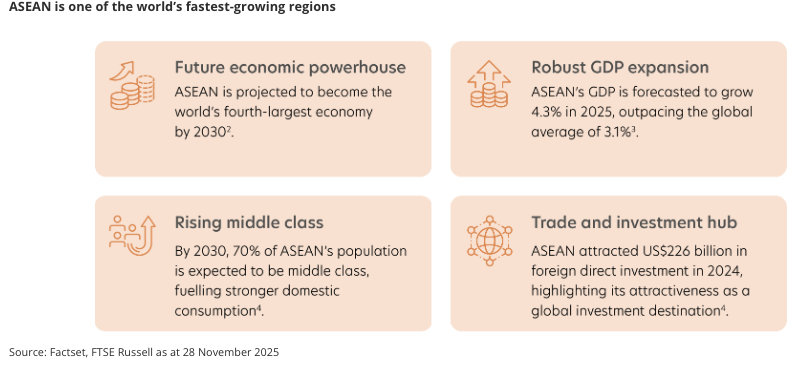
ASEAN, by comparison, provides access to a broader mix of developing economies such as Indonesia, Malaysia, Thailand and the Philippines. These markets benefit from younger populations, rising middle-class consumption and domestic-oriented companies that generate recurring cash flows, much like Singapore’s own blue-chip stocks.
Source: UOBAM, as of 28 November 2025
For income investors, the objective is not to chase the highest yield, but to diversify dividend sources across countries and sectors, reducing reliance on any single market while potentially earning higher dividend returns.
The challenge, however, lies in execution.
How An ETF Makes ASEAN Dividend Exposure More Practical
Buying individual dividend stocks across multiple ASEAN markets can be complex. This is because each market operates with different currencies, trading rules and settlement processes. Managing dividends, rebalancing portfolios and assessing dividend sustainability across countries can quickly become time-consuming and operationally difficult even for experienced investors.
An ETF simplifies this process significantly. With a single trade, investors gain instant exposure to a diversified basket of dividend-paying stocks that trades like a regular share.
Introducing The UOBAM Ping An FTSE ASEAN Dividend Index ETF
For investors seeking dividend income across ASEAN, the UOBAM Ping An FTSE ASEAN Dividend Index ETF (SGX: UPD/UPU) is an ETF worth considering. Listed on the SGX, the ETF is designed specifically to provide investors with dividend-focused exposure to ASEAN equities.
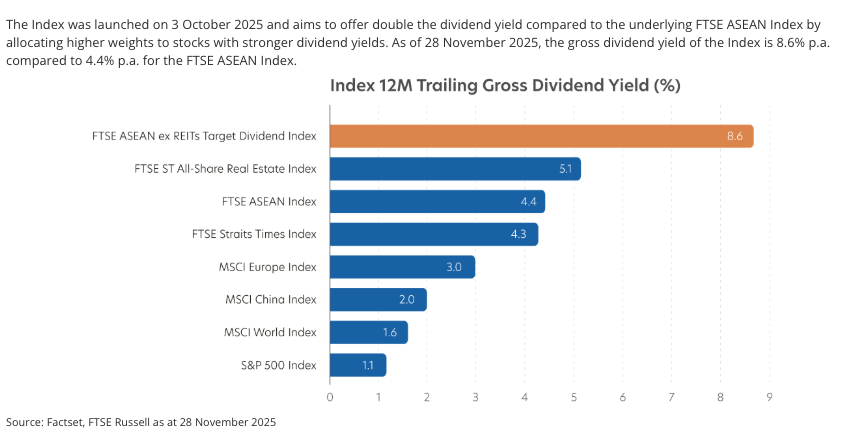
The ETF tracks the FTSE ASEAN ex REITs Target Dividend Index (“the Index”). The Index, in turn, aims to achieve a 100% increase in dividend yield relative to its underlying benchmark, the FTSE ASEAN Index.
Source: UOBAM, as of 28 November 2025
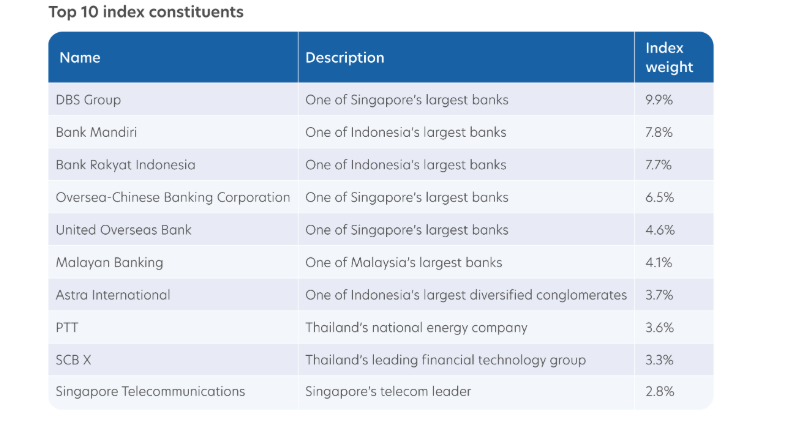
Through the UOBAM Ping An FTSE ASEAN Dividend Index ETF, investors can gain exposure to large and mid-cap companies across Singapore, Indonesia, Malaysia, Thailand and the Philippines. These also mean familiar Singapore names such as DBS, OCBC, UOB and Singtel. Thus, a Singapore-based investor investing in the ETF will also be getting exposure to blue-chip, dividend-paying stocks in Singapore.
Source: UOBAM, as of 28 November 2025
How The Target Dividend Strategy Works
Unlike broad-market-cap-weighted funds, the UOBAM Ping An FTSE ASEAN Dividend Index ETF uses a target-dividend approach. The index is constructed with the explicit aim of delivering a potentially higher overall dividend yield than the broader ASEAN market.
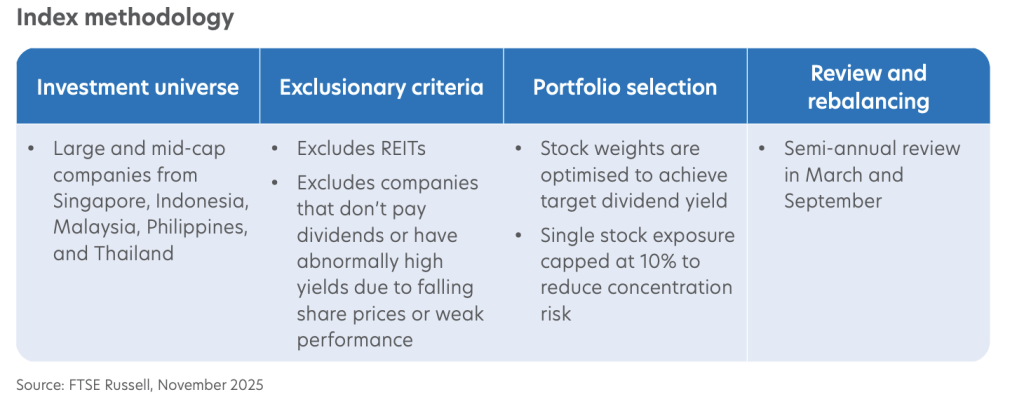
Companies with stronger dividend characteristics receive higher weightings, while the portfolio is regularly reviewed and rebalanced to maintain its income focus. This systematic process helps ensure the strategy remains aligned with its dividend objective over time.
The UOBAM Ping An FTSE ASEAN Dividend Index ETF targets a potential distribution of at least 6.0% per annum in 2026 and 2027, with distributions paid semi-annually. Distributions are not guaranteed and may be made out of income, capital gains and/or capital, in accordance with the Fund’s disclosed distribution policy set out in the prospectus.
Managing The Risk Of Dividend Traps
High dividend yields can sometimes signal risk rather than opportunity. For example, a falling share price or unsustainable payout can make a stock appear attractive based on its dividend yield.
To mitigate this, the index excludes companies that don’t pay dividends or have abnormally high yields due to falling share prices or weak performance. These filters are designed to tilt the portfolio towards more sustainable dividend payers, rather than maximising yield at all costs.
Source: UOBAM, as of 28 November 2025
While no strategy can eliminate risk entirely, these rules help improve the quality and durability of the index, and thus, the ETF’s income profile.
Where ASEAN Fits In A Dividend Income Portfolio
From a portfolio perspective, ASEAN exposure can complement a Singapore-centric income strategy. Many dividend-paying companies in the region operate in sectors such as financial services, telecommunications, utilities, and infrastructure, which tend to generate stable, recurring cash flows.
At the same time, long-term growth drivers such as urbanisation and rising domestic consumption can support earnings growth, ultimately contributing to dividend sustainability.
For investors, this means ASEAN exposure can enhance diversification, introduce income linked to different economic cycles and help build a more balanced regional income portfolio.
Risks & Considerations When Investing In The UOBAM Ping An FTSE ASEAN Dividend Index ETF
For investors who are interested in considering investing in the UOBAM Ping An FTSE ASEAN Dividend Index ETF, it’s important to remember that the broader ASEAN markets are generally more volatile than Singapore, and that foreign exchange movements can affect returns when dividends are converted back into Singapore dollars. As a result, this ETF may be more suitable for investors with a longer-term horizon and a moderate risk tolerance, rather than those seeking stable or fixed income with little to no risk.
However, income investing is ultimately about building a portfolio that can hold up across different economic environments. For investors whose dividend portfolios are heavily concentrated in Singapore, ASEAN exposure offers a way to diversify potential income sources while staying within familiar, cash-generative sectors.
Rather than viewing the UOBAM Ping An FTSE ASEAN Dividend Index ETF as a standalone investment, it may be more useful to assess how it fits alongside existing holdings, whether as a regional complement, a diversification tool, or a way to gradually broaden income exposure beyond Singapore.
Read Also: Understanding The Biggest Companies In China And How We Can Invest In Them


