

This article is sponsored by UOB Asset Management (UOBAM). All views expressed in this article are the independent opinion of DollarsAndSense.sg based on our research, are purely for informational purposes, and should not be relied upon as financial advice. DollarsAndSense.sg is not liable for any financial losses that may arise from any transactions, and readers are encouraged to do their own due diligence. You can view our full editorial policy here. This advertisement has not been reviewed by the Monetary Authority of Singapore.
Investors are often encouraged to build a globally-diversified portfolio. So, a slowdown in one region can be mitigated by growth elsewhere, and your overall portfolio will be protected.
However, when you try to invest in global ETFs today, one of the world’s most influential economies – China – is typically under-represented.
One popular global benchmark is the FTSE All-World Index, which comprises over 4,250 constituent companies across both developed and emerging economies. China only makes up about 3.4% of the index, while the US comprises over 63% of the index (as of 28 November 2025).
For reference, China’s GDP is around US$18.7 trillion. The US economy is less than twice its size at US$29.2 trillion, but dominates the global index.
This suggests that China likely plays a far bigger real-world role than its weight in broad global indexes.
The Biggest Chinese Companies Are Already All Around Us
Far from being invisible or inaccessible, Chinese brands have deeply entrenched touchpoints across the world today – shaping the environment we live, play and work in.
Many of us eat and drink at Haidilao, Chagee and Mixue, we own home appliances from Midea, Haier and Hisense, we may be using Xiaomi devices, driving BYDs, shopping on Alibaba, communicating on WeChat (Tencent).
Increasingly, Chinese companies are also asserting global leadership across major industries such as finance, engineering, technology, energy, consumer goods, electric vehicles and others.
While Chinese companies have been winning over the trust and support of international markets, its domestic demand is an equally, if not more, important growth engine. In fact, over the past four years, domestic demand has fuelled 86.4% of China’s growth.
This can be an important point, considering many investors are becoming more cautious with Trump’s see-saw approach in setting tariffs on Chinese products.
After nearly five decades of near-constant economic growth and development, China’s middle class has become a significant part of its economy. With higher-paid workers in higher-skilled jobs, many households now have bigger spending power.
Investing in the companies that cater to its domestic consumers may align your portfolio more closely with global economic realities and tap into long-term structural growth. At the same time, it can mitigate some short-term stock performance concerns with external-facing Chinese companies.
Investing In China A-Shares
Many of you will know that the S&P 500 ETF gives you exposure to US-listed stocks. But, not many will be as familiar with gaining exposure to China’s domestic market.
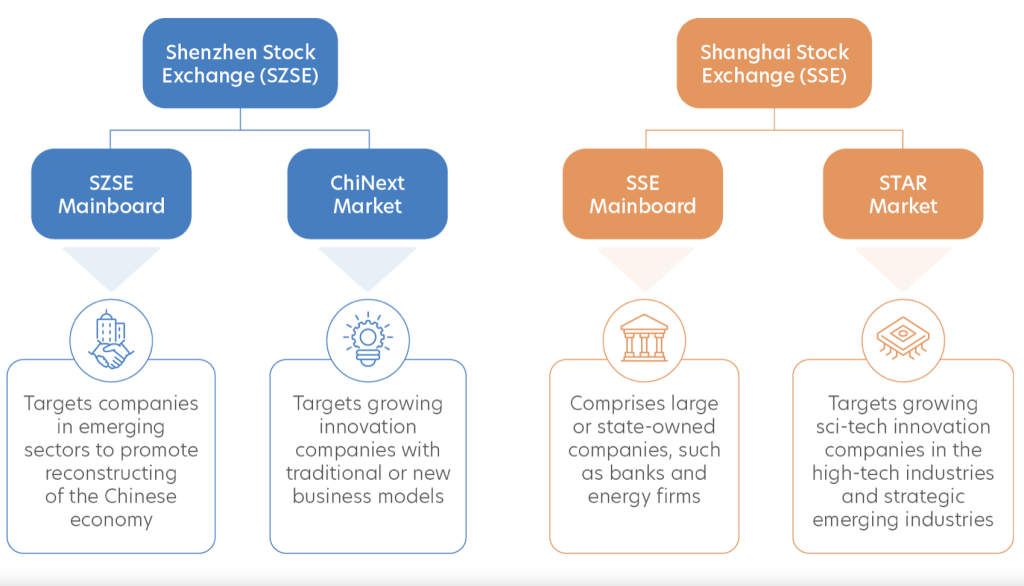
One way to invest in Chinese companies that offer a direct gateway to its domestic market is through A-shares – which are companies on the Shanghai Stock Exchange (SSE) and Shenzhen Stock Exchange (SZSE) and traded in RMB.
This gives you the best that both exchanges have to offer. The Shenzhen Stock Exchange targets companies in emerging sectors on its mainboard, and innovative companies with both traditional and new business models on its ChiNext board.
The Shanghai Stock Exchange typically comprises large state-owned enterprises on its Mainboard, and growing high-tech companies on its secondary STAR Market.
Source: UOBAM FTSE China A50 Index ETF as of 31 October 2025
Conveniently for Singapore investors, we can buy the UOBAM FTSE China A50 Index ETF, listed on the SGX. As its name suggests, we will be investing in an ETF that comprises the top 50 stocks within the A-share universe.
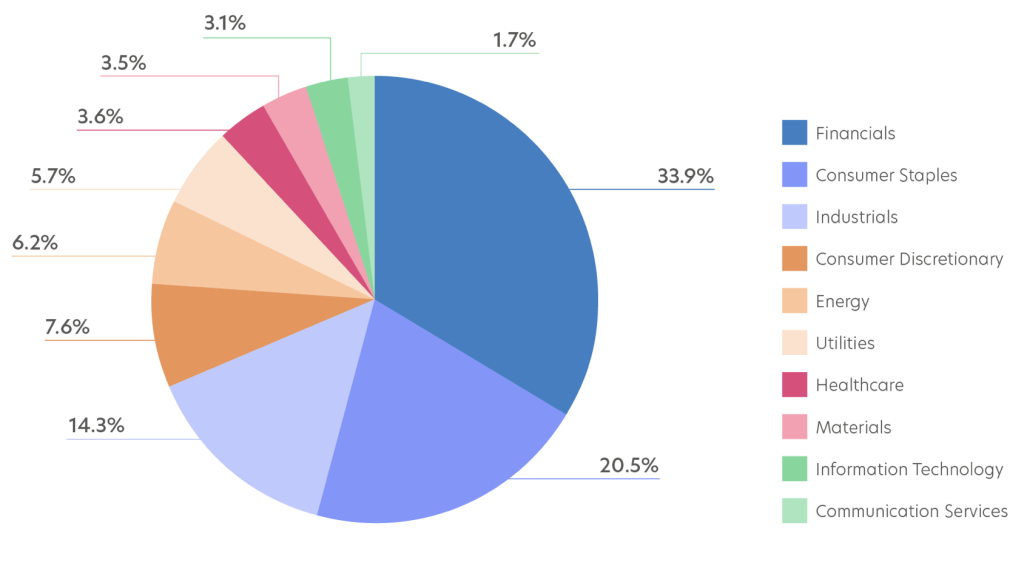
The index it tracks, the FTSE China A50 Index, has been around for over 20 years, and is diversified across key Chinese industries, from Financials and Consumer Staples to Energy and Healthcare to Information Technology.
Source: UOBAM FTSE China A50 Index ETF as of 31 October 2025
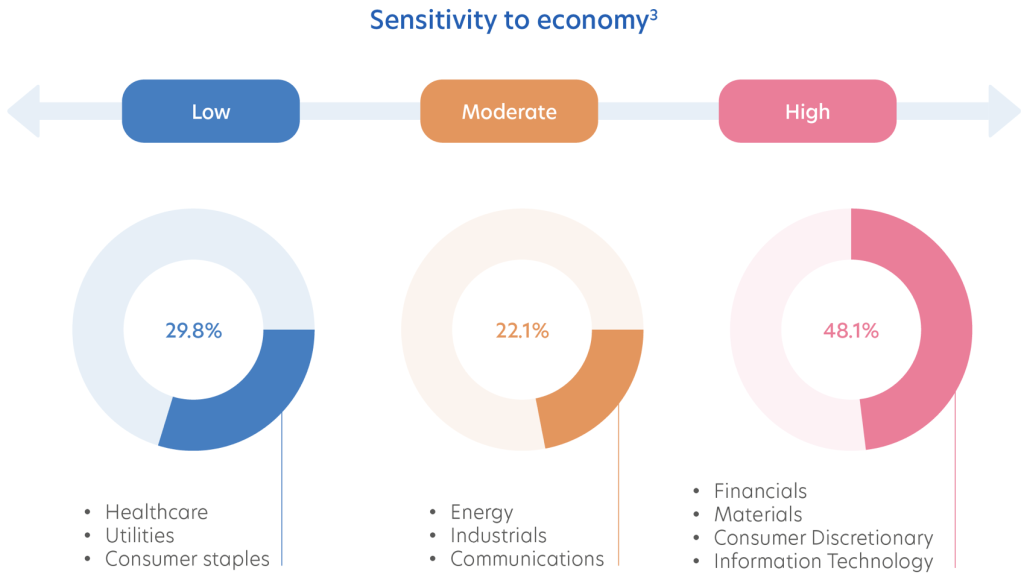
Not only will you gain diversified exposure across Chinese industries, but they’re also spread across defensive and growth sectors. For example, nearly 30% of the constituents are in Healthcare, Utilities and Consumer Staples, which provide defensive support for the ETF.
On the other hand, close to half of the index is skewed towards Financials, Materials, Consumer Discretionary and Information Technology, which are sectors that tend to do better when the economy is accelerating, and vice versa.
Source: UOBAM FTSE China A50 Index ETF as of 31 October 2025
While there are over 5,000 stocks in the China A-shares universe, the 50 largest constituents represents about a third of the A-share market, based on market capitalisation.
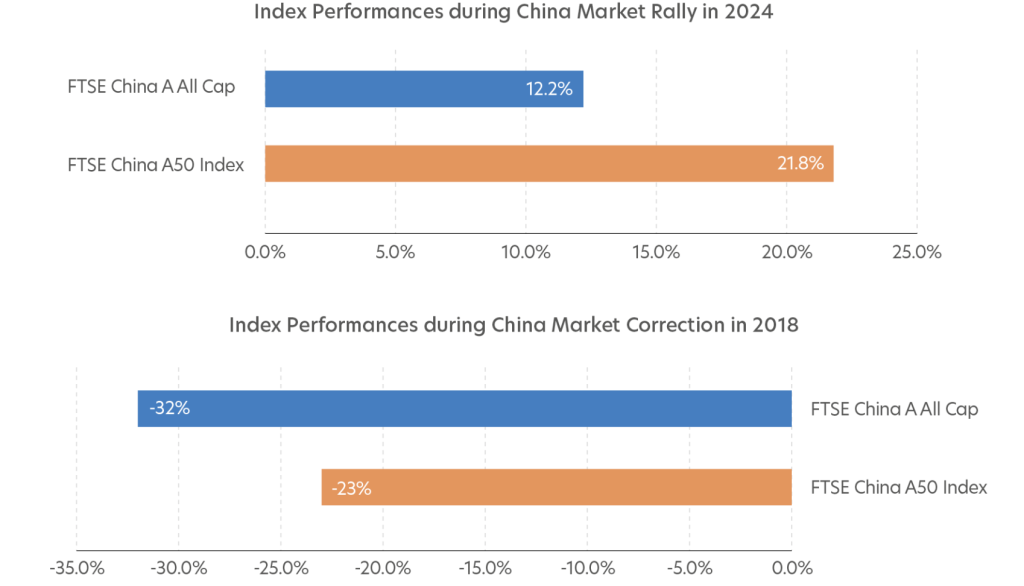
Moreover, investing in a more select group of the 50 largest A-shares also gives us a potentially better performance during both market rallies and corrections. For example, during the 2024 market rally, the FTSE China A50 Index rose 21.8%. In contrast, the FTSE China A All Cap Index only rose 12.2%.
Similarly, in a downward market during the 2018 correction, the FTSE China A50 Index declined 23%. Meanwhile, the FTSE China A All Cap Index spiralled 32%.
Source: UOBAM FTSE China A50 Index ETF as of 31 October 2025
Note: Performance relative to the FTSE China A All Cap Index (in CNY). Data as of 29 November 2024, based on three years of historical data.
For those interested to know how UOBAM FTSE China A50 Index ETF has fared in the past year, it has delivered a return of 16.2%1. This trails the benchmark slightly, as there will be tracking error and a 0.45% fund management fee that investors pay.
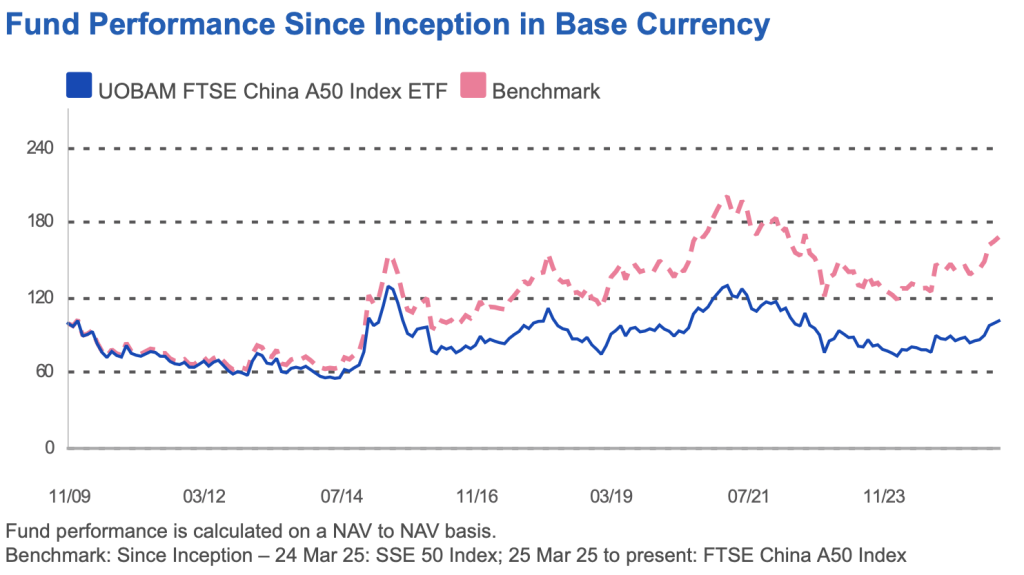
Source: UOBAM FTSE China A50 Index ETF as of 31 October 2025.
Note: Base currency refers to Singapore Dollars (SGD).
When looking at the biggest components of the UOBAM FTSE China A50 Index ETF, you will realise that many of the external-facing brands are not included.
Instead, you can gain access to companies such as Kweichow Moutai, one of the largest liquor companies most recognisable baijiu brands in China and internationally. Contemporary Amperex Technologies or CATL is a global leader in EV battery manufacturing.
Unsurprisingly, you can also see a slew of Chinese banks and financial companies as constituents in the UOBAM FTSE China A50 Index ETF. With over 1.4 billion people and nearly 200 million businesses, banking will naturally play a key role in the domestic economy.
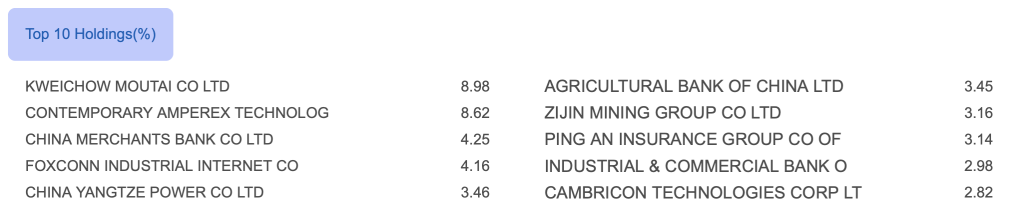
Source: UOBAM FTSE China A50 Index ETF as of 31 October 2025
Energy is another sector closely linked to the local economy, and China Yangtze Power runs four hydropower stations along the Yangtze River total installed capacity of 45,537,000kW.
Zijin Mining Group owns global mining operations across China, Central Asia, Europe, Africa, South America and Oceania, engaged in exploring and extracting metals such as copper, gold, zinc, lithium, silver and molybdenum.
In the high-tech sector, Cambricon Technologies provides a domestic alternative to Nvidia chips, building core processor chips and general-purpose graphics processing units.
Investing In A-Shares On The SGX
While A-shares are focused on China’s domestic economy, Singapore investors can gain exposure without going outside the SGX. You can invest in UOBAM FTSE China A50 Index ETF the same way you currently buy and sell Singapore-listed stocks in your portfolio
No need to open any new accounts or fill in any new forms – you can simply use your existing stock brokerage firm, and even store your shares with CDP.
No need to monitor a new platform – you can view all your holdings in your existing brokerage firm.
No need to trade in China’s market hours – you continue trading during Singapore trading hours.
The UOBAM FTSE China A50 Index ETF is also traded in both Singapore Dollar (SGD) or US Dollar (USD), giving you more convenience to use currencies that are likely already part of your existing portfolio to invest. No need to consider a new currency in the RMB.
At the same time, by investing in China A-shares in an ETF, you do not need to monitor each and every counter, as the index is reviewed and rebalanced quarterly in March, June, September and December. This also aligns with earnings season and China Central Bank meetings.
Providing an additional layer of safety buffer, stocks are also screened on both inclusionary and exclusionary criteria. For example, stocks need to have a certain level of liquidity before they are included, and those that are sanctioned or have excessive foreign ownership will be excluded from the index.
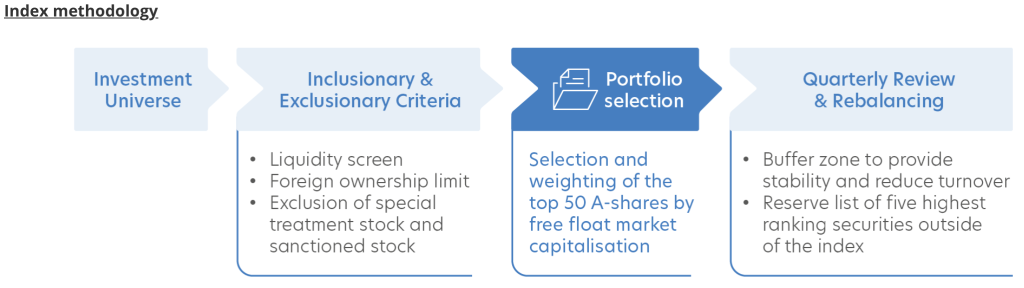
Source: UOBAM FTSE China A50 Index ETF as of 31 October 2025
Like other SGX-listed ETFs, you can use your Supplementary Retirement Scheme (SRS) Account to buy the UOBAM FTSE China A50 Index ETF. Investing this way allows you to enjoy tax savings, while growing your long-term portfolio.
For those who prefer to Dollar-Cost-Average (DCA), you’ll be glad to know that there is no minimum number of lot that you have to buy. You can start investing from as little as 1 unit. If you’re doing this, bear in mind that your broker may still charge a minimum commission, so ensure that you know the relevant investing charges, and use a low-cost brokerage platform.
To learn more about the UOBAM FTSE China A50 Index ETF, you can visit its website and read its latest factsheet, as well as important notice & disclaimers.
1 Past performance is not indicative of future performance.


