

With an enviable standard of living, world-class healthcare, excellent education system, and an economy that has a perpetual need for talented workers, Singapore can be a haven for those with the right skillsets to work and develop their careers.
Whether you’re coming here for a few months on a work rotation, a few years on an extended stint, or planning to call Singapore your home for good, here’s a guide to help you start your new life in Singapore on the right note, including immigration matters, healthcare, and banking services.
Read Also: Migrating Overseas? Here Are Some Surprising Costs You Might Not Think About
Immigration Matters
Whether you are transferring to the Singapore office from your existing job or have landed a new job in Singapore, your Singapore employer will need to make an application for your Employment Pass (EP). You can take a look at the Ministry of Manpower website to find the relevant documents that you will need to prepare in support of the application.
In Singapore, those of Employment Pass need to be paid a minimum income to qualify, depending on your age. This is to ensure that there are no equivalent-level local talent – and to prevent hiring foreigners just as a cost-saving measure.
For example, the minimum qualifying salary for new applicants from January 2025 is $5,600 for all sectors other than the financial sector, and $6,200 for those hired in the financial sector. However, this only applies to those 23 years and below. This scale gradually rises for each subsequent year older a new foreign employee is, until a maximum of $10,700 for those 45 years and above. Similarly, in the financial sector, it goes up to $11,800 for those 45 years and above
Once your online Employment Pass application is approved (around 3 weeks), you’ll receive an in-principle letter, which is valid for 6 months. You’ll then need to complete any medical examinations/declarations and collect your EP in person.
If you’re bringing your family with you, you need to apply for Dependant Passes, which allow them to stay in Singapore for 2 years, and are renewable.
Read Also: Complete Guide To Filing Your Personal Income Tax For YA2025
Housing
Before you even come to sunny Singapore, your main concern would be finding a comfortable, affordable roof that meets your family’s needs. Proximity to your workplace will be one important consideration, though if you have children living with you, their choice of school will be an equally important consideration as well.
There are certain expat enclaves in Singapore too, including Holland Village, River Valley, Orchard Road, Tanjong Pagar, Buona Vista, Robertson Quay, East Coast and others.
Unless you’re staying in Singapore for good, you’re most likely going to be renting. Renting a home has its pros and cons. While you can always move after staying through your first rental lease, this will typically be two years later. Nevertheless, this can give you sufficient time to get a better feel of Singapore and be clearer on where you want your ideal home to be.
PropertyGuru is one of the largest portals for Singapore property hunters, so you can do some research on your shortlisted locations and get a sense of the rental prices.
Read Also: Ultimate Expat Guide To Renting A Condominium In Singapore
Healthcare
When you’re based overseas (i.e. in Singapore if you’re coming here to work), you no longer have access to the healthcare system you’re used to in your home country. While Singapore has a great private and public healthcare system with one of the best outcomes in the world, it can be really expensive if you do not have the right insurance coverage.
First, employers here know this and usually provide a medical benefits package that typically goes beyond basic requirements for their foreign employees. So, check with your employer about the medical and insurance benefits you’ll be enjoying.
Next, international medical insurance should be another key area that you should look into before coming to Singapore for work.
Essentially, international medical insurance covers any healthcare costs that you incur overseas, including hospital bills, surgeon fees, specialists’ consultations, physiotherapy, among others. In addition to the medical insurance, expats can also opt for riders that cover international outpatient treatment, visual and dental treatment, health and wellness, and medical evacuation.
Read Also: Expat Guide To Understanding International Health Insurance Plans In Singapore
Banking Needs
You need to open a local bank account as soon as you arrive so that you’ll be able to start receiving your salary, make bank transfers and ATM withdrawals, as well as gain access to a credit card and make payments without incurring hefty overseas conversion fees and transaction fees when you use your existing cards.
Check with the bank on the specific documents you’ll need to open a local bank account, which typically includes your passport, Employment Pass, and sometimes, a certain minimum cash to deposit. For some of these accounts, you can even open them before landing in Singapore, so do your research on these accounts.
Major banks have remittance services, so you can inquire about them, though you can continue to use services like YouTrip and Wise to remit money back (or receive emergency funds) in a cost-effective way.
Read Also: Complete Guide To Opening A Bank Account In Singapore For Foreigners
Paying Taxes
In Singapore, locals and foreigners pay the same rate of taxes. IRAS, the Inland Revenue Authority of Singapore, charges a progressive tax rate of between 0% and up to a top level of 24% for those earning $1 million a year and above. Assuming an expat earns at the minimum range of $11,800 a month or $141,600 for those 45 years and above, you can expect to pay around $11,190 in income taxes.
Unlike locals working in Singapore, who get CPF contributions for their retirement savings, foreign employees will not. You may want to consider setting aside some of your income for retirement savings, and Singapore has an Supplementary Retirement Scheme (SRS) for both locals and foreigners. When doing so, we enjoy a dollar-for-dollar tax benefit for setting aside a retirement nest egg.
Expats can contribute up to $35,700 to their SRS account, and lower their taxes by that amount.
Read Also: Complete Guide To Supplementary Retirement Scheme (SRS) Account For Foreigners In Singapore
Your Children’s School
As an expat, it may not be easy to send your child into a local school. Similarly, you may also prefer for your child to learn in an environment that is either made up of international students or in line with your home syllabus, so you retain the flexibility to going back home and seamlessly integrating back into the schools back home.
As you may expect, international school fees can be expensive. There are also a wide variety of international school in Singapore that may charge fees that vary substantially. At the lower-end, you can expect to fork out about $20,000 per year in school fees, while it can go up to about $55,000 and more at the higher end.
Read Also: How Much Do International School Fees Cost In Singapore?
Owning A Car
Unlike living and working in other countries or cities, it may not be an absolute neccesity to own a car in Singapore. The island is well-connected with a network of trains and buses, as well as taxis and ride hailing apps, such as Grab, Gojek and Tada.
If you’ve read about buying and owning a car in Singapore, you’ll start to understand why this is a section you need to understand as an expat. Expect to pay over $250,000 over a 10-year owning period for a very average car.
Read Also: Cost Of Owning A Car In Singapore Over 10 Years
Foreigners who already have a valid driving licence in their home countries can convert your foreign driving licence to a Singapore Driving Licence by:
1) Passing the Basic Theory Test (BTT) in Singapore. The BTT is administered by the Traffic Police, and comprises 50 multiple-choice questions, covering various driving-related topics. You must score over 90% within a 50-minute timeframe to pass the BTT.
2) Have a valid foreign driving licence
3) Have supporting documents (both originals and photocopies) required for the application assessment, identification of the applicant, confirmation of valid driving licence and residency in country where the driving licence was issued.
All applicants of foreign driving licence conversion are required to submit their applications online.
What Else You Need To Know Before Coming To Singapore
If time allows, making a trip to Singapore before your actual move might be helpful to allow you to see the place for yourself. For a start, this will be an introduction to the sunny and humid climate in Singapore that is regularly interspersed with heavy rainfall! This will take some getting used to.
You can also take this time to explore the neighbourhoods you plan to live in. You can also make appointments to settle any paperwork if you haven’t been able to do so online.
Much has been discussed about how expensive and stressful Singapore can be, but there are also avenues to live more affordably and enjoy the sights and sounds around Singapore – potentially for free.
Read Also: Is Singapore Really The Best Place In The World For Expats?
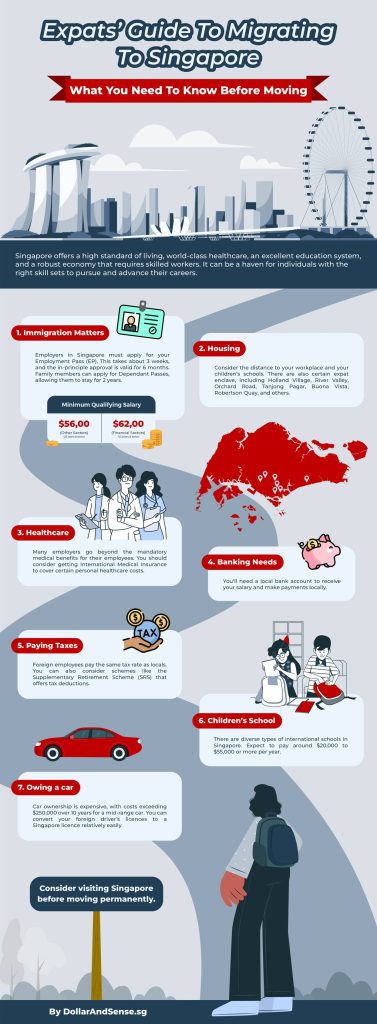
You can also refer to this infographic summarising the things you need to know before moving to Singapore as an Expat:
Advertiser Message
Thinking Of Switching Brokers Or Consolidating Your Holdings?
Tiger Brokers is currently running a transfer-in campaign where eligible clients can receive an iPhone 17 Pro Max* when they transfer in their assets.
For SGX investors, there is also a CDP Transfer promotion with 0* commissions on Singapore stocks.
Find out more here. *T&Cs apply.



Street Smart
Singapore Gym Membership Price Guide (2026 Edition)


