
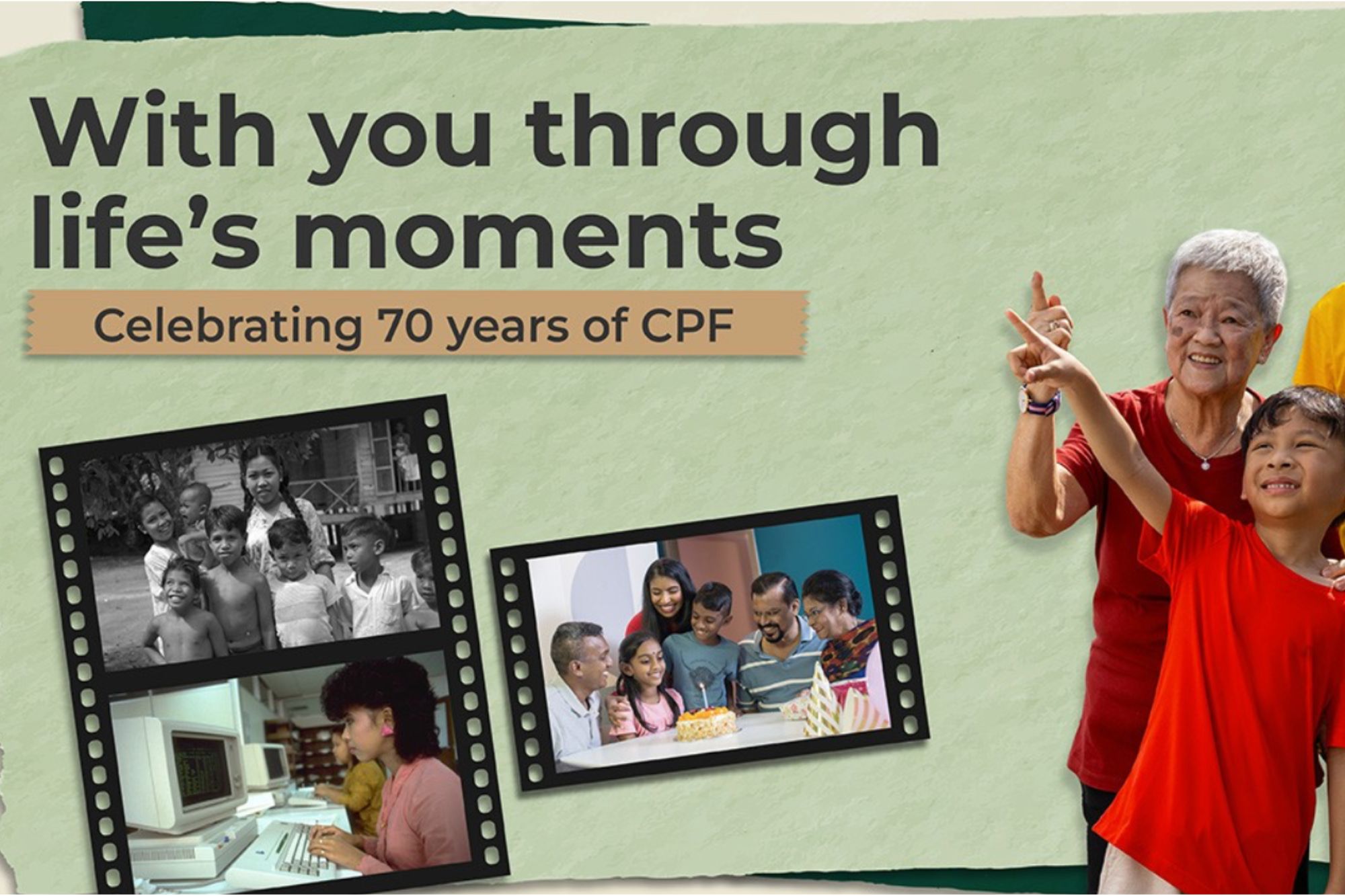
Established on 1 July 1955, the CPF scheme is older than independent Singapore – and turned 70 this year. In celebration of this milestone, the CPF Board launched a book that covers CPF’s journey through the years as it evolved and grew alongside Singaporeans.
The CPF scheme was initially designed to help workers save for their old age. When it was first implemented, both employers and employees contributed 5% to employees’ CPF accounts.
The CPF scheme evolved over the years, supporting buying their homes paying for their medical expenses, and even invest if we believe we can beat the CPF interest rates. More recently, in 2009, CPF LIFE was introduced to provide Singaporeans a lifelong monthly payout – regardless of how long they lived.
Today, many Singaporeans recognise CPF has part of their overall pay packet. Despite contributing up to 37% of our salaries into the CPF system, we understand its value – and many go further to voluntarily contribute more into their CPF.
The CPF journey wasn’t always smooth sailing though, and over the years, there have been 3 instances when CPF contribution rates had to be cut. For Singaporean workers, this effectively meant taking a pay cut, but the government made the painful decision to go ahead with it.
1986: After Singapore’s First Post-Independence Recession In 1985
Singapore experienced its first post-independence recession in 1985. This was a result of both external and internal forces.
Externally, demand for Singapore’s goods and services fell as major industrialised economies like the U.S. was slowing down. At the same time, regional neighbours began trading directly, and bypassing Singapore. Moreover, countries like Indonesia, Thailand, and the Philippines imposed exit taxes, while Malaysia levied a 50% tax on goods bought from Singapore, which further dampening trade. Key industries in Singapore at the time, such as oil refining and shipbuilding, also declined due to rising global competition.
Internally, Singapore faced high operating costs from rising wages and rents, without a matching boost in productivity. A slowdown in construction, high domestic savings, and a rigid economic structure further weakened growth.
To combat this recession, the government introduced a slew of cost-cutting measures, including reductions in employer CPF contributions.
At the time, the CPF contribution rate was at 50% – split equally between employer CPF contributions and employee CPF contributions. In 1986, the employer CPF contributions were slashed to 15% – effectively cutting Singaporean wages by 10%.
While this was partially restored starting from 1988, it also marked the year that CPF contributions were differentiated based on age. The partial restoring of CPF contributions in 1988 was only for those aged 55 and below. Those who were older saw their CPF contributions cut even further to spur employment for older workers.
Read Also: History Of CPF Interest Rates And How They Have Changed From 1955 To 2025
1999: Due To The Asian Financial Crisis (AFC)
From a healthy 8% growth in 1997, Singapore’s growth fell to a dismal 1.5% in 1998. To mitigate further fallout from the Asian Financial Crisis (AFC), cost-cutting measures were introduced.
CPF contribution rates were cut from 1999. This was meant to be temporary. The employer CPF contribution rate was cut from 20% to 10%. With the quick economic rebound, though, employer CPF contribution rate was partially restored to 12% in April 2000. In 2001, it was partially restored again.
However, before further restoration measures were introduced, CPF contribution rates would again be lowered.
Read Also: Complete Guide To Employer’s CPF Contributions In Singapore (2025)
2003: Cost-Cutting Measure In The Aftermath Of The 9/11 Terrorist Attacks In The US
After achieving a healthy 10% growth in 2000, Singapore’s economy expanded a meagre 2% in 2001 – mainly due to a slump in external demand. This was in the aftermath of the 9/11 terrorist attacks in the US in 2001.
And, to support businesses and investments in the country, CPF contribution rates were slightly lowered for majority of workers, i.e. those aged 55 and below. Those older were already receiving an even lower rate of CPF contributions.
In 2005, CPF contributions for those aged 50 to 55 was separated from those below 50 years-old. CPF contribution rates for this group, those 50 to 55, were reduced in 2005 and 2006.
From 2007, there was a gradual restoration of CPF contribution rates.
Reaching Desired CPF Contribution Rates In 2015
During the CPF 70th Anniversary Commemorative Book Launch, Senior Minister Lee Hsien Loong was the Guest-of-Honour, and in his speech, he described reaching the desired CPF contribution rate in 2015.
Since 2015, Singaporean employees see up to 37% of their monthly salaries contributed to their CPF accounts. Now, 20% of the CPF contributions come from employees, and 17% of CPF contributions come from employers.
In his speech, he said that the current CPF contribution rates are “about the right level for the long term”.
In recent years, we’ve seen some moves by the government to support the current CPF contribution rates. During the COVID-19 economic crisis, the government pulled out all the stops to support the economy, including offering salary support measures. But, unlike previous major economic downturns, resisted cutting the CPF contribution rates.
In fact, in recent years, the government has also been increasing CPF contribution rates for older workers. It has brought CPF contribution rates for those aged 50 to 55 back to parity with younger workers.
By 2030, CPF contributions for those below 60 will also be increased to the same level as younger workers. At the same time, there will be gradual CPF contribution increases for those between 60 to 70.
Read Also: Senior Worker CPF Contribution Rates And CPF Transition Offset Scheme: What Businesses Need To Know


Lifestyle
15 Of The Cheapest EV Cars In Singapore


Budgeting 101
7 Ways Being Frugal Is Different From Being Cheap


Street Smart
Singapore Gym Membership Price Guide (2026 Edition)
Street Smart
Singapore Gym Membership Price Guide (2026 Edition)


