

This article is sponsored by StashAway. All views expressed in this article are the independent opinion of DollarsAndSense.sg based on our research, are purely for informational purposes, and should not be relied upon as financial advice. DollarsAndSense.sg is not liable for any financial losses that may arise from any transactions, and readers are encouraged to do their own due diligence. You can view our full editorial policy here. This advertisement has not been reviewed by the Monetary Authority of Singapore.
Most Singaporeans who are actively saving for retirement are likely already doing the basics: contributing to CPF, having cash in fixed deposits, and investing in ETFs or unit trusts.
It’s a reasonable plan, but for those who want to enjoy greater financial freedom in retirement, there’s another option worth considering: the Supplementary Retirement Scheme (SRS).
For those already building substantial retirement savings through our CPF and other investments, SRS could provide a way to accumulate an additional million dollars over the long term, although this will depend on how much they contribute, how early they start and the returns they earn.
The Supplementary Retirement Scheme (SRS) is a government scheme by the Ministry of Finance that allows Singapore citizens and permanent residents to contribute up to $15,300 a year (or up to $35,700 for foreigners) into a dedicated retirement account. You can claim tax relief on eligible contributions, subject to the overall personal income tax relief cap of $80,000, invest those funds in eligible investments and potentially pay less tax when withdrawing them in retirement.
Done consistently over time, it’s one of the more efficient ways to build a retirement portfolio in Singapore.
Two People, Two Timelines
Let’s look at two examples to see how much SRS could help you build for retirement.
Jason is 35 and starts contributing $15,300 a year to his SRS account. He plans to withdraw at age 64, the statutory retirement age since 1 July 2026, giving him 29 years to invest. Over this period, he would contribute $443,700. Assuming an average annual return of 8%, his SRS investments could grow to roughly $1.59 million by age 64.
Now consider Karen, who is 50 and opening her SRS account for the first time. With just 14 years until age 64, she would contribute $214,200 in total. At 8% annual returns, her investments could grow to around $370,000. While Karen would accumulate less than Jason, she could still benefit from SRS tax relief, particularly if she is in her peak earning years.
The biggest difference between Jason and Karen is time. Starting earlier gives your investments more years to compound, which is why even smaller contributions in your thirties could make a significant difference to your retirement savings. For example, investing just $5,000 a year from age 35 could grow to about $520,000 by age 64 at an assumed annual return of 8%.
Editor’s Note: These figures are illustrative and assume contributions at the end of each year and a constant annual return of 8%, before fees, taxes and inflation. For context, the MSCI World Index recorded an annualised gross return of 8.72% in US dollar terms from 31 December 1987 to 31 March 2026. This historical index return is not a forecast or a guarantee of investment performance, and actual SGD returns will vary.
How SRS Tax Savings Could Add To Your Retirement Portfolio
One immediate benefit of SRS is the tax relief. Eligible contributions reduce your chargeable income, which can mean a smaller tax bill.
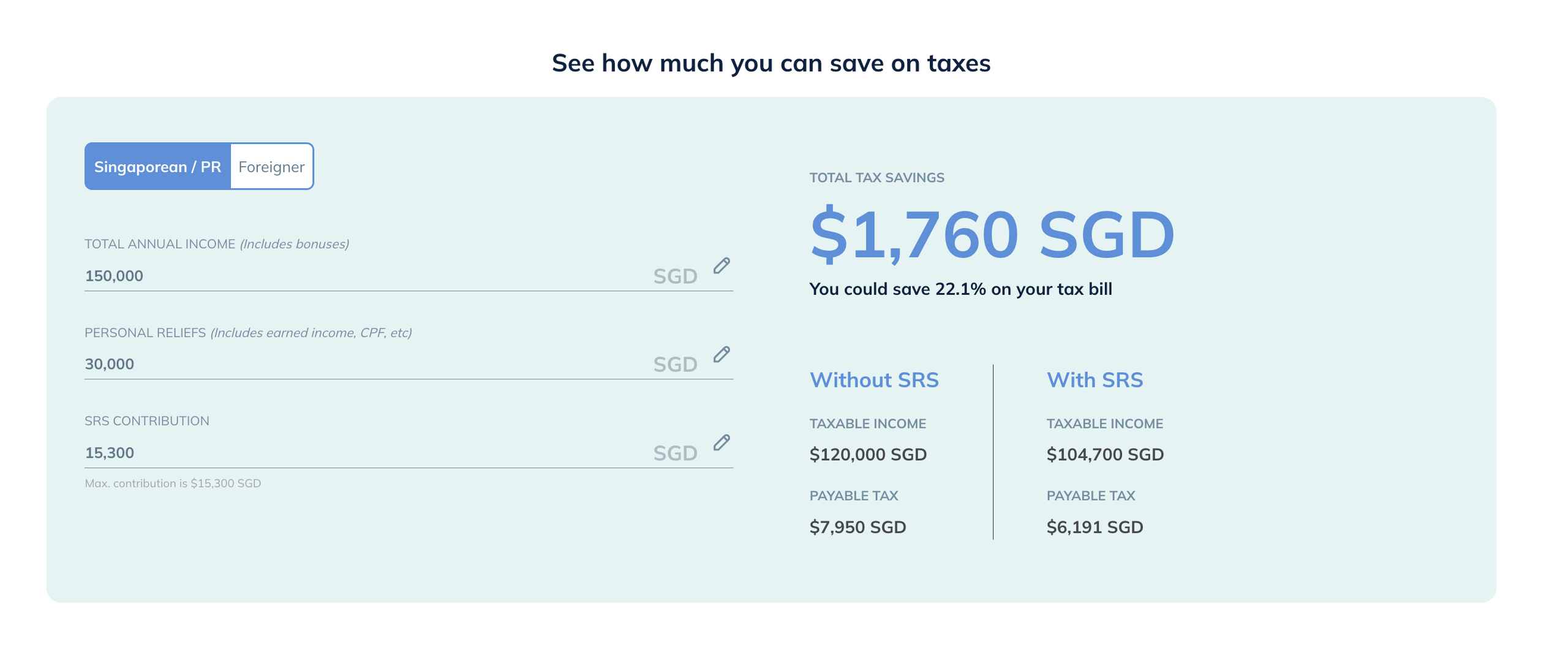
For someone with a chargeable income of $120,000 a year, contributing the full $15,300 to SRS could reduce their annual income tax from about $7,950 to $6,191, saving around $1,760. This is like getting an “immediate return” of 11.5% on their SRS contribution.
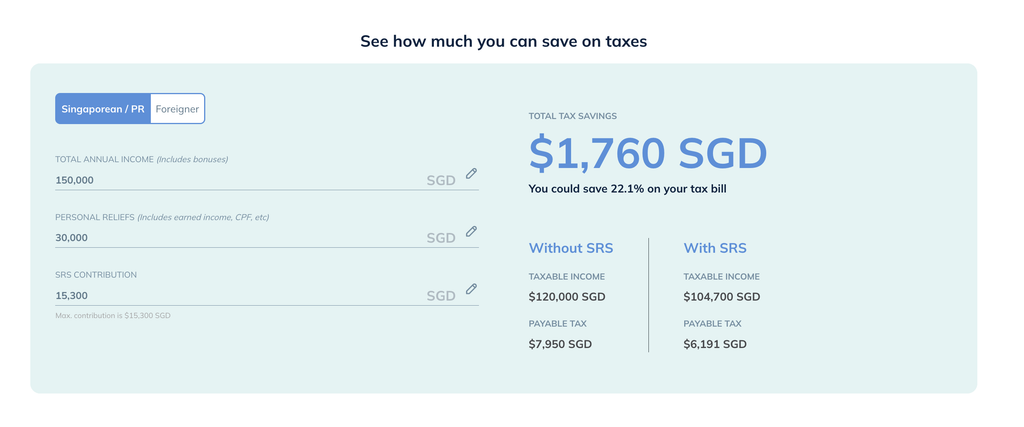
Source: StashAway
But the benefits don’t have to stop at tax savings. What if you invested the money you saved on taxes instead of spending it?
If Jason enjoys annual tax savings of around $1,760 and invests these savings separately at the end of each year at an assumed 8% annual return for 29 years, this could grow into another $183,000 by retirement.
Combined with the $1.59 million accumulated in his SRS account, that’s potentially $1.77 million in retirement savings, even before accounting for his CPF savings and other investments.
When Can You Withdraw Your SRS Savings?
Your penalty-free SRS withdrawal age depends on the statutory retirement age when you first contribute to your account. If you make your first contribution today, that age is 64. Withdrawing earlier generally means paying income tax on the full amount withdrawn, plus a 5% penalty.
Once you reach your eligible withdrawal age, you can start withdrawing your SRS savings without penalty. Your first withdrawal starts a 10-year window, during which you can spread out your withdrawals to minimise income tax.
For example, if you start withdrawing at age 64, you have until age 74 to withdraw your savings. Except for qualifying life annuities, any remaining balance at the end of the 10 years will be treated as withdrawn, with 50% subject to tax.
More importantly, only 50% of each withdrawal is taxable. If you withdraw $40,000 in a year, only $20,000 counts towards your taxable income. Since the first $20,000 of chargeable income in Singapore is taxed at 0%, you could effectively withdraw the full amount tax-free, assuming you have no other taxable income.
This means you can enjoy tax relief when contributing to SRS, invest the money over the years, and potentially pay less income tax when withdrawing it in retirement. For investors like Jason with a substantial SRS balance, however, keeping withdrawals to $40,000 a year may not be realistic within the 10-year window, so some income tax may still be payable.
How To Invest Your SRS Savings With StashAway
Despite the benefits of investing SRS funds, 21% of SRS savings were still sitting in cash at the end of 2025, according to the Ministry of Finance. That’s a sizeable amount of retirement savings potentially missing out on investment returns.
For those looking to invest their SRS savings, StashAway offers several options for investors depending on their risk appetite and how much control they want over their portfolio.
General Investing powered by BlackRock offers four globally diversified portfolios with equity allocations ranging from 20% to 100%. These portfolios invest across more than 30 iShares ETFs, with BlackRock providing the asset allocation guidance, and StashAway handling the trades and regular rebalancing. This could suit investors who prefer a more hands-off approach, with higher-equity portfolios potentially suitable for someone with a longer investment horizon, such as Jason, if consistent with their risk tolerance. The four portfolios have returned between 3.4% and 11.4% p.a. since inception, depending on risk level.*
For investors who prefer to manage their own portfolio, StashAway ETF Explorer provides access to US-listed and UCITS ETFs across more than 100 asset classes. Investors can choose their own ETFs based on the markets, sectors and asset classes they want exposure to.
For investors closer to retirement or the withdrawal phase, such as Karen, Income Investing offers a lower-risk bond portfolio focused on capital preservation. For SRS investors, dividends are automatically reinvested into the portfolio. Like other bond investments, it is still subject to market and credit risks, and capital is not guaranteed.
Meanwhile, StashAway Simple offers a cash management option that invests in fixed income instruments. This could be useful for investors who want to keep a portion of their SRS savings in lower-risk assets rather than equities.
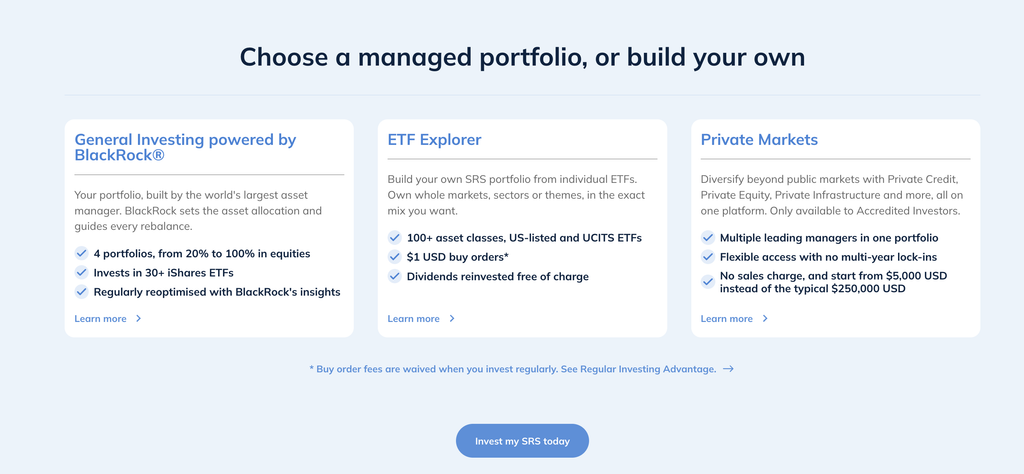
Source: StashAway
StashAway’s managed portfolios charge annual management fees ranging from 0.2% to 0.8%, depending on the amount invested, while ETF Explorer offers US$1 per buy or sell order, with the fee waived when investors invest regularly. StashAway Simple charges an annual management fee of 0.15%. Investors can link their existing SRS accounts from DBS, OCBC or UOB to start investing.
Ultimately, the tax savings from SRS are only part of the benefit. How you invest your contributions over the years will play an equally important role in how much you accumulate for retirement. To enjoy SRS tax relief for Year of Assessment 2027, make your contribution by 31 December 2026, subject to your SRS operator’s applicable processing cut-off.
Enjoy Exclusive StashAway SRS Promo
New to StashAway? Invest $1,000 of your SRS funds and get:
$50 cash rebate.
A chance to win $1,000 in ETFs
Learn more here: https://www.stashaway.sg/srs
From 23 November 2026, sign up through DollarsAndSense and get an extra $30 cash rebate into your Simple portfolio. Learn more here: https://www.stashaway.sg/ref/dollarsandsense-exclusive
Terms and conditions apply.
StashAway is a brand of Asia Wealth Platform Pte Ltd. and reserves the discretionary right to change the underlying ETF for specific asset classes. Not financial advice nor solicitation to purchase any financial product. Terms and conditions apply, visit stashaway.sg/legal for more information.
*Returns in SGD terms as of 20 November 2026, across 4 risk levels. Performance figures are before fees and assume that dividends or any payouts were reinvested. Numbers used are indicative and should not be seen as an advertisement of a rate. Past performance is not indicative of future performance. This material is issued by StashAway, a brand of Asia Wealth Platform Pte. Ltd. BlackRock® is not affiliated with StashAway. See stashaway.sg/blackrock for full disclaimer.


Branded Content
Could SRS Help You Build Your Second Million For Retirement?


Retirement Planning
What Is The 4% Retirement Withdrawal Rule, And Why You Should Plan Beyond It


