

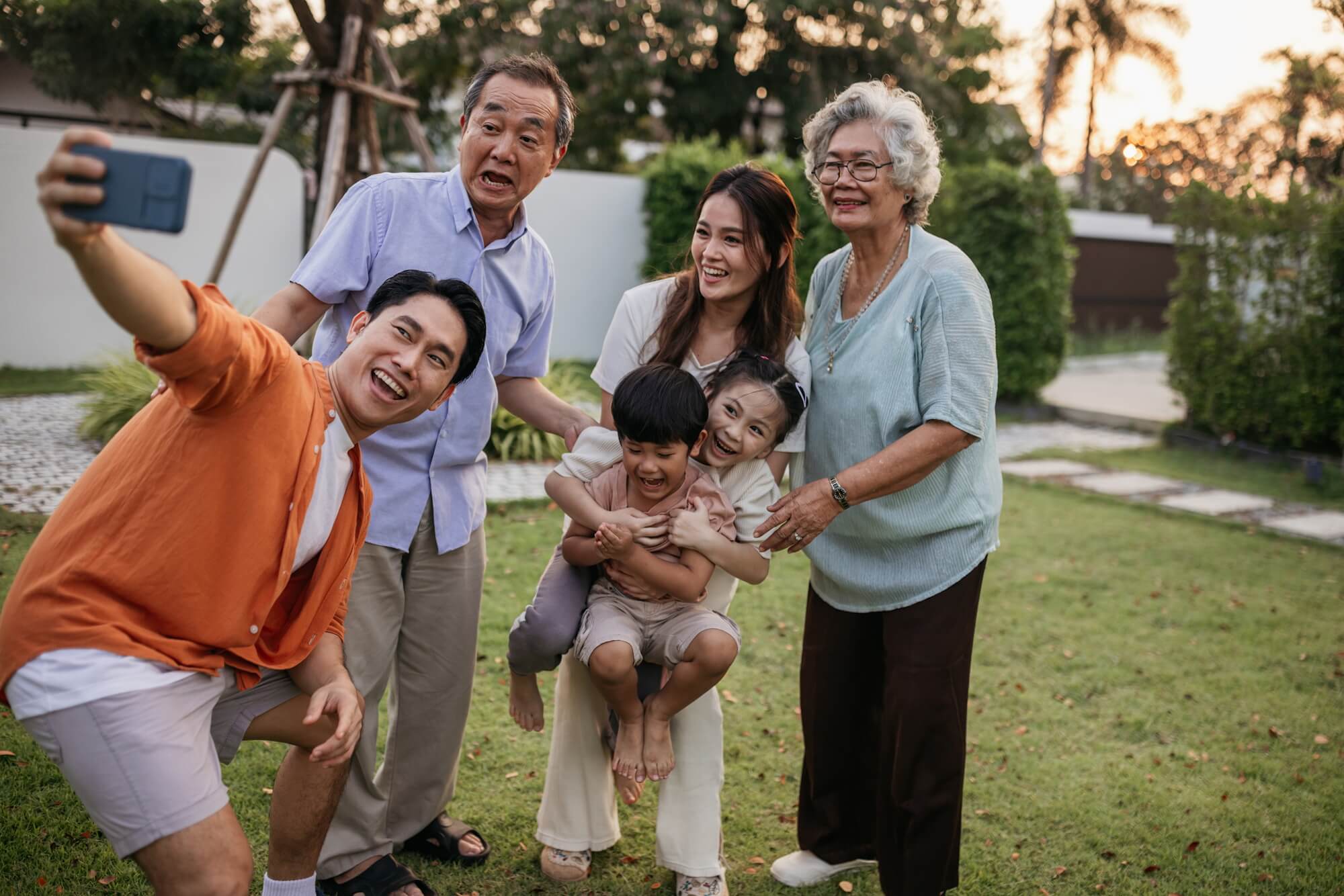
The number of Singapore residents aged 65 and over has grown from 460,923 in 2015 to 768,823 in 2025, according to the Singapore Department of Statistics. This number will continue to grow as Singapore becomes a super-aged society, with more than 21% of the citizen population aged 65 and older. However, despite growing opportunities for Singaporeans to live on their own in retirement, such as Community Care Apartments, most parents aged 65 and over live with their children, though the proportion is shrinking.
According to SingStat data, 51% of residents aged 65 and over live with their children in 2025. This is down from 2015, when 61.3% of residents aged 65 and over lived with their children. This arrangement can make both emotional and financial sense. Housing costs are shared, caregiving becomes easier, and elderly parents can continue ageing in familiar surroundings.
Unlike previous generations that may have relied more on their children, today’s retirees often enter retirement with multiple sources of support. For example, many aged 68 and below must join CPF LIFE, which provides lifelong income based on their CPF savings.
Beyond that, healthcare costs are heavily subsidised for seniors, and various government schemes supplement retirement savings. As a result, supporting ageing parents is often less about paying entirely for their retirement and more about helping them manage the additional costs that come with ageing.
What Do Elderly Households Actually Spend On?
Before considering how much support elderly parents might need, it helps to look at what retired seniors already spend.
According to the latest Department of Statistics’ Household Expenditure Survey 2023 data, resident households comprising solely non-employed persons aged 65 and above spent an average of $1,383.60 per household member per month.
Breaking it down by category, it’s $373.10 on food and beverages (including eating out), $224 per household member per month on healthcare, $144.70 on insurance and financial services, and $116.70 on transport.
Assuming we remove the average of $195.10 spent per person per month on housing and utilities, the remaining $1,188.50 can serve as a good gauge of how much a Singaporean aged 65 and above might spend when living with their children.
CPF LIFE Already Covers A Significant Portion Of Retirement Needs
The most common misconception about supporting ageing parents is that retirement automatically means having no income.
For most Singaporeans, retirement income begins with CPF LIFE. According to CPF Board back in 2016, payouts for those turning 65 in 2026 would start around $660 if they set aside the Basic Retirement Sum of $80,500, from $1,220 if they set aside the Full Retirement Sum of $161,000, and from $1,770 if they had set aside the Enhanced Retirement Sum of $241,500.
Viewed in this context, many elderly parents are not entirely dependent on their children for support. Instead, CPF LIFE often covers a substantial portion of their basic living expenses before any assistance from family members is considered.
Additional Government Support For Lower-Income Seniors
The Silver Support Scheme provides quarterly cash supplements to Singaporeans aged 65 and above who had lower incomes during their working years and have limited resources in retirement. Eligible seniors living in 1- and 2-room flats can receive up to $1,080 per quarter, while those in 3-room flats may receive up to $860. Eligible seniors in 4-room flats can receive up to $650 quarterly, while those in 5-room flats may receive up to $430.
Depending on eligibility, this translates to about $143 to $360 per person per month. For lower-income retired couples, Silver Support can meaningfully supplement CPF LIFE payouts and provide a more stable retirement income stream.
Seniors may also qualify for GST Voucher benefits and MediSave top-ups, which help offset everyday expenses even though they are not direct retirement income.
Read Also: What Happens To Your Parents’ HDB Flat When They Can No Longer Live On Their Own
Healthcare Costs And Transport Costs Are Also Subsidised
Pioneer Generation seniors receive annual MediSave top-ups ranging from $300 to $1,200 for life, depending on birth cohort. They also enjoy enhanced healthcare subsidies, including up to $28.50 per visit for common illnesses, up to $90 per visit for simple chronic conditions and up to $135 per visit for complex chronic conditions at CHAS clinics. They additionally receive an extra 50% subsidy on remaining bills for subsidised treatment at polyclinics and public specialist outpatient clinics.
Merdeka Generation seniors receive similar, though slightly lower, levels of support. Subsidies can reach up to $23.50 per visit for common illnesses, $85 for simple chronic conditions and $130 for complex chronic conditions, alongside an additional 25% subsidy for subsidised outpatient treatment in the public healthcare system.
Even outside these schemes, CHAS subsidies remain significant. Under the CHAS Blue tier, subsidies can reach up to $80 per visit for simple chronic conditions and $125 for complex chronic conditions.
Taken together, these programmes substantially reduce healthcare costs for many elderly Singaporeans and lower the financial burden that might otherwise fall on adult children.
For many seniors, public transport remains affordable. The larger issue is often mobility rather than cost. As people age, they may become less comfortable navigating bus and MRT interchanges, or walking long distances.
Consequently, reliance on taxis and private-hire vehicles can increase, particularly for medical appointments and specialist visits. In many households, rising transport expenses are therefore linked closely to declining mobility.
The Largest Additional Expense Is Often Caregiving
Many families eventually hire a foreign domestic worker to assist with daily care. Under current Ministry of Manpower rules, employers generally pay a monthly levy of $300. However, households with a Singapore Citizen aged 67 and above qualify for a concessionary levy of just $60 per month.
Employers must also provide at least $60,000 of medical insurance coverage and $60,000 of personal accident insurance coverage for their helper.
The levy itself is often not the most significant expense. Rather, the ongoing costs of salary, accommodation, food, and overall caregiving support often become the largest recurring outlay when supporting elderly parents. Expect total costs to start around $1,350 per month. This is also the point at which retirement-related expenses can begin to exceed what retirement income alone comfortably covers.
Read Also: How Much Does It Cost To Hire A Maid In Singapore?
Government Matching Schemes Help Families Do More
For families that wish to provide additional financial support, recent CPF matching schemes can make each dollar go further.
Under the Matched Retirement Savings Scheme (MRSS), eligible seniors can receive dollar-for-dollar matching grants of up to $2,000 annually when they make cash top-ups to their Retirement Account. CPF Board estimates that fully utilising the scheme from age 55 to 65 could increase CPF LIFE payouts by around $260 per month.
The Matched MediSave Scheme (MMSS) similarly provides dollar-for-dollar matching grants of up to $1,000 annually for cash top-ups made to eligible seniors’ MediSave accounts.
While less well known than CPF LIFE or Silver Support, both schemes allow families to leverage government support alongside their own contributions.
Advertiser Message
Catch Tiger Trade Experience 2026 at Suntec City
Drop by the Suntec City Convention Centre Atrium (beside Chagee) on 28 or 29 November, from 10am to 10pm. Explore the event, check out the early bird rewards and stand a chance to win prizes, including stock vouchers.




Bonds and Fixed Income
6 Investments In Singapore That Provide Guaranteed Principal And Returns


