

After living in your Build-To-Order (BTO) or resale Housing & Development Board (HDB) flat for several years, upgrading to a private condominium may be the natural next step.
For many Singaporeans, buying an HDB flat is the most practical first step towards homeownership. But as incomes grow, family needs evolve and savings accumulate, many homeowners begin considering whether it is time to upgrade to a private property.
Before making the move, however, there are several rules, taxes and financing restrictions you need to understand. These have changed significantly over the years, particularly with tighter cooling measures, revised Additional Buyer’s Stamp Duty (ABSD) rates and stricter financing frameworks.
You Must First Fulfil Your Minimum Occupation Period (MOP)
HDB flat owners must fulfil their Minimum Occupation Period (MOP) before they can buy a private residential property, whether in Singapore or overseas. For most HDB flats, this is five years, although newer Prime and Plus flats come with a 10-year MOP. The MOP is based on the period you physically occupy the flat, and any period when you are not living in the flat may not count towards it.
During the MOP, you cannot sell your flat, rent out the whole flat, or acquire private residential property. Before starting your condo search, you should check your exact MOP completion date via HDB.
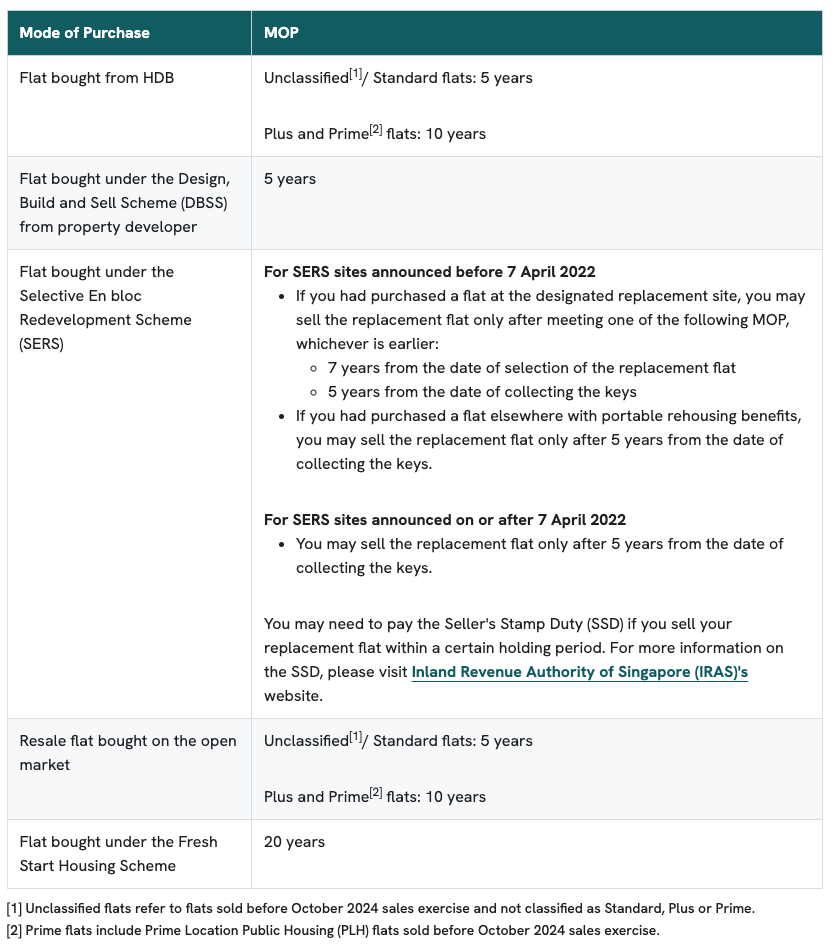
Source: HDB
Buying Your Condo After MOP
Once your MOP has been fulfilled, you can buy a private condo. Unlike buying an HDB flat, you will need to finance the purchase with a bank loan rather than an HDB loan.
For a first housing loan, the maximum Loan-To-Value (LTV) limit is generally 75%, subject to the bank’s credit assessment. This means you need to prepare at least 25% of the purchase price, of which at least 5% must be paid in cash, while the remaining 20% can be paid using cash and/or CPF.
Your loan will also be assessed under the Total Debt Servicing Ratio (TDSR), which limits your total monthly debt obligations to 55% of your gross monthly income. This includes your home loan, car loan, credit card debt, personal loans and other borrowings.
CPF savings can be used for the purchase and mortgage repayments, but CPF usage is still subject to housing withdrawal limits. Once those limits are reached, future mortgage repayments must be made in cash.
Stamp Duties & ABSD
You will need to pay Buyer’s Stamp Duty (BSD) when buying a private property. Since 15 February 2023, residential BSD rates have gone up to a top marginal rate of 6% for higher-value residential properties.
The bigger concern for many HDB upgraders is the Additional Buyer’s Stamp Duty (ABSD). If you buy a condo before selling your HDB flat, the condo is treated as your second residential property. For Singapore Citizens, the ABSD rate on a second residential property is currently 20%.
Eligible married couples may be able to apply for ABSD remission if they sell their first residential property within the stipulated timeline. However, ABSD has to be paid upfront first, so buyers must plan their cash flow carefully.
There are also other considerations you have to think about, such as paying stamp duty, engaging a property agent to help you buy your property, where you may incur 1%-2% commission fees for this, and hiring a lawyer to advise you on the process of buying a condominium and handling the legal documentation.
Read Also: How Much Buyer’s Stamp Duty (BSD) And ABSD Singaporeans, PRs And Foreigners Need To Pay
#1 Buying A Condominium And Selling Off Your HDB Flat
This is the most straightforward method to upgrade from your HDB flat. In this scenario, you can shop around for the condominium of your dreams. This can either be from the open market or a new launch. You may work with one or several property agents to view condominiums and eventually buy one.
Once you decide to purchase a condominium, you are usually expected to make a 1% cash payment after signing an Option To Purchase, which gives you the right to purchase the property within a limited period (usually two weeks). You will be expected to make a further 4% cash payment to exercise the Option before the deadline. After this, you will have to fork out the buyer stamp duty (BSD), of close to 3%, within two weeks of exercising the Option and signing the sales and purchase agreement. After a further two months, the remaining amount has to be paid to the seller to complete the transaction.
Even though this seems fairly clear-cut, there are important things to consider. This includes considering whether to sell your HDB flat before or after purchasing your condominium. This is crucial, as you will need to secure a bank loan to complete the purchase and pay an additional buyer’s stamp duty (ABSD).
If you intend to sell your HDB flat before buying your condominium, you will likely have sufficient cash resources to pay your down payment, but you may need to consider where you will be moving to if you do not time the purchase of your new condominium and the sale of your HDB flat perfectly. On top of costing you extra money, you will have to contend with the time-consuming and stressful process of moving your entire home twice within a short space of time.
However, if you intend to sell your HDB flat after purchasing your condominium, you need to ensure you have sufficient cash reserves to pay for your down payment as well as comply with the TDSR, where you can only repay up to 55% of your gross salary on debt, which will now include two properties, and the LTV ratio, where you may be required to fork out 55% of the property value upfront.
You will also need to pay the ABSD, as this will be considered your second property. This may complicate your transaction or financially tie up your hands when it comes to completing the purchase. Nevertheless, you can apply for a bridging loan from the banks with your new home loan, and if you sell your HDB flat within six months of your condominium purchase, you will be able to apply for a refund for it.
#2 Buying A Condominium And Keeping Your HDB Flat To Rent Out
Singapore Citizens who have fulfilled their MOP may be allowed to keep their HDB flat after buying private property. However, Singapore Permanent Resident households generally have to dispose of their HDB flat after acquiring private residential property.
Keeping your HDB flat can provide rental income, but it also makes the upgrade much more expensive. You will need to pay ABSD, meet stricter financing requirements, and ensure that you can service both property-related obligations.
If you rent out your HDB flat, you must comply with HDB’s rental rules. Singapore Citizen owners who have fulfilled their MOP may rent out the whole flat, subject to eligibility conditions, tenant rules and the non-citizen quota. The quota applies if any tenant is a non-Malaysian non-citizen, and is set at 8% at the neighbourhood level and 11% at the block level.
Once your HDB flat is rented out, it will also no longer enjoy owner-occupier property tax treatment. Residential property tax rates are progressive, and non-owner-occupied residential properties are taxed differently from owner-occupied homes.
Alternatively, you could also look at the purchase of this condominium solely as an investment, should you choose not to move into it.
Additional Restrictions You Face If You Want To Rent Out Your HDB After Moving Into Your Condominium
You and your tenants must meet certain conditions to rent out your HDB flat to them. If these conditions are not met, you will not be able to rent out your HDB flat.
Eligibility
Beyond fulfilling your MOP, you must meet a non-citizen quota when renting out your HDB flat, which stipulates that you can only rent to Singaporeans and Malaysians. If you want to rent out your HDB flat to a foreigner, you have to adhere to the quota, which restricts neighbourhoods to no more than 8% and individual blocks to no more than 11% foreigners.
In addition, tenants who are not Citizens or PRs must be legally residing in Singapore and holding Employment Passes, S Passes, Work Permits, Student Passes, Dependant Passes, or Long-Term Social Visit Passes. And these passes must have a validity of at least six months on the date of your subletting application. Work permit holders from the construction, manufacturing, marine and process sectors must also be Malaysians.
You also have to ensure that your tenants adhere to the maximum number allowed in each flat type.
| Flat Type | Total Number Of Subtenants |
| 1-room and 2-room | 4 |
| 3-room | 6 |
| 4-room | 9 |
Source: HDB
Lastly, subtenants must also not be tenants or owners of other HDB flats unless they are divorced/ legally separated (only one party can be a subtenant) or owners who are eligible to rent out their whole flat (they must rent out their own flats within one month of renting the HDB flat).
Subletting Regulations
You are also responsible for complying with subletting regulations, ensuring that
- Only authorised tenants are staying in your HDB flat
- The number of tenants do not exceed the maximum number
- Tenants do not further sublet to others, create nuisance or misuse the flat
- Your tenants are legally residing in Singapore
- Your tenants comply with all the covenants in the lease and provisions of the Housing & Development Act. You are responsible for all infringements committed by them
Unauthorised subletting of your HDB flat may result in serious consequences, including financial penalties and even the acquisition of your HDB flat. Even if you have received permission to rent out your flat, you should check on it regularly to ensure rules and regulations are met.
#3 Buying An Executive Condominium And Selling Off Your HDB Flat
Another way to upgrade is to buy an Executive Condominium (EC). ECs are built by private developers and offer condo-style facilities, but are subject to HDB eligibility rules at launch.
For HDB upgraders, ECs can be attractive because they are usually priced below comparable private condos. However, buyers must still meet EC eligibility conditions and will need to sell their existing HDB flat within the required timeline after collecting the EC keys.
ECs also come with ownership restrictions. They can only be sold to Singapore Citizens and Permanent Residents after the five-year MOP, and become fully privatised only after 10 years. Moving forward, new ECs will have a 10-year MOP, with privatisation only occurring after 15 years.
Read Also: From $1,142 psf To $1,893 psf: How EC Launch Prices Have Changed Since 2021
What To Expect After Moving Into Your Condominium
Moving into a condo can improve your lifestyle, but it also comes with higher recurring costs.
Beyond the monthly mortgage, you will need to budget for maintenance fees, property tax, insurance, utilities and renovation costs. Condo maintenance fees can vary widely depending on the project size, facilities and share value, but they are a recurring expense that HDB owners may not be used to.
You should also avoid assuming that upgrading will automatically be a profitable investment. Private property prices can rise or fall, interest rates can change, and government cooling measures may affect demand and resale flexibility.
Ultimately, the best reason to upgrade is that the property suits your family’s long-term housing needs and remains affordable even under less favourable conditions. A condo should improve your quality of life without overstretching your finances.
Read Also: Selling Your Home Before Buying The Next One: 8 Things That Can Go Wrong In Singapore


Street Smart
Singapore Gym Membership Price Guide (2026 Edition)


