
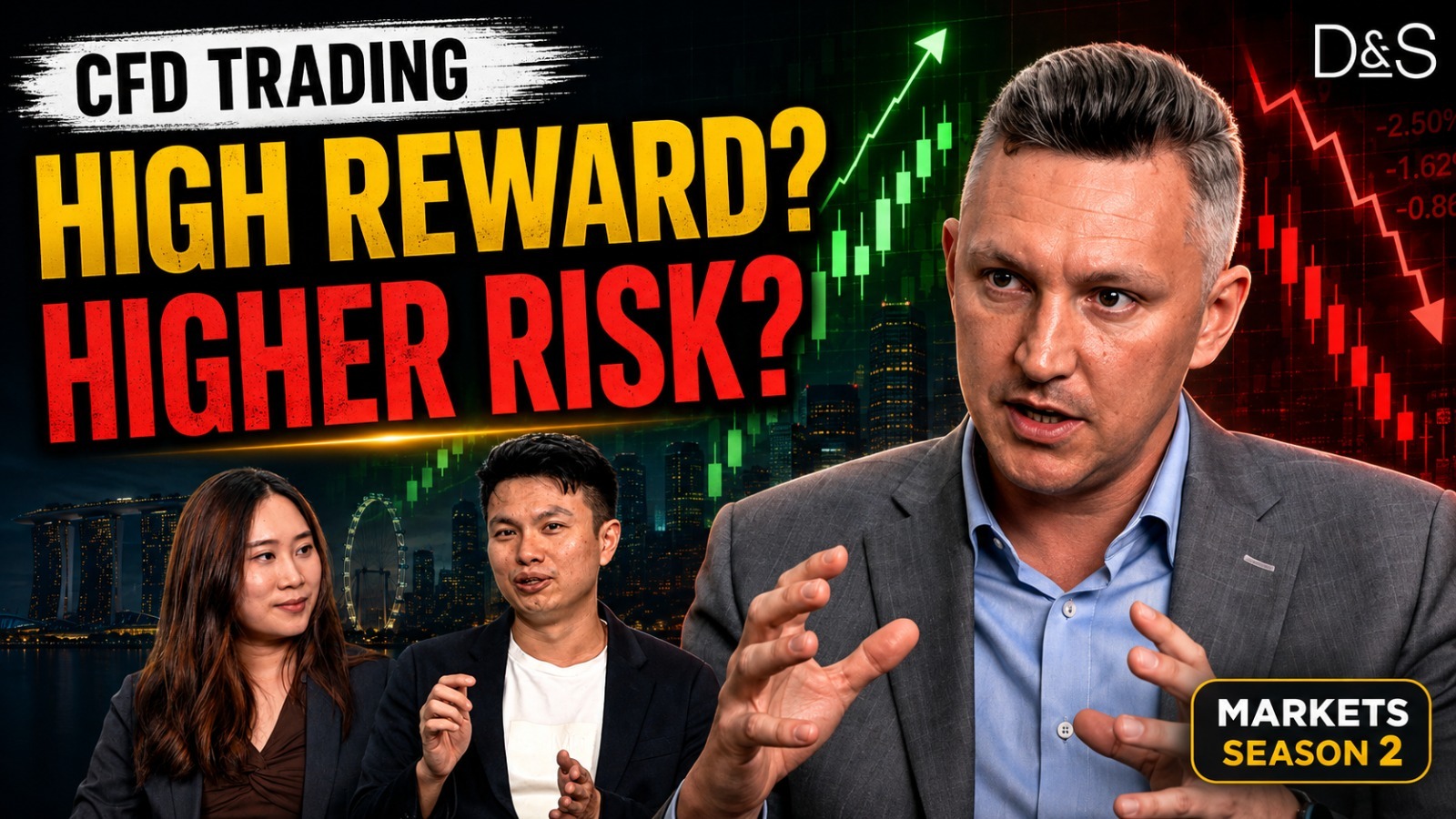
Contracts for Difference can help traders hedge portfolios and respond to short-term market moves, but leverage can magnify losses just as quickly.
When markets turn volatile, some investors look for ways to protect an existing portfolio or trade shorter-term opportunities. One tool some traders use for these purposes is a Contract for Difference, or CFD.
Unlike buying stocks, ETFs or REITs, CFD trading does not involve owning the underlying asset. Instead, traders take a position on whether its price will rise or fall. That flexibility can be useful, but because CFDs typically involve leverage, mistakes can become costly very quickly.
In this episode of the DollarsAndSense Market Series Podcast, we spoke with Alex Furber, Head of Client Engagement at Maybank Securities, about how CFDs work, why traders use them and the risks to understand before getting started.
Watch the full DollarsAndSense Market episode here.
CFD Trading Is Different From Long-Term Investing
When we buy a stock, we own part of the underlying company. With ETFs and REITs, we own units that may generate income or grow in value over time.
CFDs work differently. As Alex explains, “It’s an instrument that allows you to take a direction on a financial market without taking ownership.”
If a trader expects an index to rise, they can take a “long” position. If they expect it to fall, they can take a “short” position. This ability to trade in either direction is one reason CFDs are often used for short-term opportunities rather than buy-and-hold investing.
Depending on the provider, CFDs may offer access to markets including shares, equity indices, oil, metals and volatility-related instruments. For long-term investors, the aim is usually to build wealth over many years. CFDs are more tactical and may sit alongside a long-term portfolio for a specific short-term purpose.
CFDs Can Be Used To Hedge A Portfolio
Consider an investor who owns a portfolio of US equities and expects a temporary market downturn. Rather than selling the portfolio and buying it back later, one option could be to take a short CFD position on a broad US stock market index.
If the market falls, gains from the CFD position may help offset some of the decline in the underlying portfolio. Alex also highlighted volatility-related instruments as another way traders may respond to periods of market stress.
Because CFDs are leveraged, only a percentage of the total position value needs to be committed upfront. This can reduce the amount of capital required initially for a hedge, although it also introduces leveraged risk.
A CFD hedge is therefore not something to simply set and forget. The position still needs to be monitored, and the hedge can generate losses if the market moves differently from expected.
CFDs Can Also Be Used For Short-Term Trading
Markets may rise over the long term, but they rarely move in a straight line. Because CFDs allow both long and short positions, traders can respond to rising and falling markets.
This may include day trading, where positions are opened and closed within the same day, or swing trading, where trades may be held for several days or weeks. Technical traders may also use CFDs when making decisions based on price charts, support and resistance levels, moving averages and other indicators.
News events can also create sharp short-term market moves. Inflation data, central bank decisions, company announcements or geopolitical developments may all affect prices quickly.
The ability to react in either direction can be useful, but it does not make market movements easier to predict. A trader can just as easily end up on the wrong side of a sudden move.
Leverage Magnifies Both Gains And Losses
Leverage is one of the most important concepts to understand before trading CFDs. It allows a trader to take a position larger than the amount of cash initially committed.
For example, a trader might gain $10,000 of market exposure while putting up only $1,000 as margin. If the market moves in their favour, gains are based on the $10,000 position. But losses are calculated on the same exposure.
A 5% adverse move would result in a $500 loss. While the market has moved only 5%, the trader has lost half of the $1,000 committed as margin.
This is what makes leverage a double-edged sword. It improves capital efficiency, but also magnifies mistakes.
Traders may also face margin calls if losses push their account below the required margin level. Alex therefore cautioned against funding an account with only the minimum amount needed for a trade, as having a buffer can provide more room to absorb adverse market movements.
Risk Management Matters More Than Getting Every Trade Right
No trader gets every market call right, so the more important question is how much one wrong trade can cost. One approach is to decide on exit levels before entering a position.
A stop-loss sets a level at which a losing trade will be closed, while a take-profit level establishes when gains are realised. Traders can then size their positions based on how much they are prepared to lose if the trade moves against them.
As one possible risk-management approach, Alex suggested that active traders could consider limiting the amount risked on a single trade to around 2% of total trading capital. This is not a universal rule, but it illustrates why risk should be viewed in the context of the whole account rather than one position in isolation.
The harder part is often psychological. Traders may hold on to losing positions hoping prices recover, or abandon their framework when emotions take over. Fear of missing out can also encourage people to chase markets after much of the move has already happened.
As Alex puts it, “It’s just about having a simple risk management framework and remaining disciplined and sticking to that framework.”
CFDs Are A Tool, Not A Shortcut
CFDs are neither automatically useful nor inherently reckless. Their value depends on how they are used and whether the trader understands the risks involved.
For traders who understand the product, CFDs can provide a way to hedge an existing portfolio or pursue shorter-term opportunities without owning the underlying asset. But the same flexibility can become dangerous without a clear strategy, appropriate position sizing and disciplined risk management.
Perhaps the simplest takeaway from the episode is Alex’s reminder: “Think of CFD more as a tool rather than a shortcut.”
Understanding how that tool works, and what can go wrong, should come before thinking about the potential returns.


Lifestyle
15 Of The Cheapest EV Cars In Singapore


Budgeting 101
7 Ways Being Frugal Is Different From Being Cheap


Street Smart
Singapore Gym Membership Price Guide (2026 Edition)


Street Smart
Singapore Gym Membership Price Guide (2026 Edition)

Bonds and Fixed Income
Complete Guide To Buying Singapore Savings Bonds (SSB) [2026 Edition]


