

This article is written in collaboration with SGX. All views expressed in this article are the independent opinion of DollarsAndSense.sg based on our research, and is purely for informational purposes and should not be relied upon as financial advice. DollarsAndSense.sg is not liable for any financial losses that may arise from any transactions and readers are encouraged to do their own due diligence. You can view our full editorial policy.
For many years, China’s technology story largely revolved around its internet giants. Alibaba became synonymous with e-commerce, Tencent built one of China’s most important digital ecosystems through WeChat and gaming, while Meituan and JD.com became major players in food delivery, online retail and logistics.
These companies were easy for investors to access and understand. Many are listed in Hong Kong or the US, widely covered by analysts, and commonly found in China-focused funds and indices such as the Hang Seng TECH Index, which investors can access via ETF such as the Lion-OCBC Securities Hang Seng Tech ETF (SGX: HST: HSS).
While there is nothing wrong with associating Chinese technology with the likes of Alibaba and Tencent, they represent only one side of China’s technology market. Increasingly, another part of China’s market is gaining attention: AI chips, semiconductors, electric vehicle batteries and optical connectivity.
For investors seeking exposure to this part of China’s growth story, opportunities may also be found in China’s onshore markets, particularly the STAR Market and ChiNext board.
What Are The STAR Market And ChiNext Board?
The STAR Market, officially known as the Shanghai Stock Exchange Science and Technology Innovation Board, was launched to support technology and innovation-driven companies in China.
ChiNext, which is part of the Shenzhen Stock Exchange, also focuses on innovative and fast-growing companies, including those involved in electric vehicles, batteries, automation and renewable energy.
For Singapore investors, these markets may be less familiar than Hong Kong-listed China stocks. Many retail investors may know Tencent or Alibaba, but fewer would be familiar with companies such as Cambricon Technologies, Hygon Information Technology, Zhongji Innolight, Eoptolink Technology, CATL or SMIC. These deep-tech companies are more closely linked to physical products, manufacturing capabilities and industrial applications.
China’s Version Of The Global Tech Stack
One way to better understand this segment is to compare it with the global technology value chain that investors may already recognise.
For example, in the US and global markets, technology investing is no longer limited to consumer-facing platforms such as Apple, Alphabet and Amazon. Many investors would also consider Nvidia part of their technology portfolio, given its close association with AI chips and accelerated computing. Other familiar names, such as AMD and Intel, are also closely tied to processors and semiconductors.
Similarly, China also has its own companies operating in comparable parts of the technology value chain.
One such company is Cambricon Technologies, which is involved in AI chips and intelligent processors, making it relevant when discussing China’s domestic AI semiconductor ambitions, even though we should be careful not to view it as a direct equivalent to Nvidia.
Hygon Information Technology is involved in high-performance processors and server chips, placing it in a segment that investors may associate with AMD and Intel.
SMIC, or Semiconductor Manufacturing International Corporation, is China’s most important semiconductor foundry. While it is often compared with TSMC, there are important differences in scale, technology leadership, customer base and global reach.
CATL is one of the world’s largest electric vehicle battery makers. Zhongji Innolight and Eoptolink Technology are involved in optical communication components and modules, which are increasingly important for AI data centres, cloud computing and high-speed networks.
How This Differs From The Hang Seng TECH Index
The Hang Seng TECH Index comprises 30 of the largest technology companies listed in Hong Kong that meet the index’s screening criteria. This includes many familiar Chinese technology names that we have already mentioned, such as Alibaba, Tencent, Meituan and JD.com. Many of these internet giants are software-led or platform-based businesses. Their value comes from scale, network effects, data, and the digital ecosystems they operate in.
The STAR and ChiNext markets are different. Instead of being dominated by consumer internet platforms, they provide exposure to companies in sectors such as information technology, semiconductors, industrials, new energy and advanced manufacturing.
While both can be considered “China tech”, they are not the same type of technology. The Hang Seng TECH Index is closer to China’s recognisable digital platform story, while the STAR and ChiNext markets are more closely linked to China’s hard-tech and industrial innovation story.
What The CSOP CSI STAR And ChiNext 50 ETF Offers Investors
For investors who want to access this part of China’s market without picking individual A-share companies, one option is to consider investing in the CSOP CSI STAR and ChiNext 50 ETF (SGX: SCY).
Listed on the Singapore Exchange, the ETF tracks the CSI STAR and ChiNext 50 Index, which comprises 50 companies listed on the STAR Market and ChiNext boards, giving investors exposure to some of China’s leading innovation and growth companies in the onshore market.
As of 30 April 2026, the CSOP CSI STAR and ChiNext 50 ETF’s top holdings are concentrated in companies linked to optical connectivity, AI chips, semiconductors, EV batteries, renewable energy and advanced manufacturing. This gives investors exposure to a different part of China’s technology ecosystem, beyond the more familiar consumer internet platforms.
| No. | Constituent | Weightage (%) | Company Focus |
| 1 | Zhongji Innolight Co., Ltd. | 13.6 | A leading provider of high-speed optical transceivers and optical interconnect solutions used in data centres, AI computing infrastructure and communications networks. |
| 2 | Eoptolink Technology Inc., Ltd. | 10.3 | Manufactures high-speed optical transceiver modules, which are used to support data transmission in cloud, AI and telecommunications infrastructure. |
| 3 | Contemporary Amperex Technology Co., Limited (CATL) | 10.2 | World’s largest battery manufacturers, supplying batteries and energy storage solutions for electric vehicles, renewable energy and other new energy applications. |
| 4 | Cambricon Technologies Corporation Limited | 7.0 | Designs AI chips, accelerator cards and intelligent computing products used in cloud servers, edge computing and AI-related applications. |
| 5 | Hygon Information Technology Co., Ltd. | 5.4 | Develops high-end processors, including CPUs and data centre accelerator chips used in areas such as cloud computing, telecommunications and financial services. |
| 6 | Semiconductor Manufacturing International Corporation (SMIC) | 4.7 | Mainland China’s largest semiconductor foundry, providing chip manufacturing services for customers that design integrated circuits. |
| 7 | Victory Giant Technology (HuiZhou) Co., Ltd. | 3.9 | Produces high-precision printed circuit boards (PCBs), including boards used in computers, communications equipment, automotive electronics and AI servers. |
| 8 | Sungrow Power Supply Co., Ltd. | 3.9 | A renewable energy equipment company best known for solar inverters, energy storage systems and other clean energy solutions. |
| 9 | Montage Technology Co., Ltd. | 3.9 | Develops memory interface and interconnect chips used in data centres, servers and AI computing systems. |
| 10 | Advanced Micro-Fabrication Equipment Inc. China (AMEC) | 3.2 | Manufactures semiconductor production equipment, including etching and deposition tools used in the chip fabrication process. |
Information is accurate as of 30 April 2026
This can be useful for Singapore investors in three ways.
First, the ETF provides diversified exposure. Instead of trying to identify which individual AI chip, EV battery, optical connectivity or semiconductor company will succeed, investors get exposure to a basket of companies across the STAR and ChiNext markets. This allows us to invest in the sector without having to pick individual stocks that we may not be familiar with.
Second, it gives investors access to a segment of China’s market that may be harder to reach directly. Buying Hong Kong-listed China stocks is relatively straightforward, but investing directly in China A-shares can be less familiar for many retail investors.
Third, the ETF offers a more targeted China growth exposure. Investors who already own broad China indices or Hang Seng TECH-linked products may find that this ETF provides a different investment focus, with a stronger tilt towards deep tech, industrial innovation and advanced manufacturing. This matters especially if you believe that China’s next phase of growth depends on whether it can move up the value chain in these strategic industries
Risks Investors Should Consider
While the investment theme may be compelling, investors should also recognise the risk when investing in this sector.
The STAR and ChiNext markets are growth-oriented segments of China’s stock market. Companies in these markets may have higher growth potential, but they can also be more volatile. Share prices may be sensitive to investor sentiment, earnings expectations and global technology cycles.
Investors should also consider China market risk, including policy changes, regulatory developments, geopolitical tensions and macroeconomic conditions.
Last but certainly not least, thematic or sector-focused ETFs are usually better used as part of a diversified portfolio, rather than as the entire portfolio.
For investors, the CSOP CSI STAR and ChiNext 50 ETF offers a way to access this segment through a single SGX-listed ETF. That said, it should not be seen as a replacement for broad diversification, nor a risk-free way to invest in China’s technology ambitions.
Rather, for investors who want to look beyond Alibaba and Tencent, the ETF provides exposure to a different side of China’s technology story: the companies developing the hardware, infrastructure and industrial capabilities that may support China’s next phase of growth.
Read Also: Understanding China A-Shares: Top ETFs to Watch
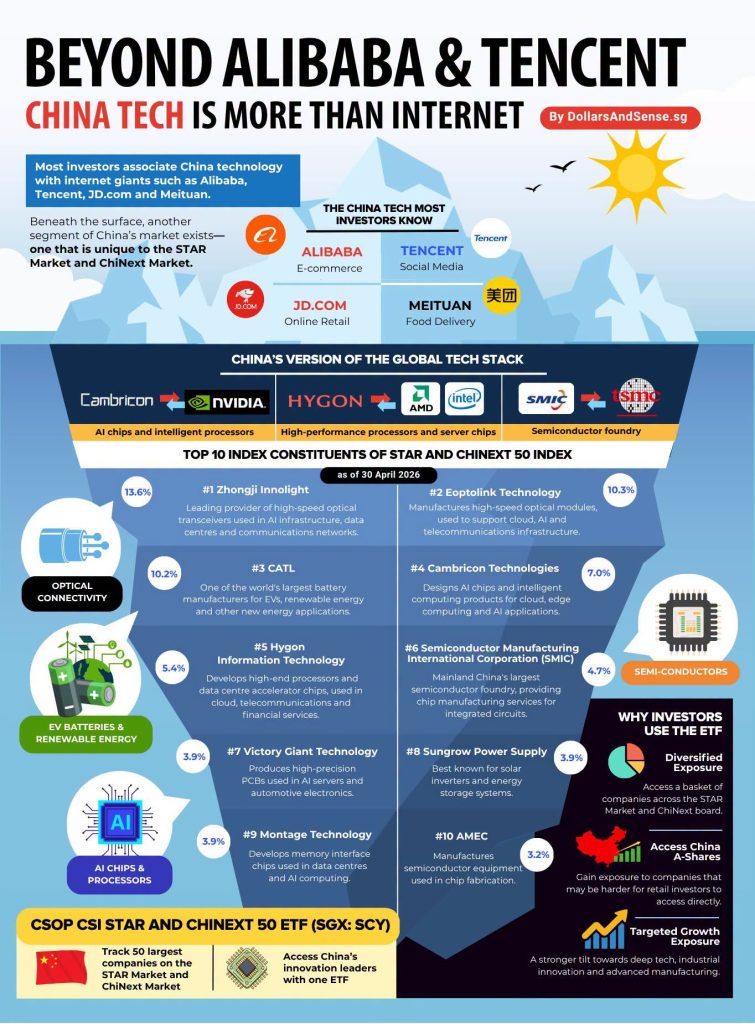
Photo Credit: iStock/kynny


Lifestyle
15 Of The Cheapest EV Cars In Singapore


Budgeting 101
7 Ways Being Frugal Is Different From Being Cheap


Street Smart
Singapore Gym Membership Price Guide (2026 Edition)
Street Smart
Singapore Gym Membership Price Guide (2026 Edition)


