

Over the weekend in Singapore, hundreds of people gathered outside Swatch stores across the island before sunrise. At ION Orchard, queues started forming in the middle of the night, prompting mall security and police to step in to manage the crowd.
What were they queuing for? A pocket watch retailing from S$535.
Welcome to the world of the Audemars Piguet (AP) x Swatch Royal Pop, the most talked-about watch collaboration of the year. It has caused commotion around the world and offers an interesting case study in how brands create hype, scarcity and demand.
What Exactly Is The Royal Pop?
The Royal Pop is a collection of eight pocket watches produced by Swatch in collaboration with Swiss luxury watchmaker Audemars Piguet, best known for the iconic Royal Oak.

Launched globally on 16 May 2026, the collection takes design cues from the Royal Oak’s signature octagonal bezel and Petite Tapisserie dial pattern, reimagined in bold Pop Art-inspired colours that reference Swatch’s late 1970s and 1980s design language.
Each watch is made from Swatch’s Bioceramic material, a lightweight composite used in previous collaborations. Inside is a newly developed hand-wound version of Swatch’s SISTEM51 movement, a 51-component calibre that is almost entirely machine-assembled.
The watches come in two configurations, both with a calfskin lanyard so they can be worn around the neck, attached to a bag, carried in a pocket or displayed on a desk. Retail pricing in Singapore starts at S$535 for the Lépine models and S$560 for the Savonnette variants. While they are obviously not priced like the usual Audemars Piguet (AP), at these prices, they are not exactly an impulse buy either.
Read More: The History of Rolex: How It Evolved To Become One Of The World’s Most Sought-After Watch Brands
Why Did AP Even Agree To This?
Audemars Piguet is an independent Swiss watchmaker with no parent company. Its Royal Oak starts at around US$19,900, placing it firmly in a very different market from Swatch.
At first glance, lending its brand to an S$535 Swatch product seems counterintuitive.
But the collaboration has been carefully structured.
The Royal Pop is a pocket watch rather than a wristwatch, and that distinction matters. It allows AP to participate in this collaboration without offering anything that directly resembles a Royal Oak wristwatch at a fraction of the usual price.
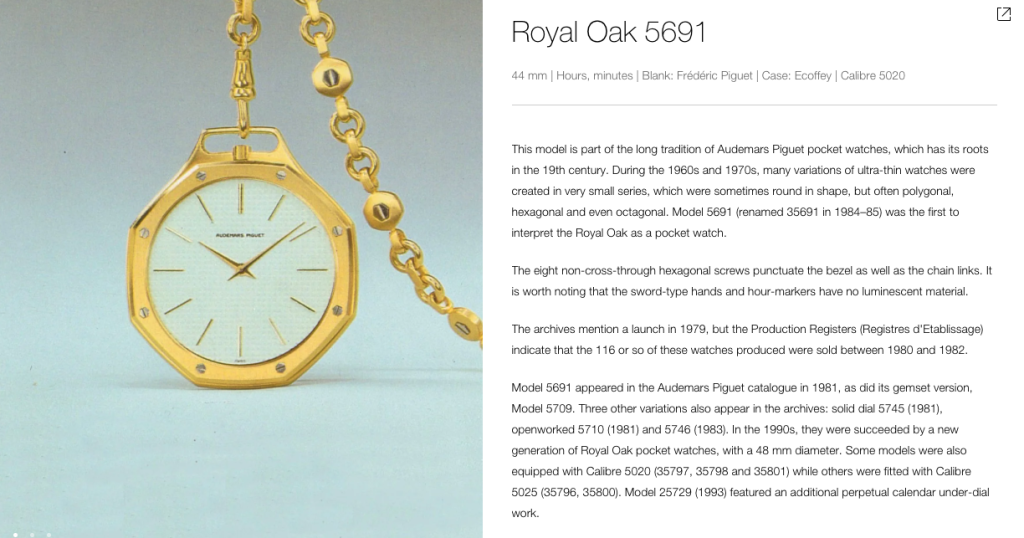
The design is also based on AP’s own Royal Oak Pocket Watch reference 5691 from 1979, giving the collaboration genuine historical roots rather than making it feel like a simple logo licensing exercise.
Source: AP
For AP, the upside is clear. It introduces the brand to a younger audience that may never have considered owning anything associated with Audemars Piguet (yet), while building familiarity and aspiration.
For Swatch, the business case is even clearer.
The MoonSwatch collaboration with Omega in 2022 reportedly sold more than two million units and significantly boosted Swatch’s revenues. It’s currently available at about S$380.

Source: Swatch
The Royal Pop follows the same formula, this time with one of the most desirable independent luxury watchmakers in the world.
Unlike Omega, which is owned by The Swatch Group, AP has no corporate ties to The Swatch Group. That gives this collaboration a different kind of credibility.
What Happened On Launch Day?
The scenes in Singapore were far from unique. Globally, 16 May 2026 was one of the most chaotic watch launch days in recent memory.
In New York’s Times Square, queues reportedly started forming nearly a week before launch, with some people offering to sell queue spots for hundreds of US dollars. In Dubai, Swatch cancelled launches at Dubai Mall and Mall of the Emirates over crowd safety concerns. In Paris, riot police were reportedly called in to disperse crowds. In Hong Kong, queues formed days before sales began.
Singapore saw similar scenes. The three Singapore launch locations were ION Orchard, The Shoppes at Marina Bay Sands and VivoCity. A polytechnic student who waited overnight at ION Orchard told The Straits Times that hundreds had gathered before security and police intervened around midnight.
Swatch’s VivoCity outlet was later closed for the rest of launch day.
Read Also: Understanding Labubu Dolls, And Why They Are So Popular (And Expensive)
The Real Popularity (And Money) Is In The Resale Market
Resale listings appeared online before some boutiques had even processed their first sale.
Within hours of launch, units were reportedly changing hands for US$1,200 to over US$8,000 overseas, despite retail prices of about US$400 to US$420. On StockX, hundreds of trades were recorded on launch day, with resale prices often several times above retail.
This is not unusual for hype-driven launches.
The MoonSwatch followed a similar trajectory in 2022, with resale prices soaring immediately after launch before gradually normalising as supply increased. Today, many pre-owned MoonSwatches trade at or even below their original retail prices. You can still buy it new today from Swatch if you want.
Should You Buy One As An Investment?
No.
According to CNA Luxury, the watches are not limited editions, while Swatch has also said the collection will remain available for several months. So this means the Royal Pop will continue to be sold at Swatch stores until demand for it, like all other products, declines. This matters because scarcity ultimately drives resale premiums.
Launch-day resale prices tend to spike because supply is artificially constrained while demand is at its peak. Once restocks begin and the novelty wears off, prices usually fall. Swatch, unlike luxury watch brands such as Rolex, has traditionally built its business around producing watches at scale and selling them directly to consumers. So while the Royal Pop may have attracted long queues and launch-day hype, it should not be mistaken for a deliberately scarce, limited-edition luxury release.
We have seen this pattern repeatedly with limited-drop products, whether watches, sneakers, or collectables.
A small number of early resellers may indeed make a profit, especially if they manage to secure the item before supply catches up. But for most buyers, treating this as an investment does not make sense.
In many cases, simply waiting for a restock would be the more rational financial decision. It is not that different from the early days of a new iPhone launch: people may queue, stocks may run out, and resale prices may spike briefly. But once supply normalises, the premium usually fades.
Read Also: 4 Factors You Should Consider Before You Invest In A Rolex Watch


Lifestyle
15 Of The Cheapest EV Cars In Singapore


Budgeting 101
7 Ways Being Frugal Is Different From Being Cheap


Street Smart
Singapore Gym Membership Price Guide (2026 Edition)


Street Smart
Singapore Gym Membership Price Guide (2026 Edition)

Bonds and Fixed Income
Complete Guide To Buying Singapore Savings Bonds (SSB) [2026 Edition]


