
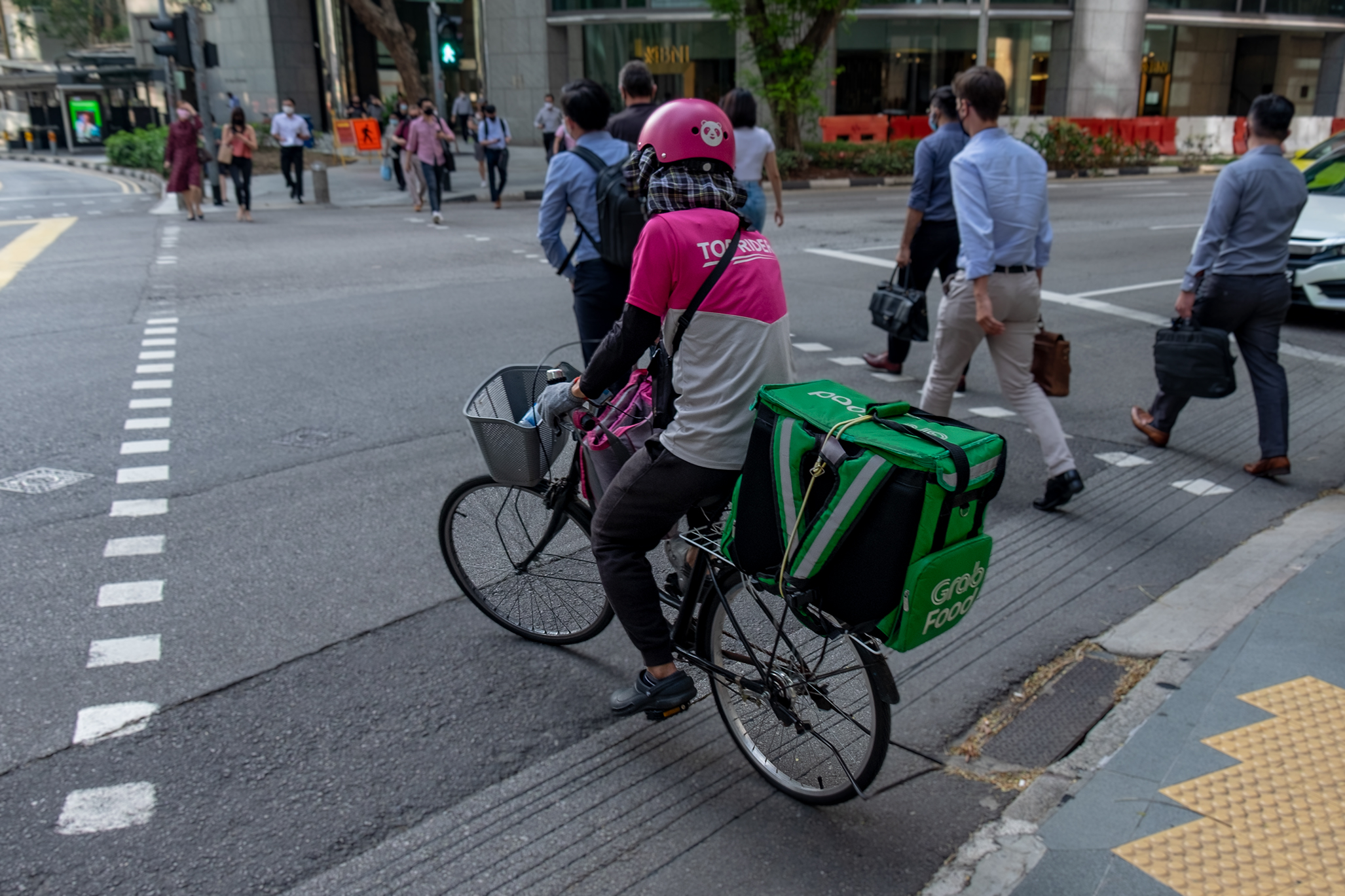
If you have ever booked a ride through Grab, ordered food via Deliveroo, or used Lalamove for deliveries, chances are the people behind the wheel or on the bike are considered “platform workers”. Unlike traditional employees, they were previously not required to make CPF contributions, which meant many had less in their retirement savings compared to salaried workers.
That changed from 1 January 2025, when CPF contributions became mandatory for younger platform workers. This policy shift aims to align them more closely with salaried employees, who already contribute a significant portion of their wages into CPF, both from their own salary (employee’s contribution) and through their employer (employer’s contribution).
How Much Are Platform Workers Contributing Today?
For 2025, the total CPF contribution rate for platform workers who are 35 and below is 14% of their earnings. This is split between:
- 10.5% contributed by the worker, deducted from their platform earnings.
- 3.5% contributed by the platform operator, such as Grab, Gojek, or Foodpanda.
This means a food delivery rider who is 35 and below, earning $2,000 in a month, will see $210 (10.5%) deducted from their pay, while the operator adds another $70 (3.5%) to their CPF account. In total, $280 goes into CPF for that month.
The contribution does change depending on the age of the platform worker. For example, those between the ages of 36 and 45 will have a total contribution of 15% for 2025. You can check out the full rates here.
A Gradual Increase Till 2029
The 14% contribution rate is just the starting point. Over the next few years, CPF contribution rates for platform workers will increase gradually until 2029, when they reach the same rate as salaried employees today, which is 37% of wages.
At that point:
- 20% will come from the platform worker
- 17% will come from the platform operator

Source: CPF
For the same $2,000 monthly earnings example, this would mean $400 from the worker and $340 from the operator, bringing the total CPF contribution to $740 — a substantial increase compared to 2025.
Why This Matters For Platform Workers?
The move has two significant implications.
First, it strengthens retirement adequacy, since many platform workers were previously left with little CPF savings for housing, healthcare, and retirement. By 2029, a worker earning $2,000 a month could expect over $8,800 a year going into their CPF accounts.
Second, while vital in the long term, it also means lower take-home pay in the short term, since the worker’s own contribution rises from 10.5% to 20% over the years. For many, this could feel like a pay cut, even though part of it is being set aside in CPF rather than being lost.
CPF Contributions For Platform Workers Born Before 1 January 1995 Is Not Compulsory
While CPF contributions became mandatory for younger platform workers from 2025, there is one crucial exemption. Platform workers born before 1 January 1995, meaning those who are 31 years old and above in 2025, are not required to contribute to their CPF accounts if they do not want to.
If they opt not to contribute to their CPF accounts (Ordinary, Special or Retirement, MediSave), they would still have to make a compulsory contribution to their MediSave. This is the existing compulsory MediSave contribution that is required for all self-employed persons.
This raises an important question: should older platform workers opt in to CPF contributions even if they don’t have to?
Why It Makes Financial Sense To Contribute To Your CPF
The clearest reason to contribute is that CPF contributions are not one-sided. By contributing to CPF, platform workers unlock additional contributions from the platform operators they work for. This works exactly like salaried employees, where employers match a significant portion of CPF savings.
Take the case of a platform worker earning $3,000 in monthly net earnings by 2029, when full CPF contribution rates are phased in. If he chooses to contribute the required 20% ($600) into CPF, the platform operator will top up another 17% ($510). That’s effectively an extra $510 every month that he would not receive if he opted out.
In a year, this adds up to over $6,000 in additional CPF savings, which can be used for housing (via the Ordinary Account), retirement (via the Special or Retirement Account), or healthcare (via MediSave).
CPF Contributions Are Calculated On Net, Not Gross Earnings
It’s also important to note that CPF contributions are based on net earnings rather than gross. This recognises that platform workers often incur operating expenses such as petrol, maintenance, or rental of vehicles.
For instance, a delivery rider using a motorcycle has a Fixed Expense Deduction Ratio (FEDR) of 35%. This means if he earns $4,000 in gross monthly income, his net earnings are considered $2,600 after factoring in expenses. CPF contributions would be computed based on this $2,600, rather than the full $4,000.
So, in 2029, his 20% CPF contribution would be $520, while the platform operator would add $442, bringing his total CPF savings to $962 for the month. The point here is that if you don’t contribute to your CPF, you miss out on a sizeable amount of “free” contribution from the platform operator.
You Have To Contribute To MediSave Anyway
Another critical point is that even if older platform workers choose not to contribute to their full CPF accounts, they would still have to make MediSave contributions. This is because under existing rules, all self-employed individuals in Singapore must contribute to their MediSave once their net trade income exceeds $6,000 a year.

Consider a younger platform worker aged 31 to 35, earning $2,500 in net monthly income. If he only contributes to MediSave, he would still need to set aside 8% of his income, or $200 a month.
However, if he opts in to the full CPF scheme in 2025, his monthly contribution rises slightly to 10.5% ($262.50). For this, he not only fulfils his MediSave requirement but also channels money into his Ordinary and Special Accounts, while receiving an extra $62.50 from the platform operator. In effect, for just $62.50 more in out-of-pocket contributions, he doubles that into $125 of additional CPF savings.
The difference becomes even clearer for older workers. A platform worker between the ages of 50-54 with the same $2,500 net income would have to contribute 10.5% ($262.50) to MediSave if he opts out of CPF. If he, instead, contributes to full CPF in 2025, the rate rises to 13% ($325) — a $62.50 increase. Yet, the platform operator would then add 3.5% ($87.50) on top of that. This means a total boost of $150 into CPF, at a relatively modest increase in contribution.
Seen this way, choosing not to opt in to CPF is like leaving money on the table. Since MediSave is already compulsory, the incremental difference in contribution is not so high compared to the extra CPF savings you receive from the platform operator.
The Trade-Off: Higher CPF, Lower Cash Flow
Of course, opting in to CPF contributions is not without cost. Older workers who choose to contribute will see their take-home pay reduced slightly since part of their earnings is contributed to their CPF.
On the other hand, choosing not to contribute means forgoing the “free money” from platform operators, which could add up to tens of thousands over several years. For platform workers who have the option to opt out of CPF contributions, it’s important to recognise that the decision is ultimately a trade-off between short-term cash flow and long-term financial security.
Those who prioritise immediate spending flexibility may lean towards opting out, but in doing so, they miss out on employer-like contributions that are unique to CPF. Conversely, those who can set aside a little more each month effectively multiply their savings with the help of platform operators, while also strengthening their ability to fund housing, healthcare, and retirement needs in the future.
In short, while CPF contributions may feel like a pay cut today, for many platform workers it is actually one of the few opportunities to enjoy employer-style benefits — and that’s a consideration worth weighing carefully before deciding.
Read Also: Pros And Cons Of Requiring Compulsory CPF Contributions For Platform Workers
Photo Credit: Raymond Quek/DollarsAndSense


Budgeting 101
7 Ways Being Frugal Is Different From Being Cheap


Street Smart
Singapore Gym Membership Price Guide (2026 Edition)


Street Smart
Singapore Gym Membership Price Guide (2026 Edition)


