

This article was contributed to us by Endowus.
Every few years, the same cycle repeats: growth is decelerating, recession risk is rising, equity markets are selling off, and the pressure to act—to reduce risk, raise cash, do something—becomes difficult to ignore.
In most cases, acting on that pressure is a mistake. Over a 30-year investment horizon, most investors will live through several recessions. Each feels singular in the moment—the 2008 global financial crisis (GFC), the 2020 COVID-19 shock—but the appropriate portfolio response is nearly always the same: not to predict the next downturn, but to build a portfolio that can soften its blow.
What is a recession, and how does it affect financial markets?
A recession is a sustained contraction in economic activity, typically characterised by falling gross domestic product (GDP), rising unemployment, and declining business investment. In the United States, recessions are formally dated by the National Bureau of Economic Research (NBER), which evaluates a broad range of indicators rather than applying a fixed rule.
For financial markets, the impact tends to be both earlier and sharper than the underlying economic data suggests. Equities and credit instruments begin repricing as soon as investors anticipate a slowdown, often well ahead of any official declaration.
Recessions vary considerably in severity and duration: some are brief and contained, while others—such as the 2008 GFC—produce prolonged drawdowns across multiple asset classes simultaneously, with credit spreads widening sharply and liquidity deteriorating across markets.
How do markets typically behave during a recession?
Equity markets generally experience significant drawdowns once a recession is underway, but the repricing typically begins before the recession is officially confirmed. Investors discount the expected deterioration in earnings and credit conditions ahead of the data, which means markets often bottom and begin recovering while economic indicators are still deteriorating—one of the most consequential and counterintuitive features of market cycles.
This dynamic is what makes market timing so difficult to execute consistently. Investors who reduce equity exposure once a recession is confirmed have usually already absorbed most of the drawdown. Those who defer re-entry until the macroeconomic outlook stabilises frequently miss the early stages of the recovery, which tend to produce the highest returns in compressed timeframes.
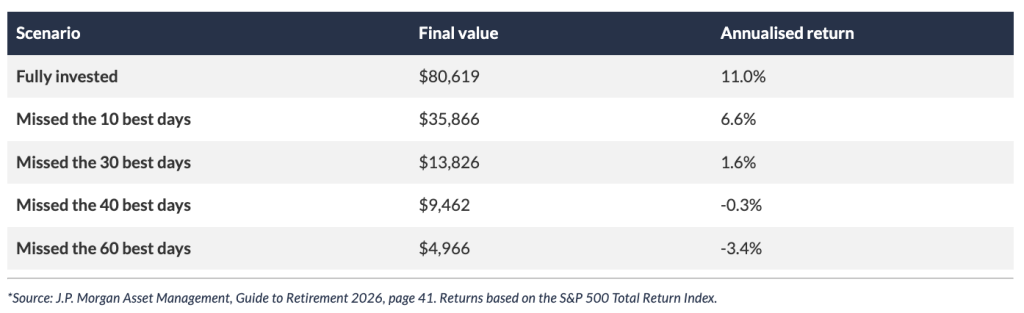
The data make this concrete. Missing just the 10 best days in the S&P 500 between 2016 to 2025 would have reduced an annualised return from 11.0% to 6.6%. Six of those 10 best days occurred within two weeks of the 10 worst—a pattern consistent with the concentrated, volatile character of market recoveries*.
How do you build portfolio resilience during a recession?
Resilience is built before a downturn, not in response to one. Three factors do most of the work: genuine diversification across asset classes and geographies, an asset allocation calibrated to your actual investment horizon, and sufficient liquidity to ensure you are never compelled to liquidate holdings at distressed valuations to meet near-term obligations.
In a well-constructed portfolio, each component serves a distinct function. Equities provide long-term capital growth. Investment-grade and government bonds reduce volatility and generate income.
Geographic and sector diversification limits concentration risk, reducing the probability that weakness in a single market or industry materially impairs overall portfolio performance.
Institutional investors, including pension funds, endowments, and sovereign wealth funds, have spent decades building portfolios designed to perform across a range of economic environments rather than to optimise for any single scenario. The same framework applies to individual investors.
It is important to acknowledge one of diversification’s structural limits. During severe market stress, cross-asset correlations tend to rise: assets that behave independently under normal conditions may move together when liquidity deteriorates and forced selling accelerates.
This was evident in 2008, when equities, credit, and real estate declined simultaneously, and even strategies designed to be market-neutral experienced significant losses. The assets that provided meaningful capital preservation were sovereign government bonds from highly rated issuers, gold, and cash—which is precisely why they warrant a structural allocation. Their function is to provide downside protection when higher-risk assets are under pressure.
This does not diminish the case for diversification. Across normal market environments, which represent the vast majority of any investment horizon, diversification delivers genuine risk reduction and return smoothing. Its most important contribution, however, may be the one that is hardest to appreciate until it is needed.
What should you actually do with your portfolio during a recession?
In most cases, less than investors typically assume. The most common response—reducing equity exposure and waiting for a trough—has historically impaired long-term returns more than the recession itself. If your investment horizon and risk tolerance have not changed, the appropriate action is usually to remain invested and allow the portfolio to perform the function it was designed for.

There are two measured exceptions. The first is rebalancing: if a sharp drawdown has pushed your portfolio materially away from its strategic asset allocation, rebalancing restores your intended risk exposure and, in effect, acquires assets at lower valuations. The second is reviewing your liquidity position. If a recession coincides with employment or income uncertainty, ensuring you hold sufficient cash or near-cash instruments to cover near-term expenditure removes the risk of being forced to liquidate investments at an inopportune point in the cycle.
What to avoid is making large tactical shifts based on macroeconomic forecasts. Recessions are rarely predicted accurately in advance, and market reactions are even harder to anticipate. A portfolio built for resilience before a downturn is far more likely to deliver over the long run than one repositioned in response to deteriorating conditions.
Do markets recover after recessions?
Yes. In every post-war US recession on record, equity markets have eventually recovered and gone on to reach new highs. The timing varies considerably—sometimes months, sometimes several years—but the long-term upward trajectory has held across every major downturn since World War II. Over every 20-year rolling period in the historical record, US large-cap equities have delivered positive total returns.
In our view, the most important implication is behavioural. The primary risk a recession poses to a long-term investor is not the drawdown itself—it is the decision to sell during the drawdown and miss the subsequent recovery. The investors who come closest to capturing the long-run return of equity markets are typically those who build portfolios calibrated to their actual investment horizon and genuine loss tolerance, and who hold them through periods of stress without making reactive allocation changes.
If you’re interested to start investing with Endowus, you’ll be happy to know that DollarsAndSense readers can enjoy $50 off their access fee Sign-up using this link to claim this special offer. Terms & Conditions apply.


Budgeting 101
7 Ways Being Frugal Is Different From Being Cheap


Street Smart
Singapore Gym Membership Price Guide (2026 Edition)


Street Smart
Singapore Gym Membership Price Guide (2026 Edition)


