

No one likes to think about death. But while it’s an uncomfortable topic, there are practical matters we shouldn’t ignore, especially when it comes to what happens after we’re gone.
Surprisingly, many people in Singapore, including those with families, don’t have a will. And without one, things can get complicated. One common area of uncertainty is what happens to a person’s assets, particularly their investments, when they pass on.
Who inherits them if there’s no clear instruction?
If you’ve ever wondered what happens to your investments when you die in Singapore, here’s what you need to know.
Understanding What Happens When You Pass Away Without A Will
If you pass on with a valid will, then the distribution of your assets is pretty straightforward. The executor of the will has to ensure that your assets are distributed in accordance with your will.
If you don’t have a will, there’s already a legal framework in place that determines how your assets will be distributed.
In Singapore, if someone passes away without a valid will, they are considered to have died intestate, which means dying without a valid will. In this instance, their assets will be distributed according to the Intestate Succession Act, which outlines how assets are divided among surviving family members and next-of-kin.
However, there’s an exception for Muslims. For Muslims domiciled in Singapore, the Intestate Succession Act does not apply. Instead, their assets will be distributed based on Muslim inheritance law, also known as Faraid principles.
When a person passes away, their investments, such as those held in brokerage accounts, savings, CPF, or other platforms, need to be declared. This responsibility typically falls to the next-of-kin or the court-appointed administrator (if no will is present).
To start the process, the administrator will need to apply for a Grant of Letters of Administration from the courts. This legal document allows them to manage and distribute the estate.
Several documents will also need to be submitted, including:
- The death certificate,
- The administrator’s NRIC, and
- The court-issued Letters of Administration.
Once granted, the administrator can begin distributing the assets according to the rules laid out in Section 7 of the Intestate Succession Act.
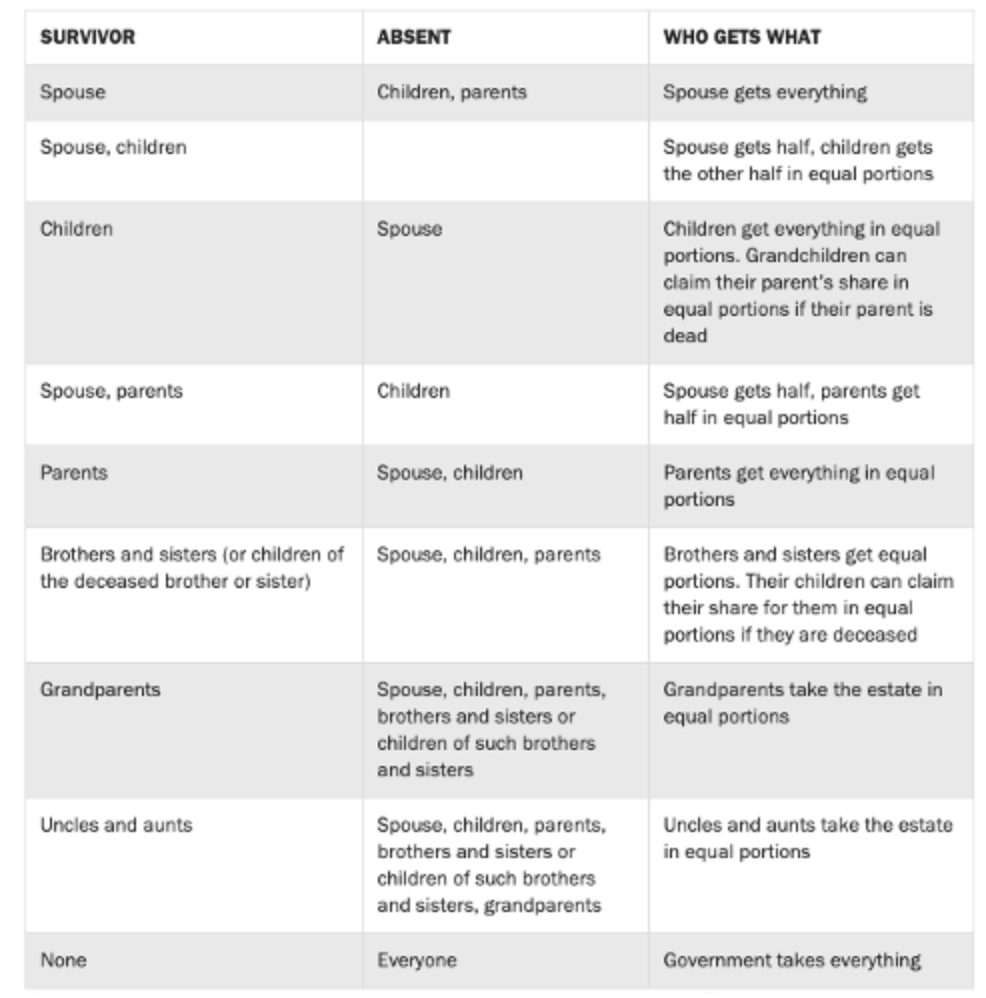
Source: Singapore Legal Advice
What About CPF Assets?
When we start contributing to our CPF accounts, one of the most important things we can do is to make a CPF nomination. This allows us to decide who will receive our CPF savings when we pass on. Without a nomination, your CPF savings will be distributed according to intestacy laws, which may not reflect your wishes.
Making a CPF nomination is straightforward. You can nominate up to 15 people and decide how much each person should receive. All you need to do is complete a nomination form and submit it at any CPF Service Centre. You’ll also need two witnesses to sign the form and they can’t be among your nominees.
Alternatively, you can make your nomination online via the CPF website, which is often more convenient. Just ensure your Singpass is ready, and your witnesses are available to verify digitally.
It’s important to note, though, that this CPF nomination does not include any assets held within the CPF Investment Scheme (CPFIS) and anything held within the CPFIS is distributed according to the processes outlined in the Intestate Succession Act.
Why Writing a Will Matters
While the process of distributing assets without a will may seem manageable, the reality can involve quite a few administrative hurdles. From applying for court documents to proving relationships between next-of-kin, things can get complicated and time-consuming.
What’s more, without a will, disagreements between family members over how assets should be divided are not uncommon. These disputes often arise during a time of grief, adding emotional strain to an already difficult situation.
That’s why it’s worth having a will, even a simple one. It helps provide clarity on your intentions and can ease the burden on your loved ones.
The good news? Writing a will in Singapore doesn’t have to be expensive. There are many low-cost and even free options available for those who want to put their wishes in writing. Taking that small step today can make a big difference for your family tomorrow.
Read Also: Funeral Guide In Singapore: Here’s What To Do After The Death Of A Loved One


Lifestyle
15 Of The Cheapest EV Cars In Singapore


Budgeting 101
7 Ways Being Frugal Is Different From Being Cheap


Street Smart
Singapore Gym Membership Price Guide (2026 Edition)


Street Smart
Singapore Gym Membership Price Guide (2026 Edition)

Bonds and Fixed Income
Complete Guide To Buying Singapore Savings Bonds (SSB) [2026 Edition]


