
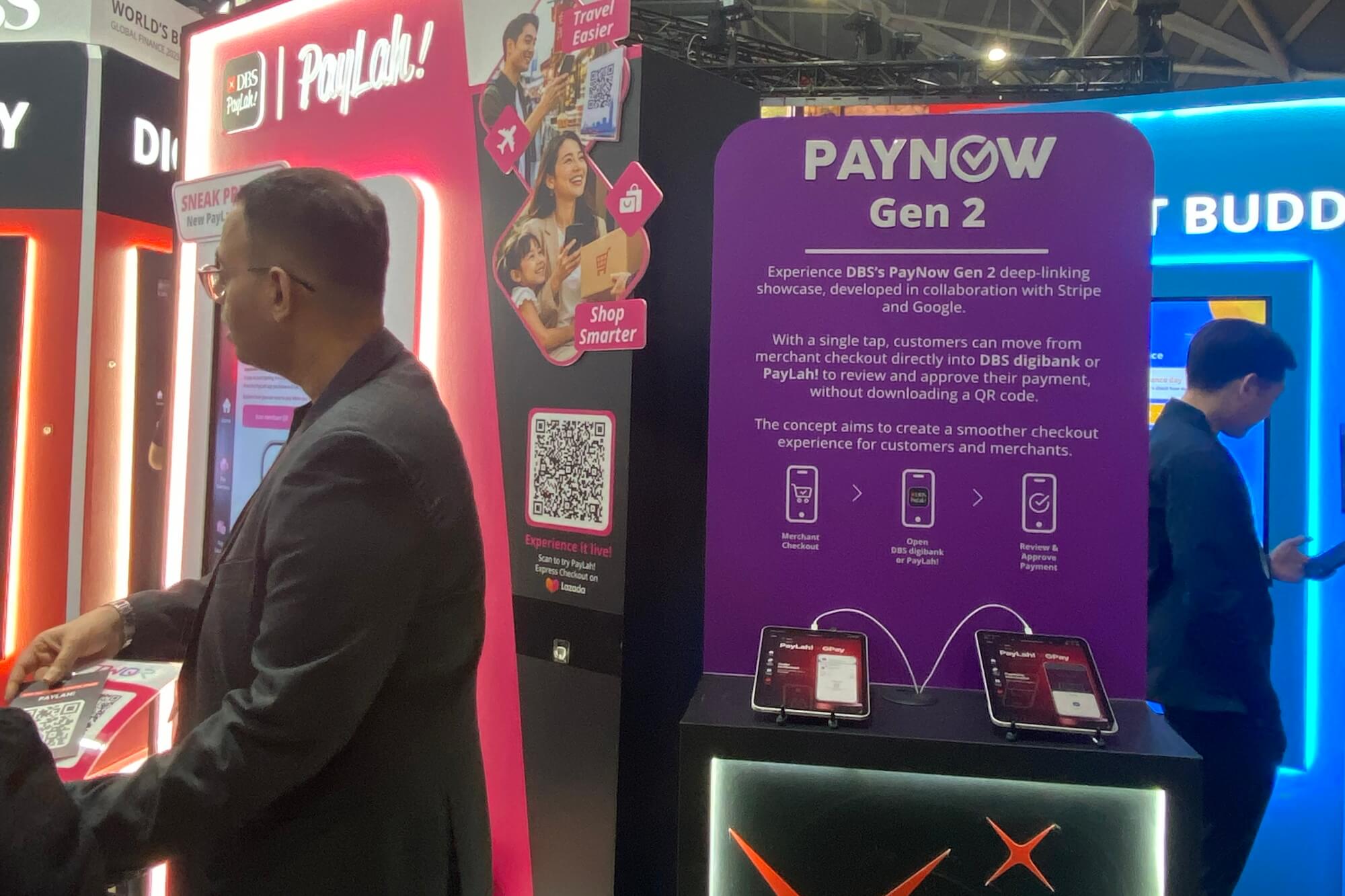
For most Singaporeans, PayNow already feels like a finished product. We use it to transfer money to friends and family members, and pay for all kinds of products and services, like at hawker stalls. Since its launch in 2017, PayNow has grown into one of Singapore’s most successful digital payment systems. According to a report by the Monetary Authority of Singapore (MAS) and the Association of Banks in Singapore (ABS), more than nine in ten Singaporeans, and about 350,000 businesses are registered on the platform. Yet there is still room for improvement, and that is where PayNow Generation 2 (PayNow Gen2) comes in.
In an implementation roadmap released as part of the Singapore Fintech Festival 2026 on 18 November, MAS and ABS outlines how PayNow Gen2 will improve the everyday payment experience. As Deputy Prime Minister Gan Kim Yong said in his keynote speech, PayNow Gen2 will “make payments simpler, safer and more accessible for everyone”.
#1 Paying Online Could Become Much Faster With Deep-Linking
Currently, using PayNow for online shopping is a multi-step process. Depending on the merchant, consumers may have to scan a QR code on another device, switch between apps, copy reference numbers, or manually navigate to their banking app before completing payment. While this process is still considerably simpler than traditional bank transfers, it can feel clunky compared to the one-click experiences that consumers have become accustomed to, for example, when using card payments.
PayNow Gen2 aims to solve this through deep-linking. Under the proposed system, customers shopping online will be able to move directly from a merchant’s checkout page into their chosen banking or payment app to authorise payment. Once approved, they will be automatically brought back to the merchant. Currently, direct PayNow checkout is already implemented on Lazada for OCBC customers, and payments to CPF Board can also be made directly through OCBC’s mobile banking app.
According to the implementation roadmap, 2027 will focus on developing common industry standards and supporting infrastructure, with broader adoption by early 2028.
For many of us, this may seem like a minor feature. But for many merchants and businesses, removing just a few steps from the checkout journey could make online payments significantly more seamless and reduce drop-offs. Similar improvements in other digital services often lead to higher conversion rates and fewer abandoned purchases.
#2 You May No Longer Need To Worry Whether A Merchant Accepts PayNow QR Or NETS QR
Currently, Singapore’s QR payment landscape requires consumers to know which QR network a merchant supports.
A customer may open a banking app expecting to pay using PayNow QR, only to discover the merchant accepts only NETS QR. While SGQR, introduced in 2018, has helped consolidate multiple QR codes into a single label and simplified the way merchants present QR payments, interoperability between payment schemes is still not always seamless.
PayNow Gen2 seeks to address this by introducing the SGQR+ switch. Rather than requiring consumers and merchants to operate within specific payment networks, the infrastructure will allow participating QR schemes to connect with one another. The report specifically highlights future interoperability between PayNow QR and NETS QR as a top priority.
In practical terms, this means we no longer need to worry about whichever banking or payment app we prefer. Merchants will also be able to reach a larger pool of potential customers without changing their payment setup.
#3 Visitors To Singapore Will Find It Easier To Pay Like Locals
PayNow has been highly successful for Singapore residents, but it is less accessible for visitors to Singapore without local banking relationships. Currently, only tourists using Wise and the newly enhanced NETS mobile apps can make PayNow QR payments at participating merchants.
With PayNow Gen2, expect to have more inclusive QR apps over the next two years. The objective is to make PayNow digital payments more accessible without needing to have a local bank account.
This may not seem immediately relevant to Singaporeans, but a smoother payment experience for tourists ultimately benefits local merchants as well. Businesses that rely on visitor spending may find it easier to accept digital payments from overseas customers, while Singapore’s broader ambition of becoming a highly connected digital economy receives an additional boost.
The enhancement also reflects a broader reality. As travel becomes increasingly regional and cross-border payment linkages continue expanding throughout Asia, consumers increasingly expect payment systems to work across countries rather than stop at national borders.
Read Also: 5 Ways Businesses Can Collect Payment More Effectively From Customers
#4 Small Everyday Transactions Could Become More Efficient
PayNow was designed primarily as an instant payment system, but not every payment is the same. The PayNow Gen 2 report identifies a growing category of very small, high-frequency transactions that could become increasingly common. These include automated and machine-to-machine payments, where traditional payment processing costs may become disproportionately high relative to the transaction value.
To address this, MAS is studying Micropayments, or FAST-LITE, a lower-cost processing approach to handle very small payments more efficiently. Testing is planned to assess whether such transactions can be processed economically while maintaining reliability and security.
For us, the immediate impact may not be obvious. However, the initiative signals that Singapore is already preparing for payment use cases that do not yet exist at scale today. Whether it eventually supports smart devices, autonomous services or other future payment scenarios, the objective is to ensure the country’s payment infrastructure remains fit for purpose.
#5 Businesses Could Spend Far Less Time Reconciling Payments
One of the biggest hidden inefficiencies in Singapore’s payment ecosystem occurs after a transaction is completed.
When businesses receive payments, they often need to determine which invoice was paid, which customer made the payment and whether the amount matches what was expected. This process frequently involves manual reconciliation, particularly for smaller businesses that lack sophisticated accounting systems.
PayNow Gen2 intends to introduce richer payment information that travels alongside the payment itself. This additional data could help businesses automatically match incoming payments to invoices and accounting records. The report also envisages tokenised payment credentials that could support recurring and contactless payment scenarios.
Again, for us consumers, we may never notice these changes directly. However, businesses that spend less time on administrative work can operate more efficiently, reduce errors and potentially lower operating costs. In many ways, this enhancement reflects how digital payments are evolving. The payment itself is only part of the transaction. Increasingly, the information attached to the payment may be just as important.
#6 Higher-Value Payments May Become Possible Through PayNow
Today, many consumers still associate PayNow with relatively modest everyday transfers. Yet certain situations require larger payments, particularly in interactions with government agencies. The report notes that trial programmes will explore enabling selected government payments above today’s PayNow transaction limits. Initial pilots are expected with selected government agencies before broader expansion.
Rather than existing solely as a convenient peer-to-peer transfer tool, PayNow is increasingly being positioned as national payment infrastructure capable of supporting a much wider range of transaction types and payment values.
#7 Disputes, Refunds And Scam Recovery Could Become Clearer
Singapore’s payment ecosystem has evolved rapidly over the past decade. Unfortunately, scams and payment disputes have evolved alongside it. One area targeted by PayNow Gen2 is clearer PayNow P2M (person-to-merchant) scheme rules governing disputes, refunds, fraud, and scam recovery. These arrangements are expected to be introduced progressively from 2028 onwards.
While no payment system can eliminate fraud completely, clearer standards can help create greater confidence among both consumers and merchants.
Perhaps most importantly, consumers increasingly expect digital payment systems to provide protections and recourse mechanisms that are comparable to those offered by established card networks. As PayNow becomes an even more important part of daily life, the need for transparent dispute-resolution processes naturally grows.


Family Planning
Price Guide To Chinese Enrichment Classes In Singapore


Bonds and Fixed Income
6 Investments In Singapore That Provide Guaranteed Principal And Returns

Health Insurance
5 Questions To Ask Before Dropping Your Integrated Shield Plan Rider
Bonds and Fixed Income
6 Investments In Singapore That Provide Guaranteed Principal And Returns


