

The Singapore FinTech Festival celebrated its 10th anniversary as a global platform for FinTech innovation this week. The annual event spans six halls of the Singapore Expo and was packed with attendees from all around the world. DollarsAndSense is proud to be a Supporting Media Partner of the Singapore FinTech Festival 2025.
Kicking off the massive three-day event at the main Festival Stage were several luminaries who truly demonstrated how this was the global gathering of policy, finance and technology. Despite their different backgrounds, several key themes emerged in their speeches and discussions.
#1 Artificial Intelligence Cannot Compromise Trust
That artificial intelligence (AI) is here to stay as a next-generation financial technology is not in question. As George Lee, Co-head of Goldman Sachs Global Institute put it in one of the morning panels, we are past questions about “what” AI is, or “why” we need to use it. The key question today is “how”.
This attitude echoed the keynote speech by Wee Ee Cheong, UOB’s Deputy Chairman and CEO, earlier that morning. He said, “AI and blockchain show promise, but scaling requires clarity and harmonisation on regulations, standards and compatibility. Financial services must be more secure and trusted as systems become more connected.”
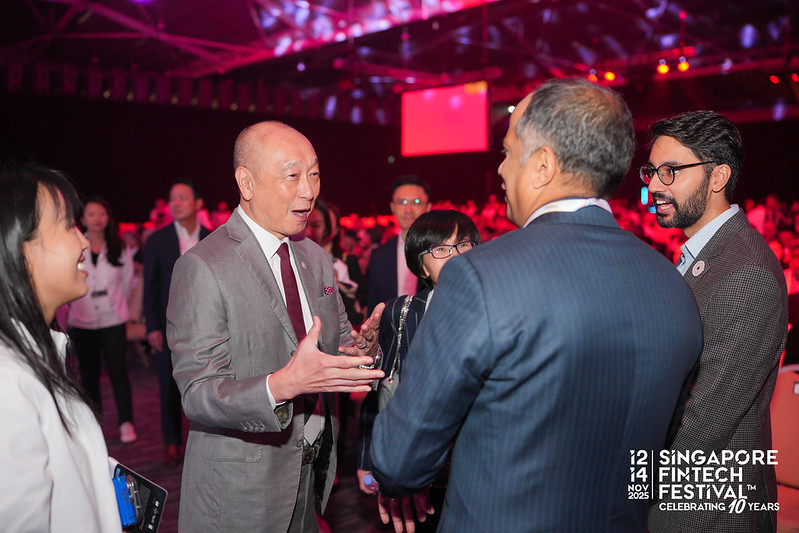
Photo credit: Singapore FinTech Festival
The connection between AI and trust was also one of the main topics discussed between Deputy Prime Minister Gan Kim Yong, who is also Minister for Trade and Industry and Chairman of the Monetary Authority of Singapore, and Tan Su Shan, Group CEO of DBS Bank.
“Trust is going to fetch a premium in today’s world, where there’s a lot of uncertainty, a lot of changes, a lot of volatility. What people are looking for is really stability, trust, and reliability,” said Mr Gan, before adding, “Singapore has that advantage, although we are small, we are trusted and a reliable partner.”
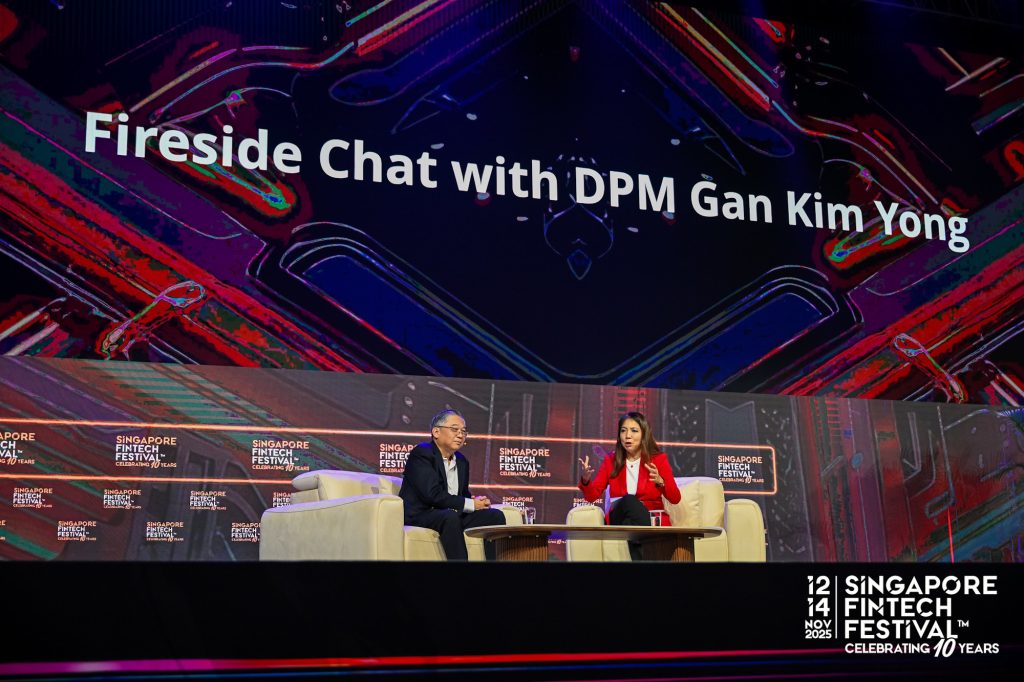
Photo credit: Singapore FinTech Festival
#2 Building AI Capabilities In The Workforce
Mr Gan also made it a point to emphasise how Singapore’s focus was on developing and uplifting Singaporeans.
“We also consistently invest heavily in our people. Training and upgrading – that has been the story of Singapore. We keep pushing Singaporeans to upgrade.”
One key focus of that development is in AI.
“AI is a very important emerging technology,” he said. “I think it’s going to have a major impact on the way we work, the way we live, and even the way we learn.”
According to Mr Gan, Singapore’s AI strategy has three different levels: broad basic literacy, systems integration, and development.
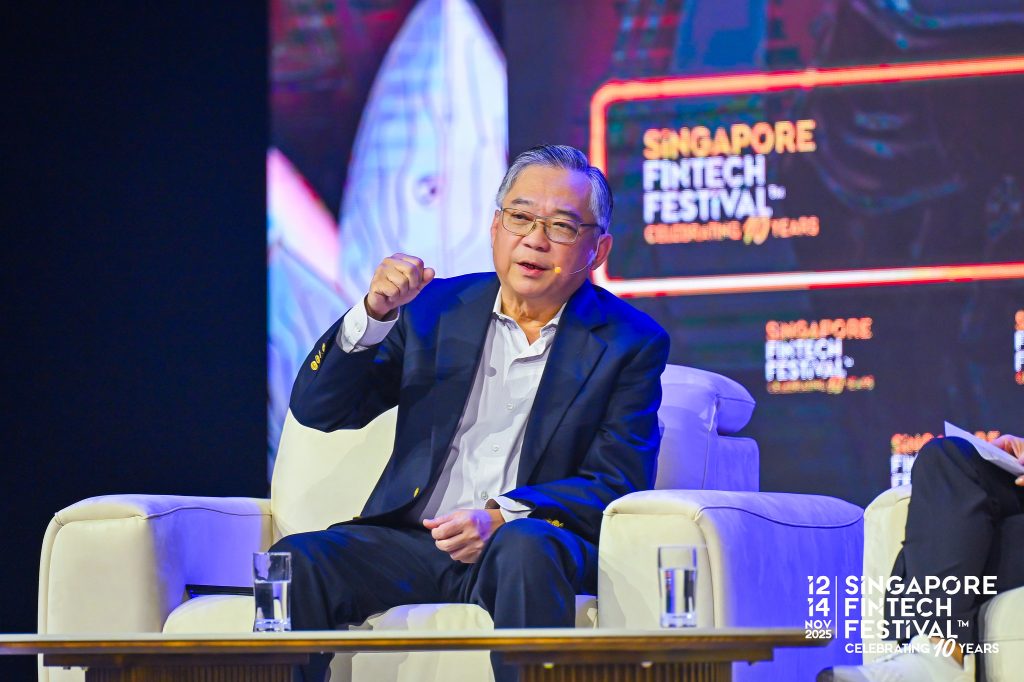
Photo credit: Singapore FinTech Festival
Just as internet literacy has become mainstream today, companies and customers must first have a baseline understanding and familiarity with AI. The next level, according to Mr Gan, is developing the capability to integrate AI into existing systems. This allows businesses to become more competitive and enable new services. Finally, at the highest level are AI developers who can create new technologies and tools.
Mr Gan stressed that “even as jobs evolve, we have to keep the people relevant. That’s why training and upgrading is very important.” He noted that more could be done to encourage “a culture of constantly learning and constantly upgrading.”
“The Government has put in a lot of investment in training and upgrading. We provide Skillsfuture, we subsidise training courses, but we also want to make sure that our training is relevant. We have to accept that training and upgrading is an investment, and we have to believe that this investment, in time to come, will yield returns to the workers, and to the companies. This is more critical today, given the fast-changing pace of technology and the nature of jobs.”
#3 A Future Of Collaboration
As the Singapore FinTech Festival celebrates its 10th anniversary, it is also an opportunity to also look ahead to the next ten years.
In his opening keynote speech, Dr Axel Weber, International Advisory Board Member and President, Center for Financial Studies at Global Finance & Technology Network (GFTN) said that “after a decade of disruption, we can now expect the next decade to be one of compliance and collaboration.”
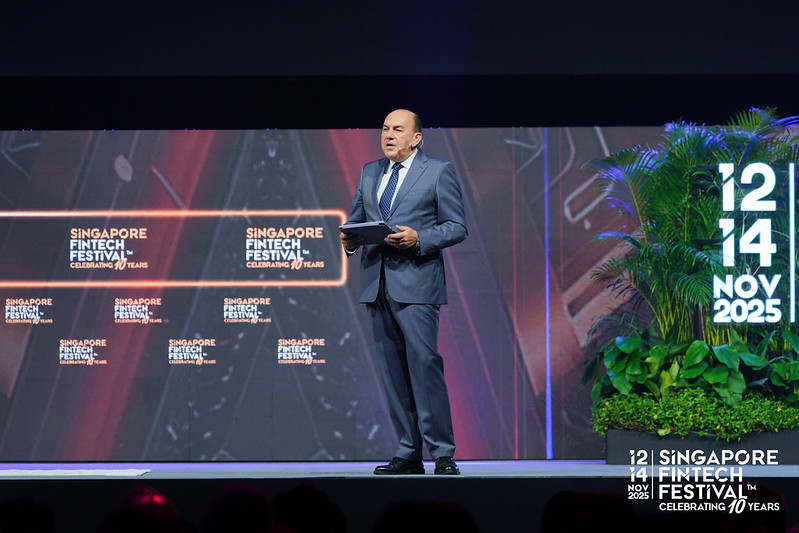
Photo credit: Singapore FinTech Festival
This theme of collaboration was echoed by UOB’s Wee Ee Cheong, who said in his speech that banks, fintech firms, and regulators must work together on shared standards, trusted digital entities and secured data networks, especially when it comes to AI integration in finance.
Across borders, collaboration was also a key theme, with DPM Gan Kim Yong also sharing that Singapore is exploring cooperation between ASEAN and the EU, the Comprehensive and Progressive Agreement for Trans-Pacific Partnership (CPTPP), and the Gulf Cooperation Council (GCC).
“One area of potential collaboration is the digital economy,” he said. “Singapore and the EU have signed a Digital Economy Agreement, and ASEAN is negotiating a Digital Economy Framework Agreement. A future ASEAN-EU digital economy agreement could be a major breakthrough, though it will take time.”
Speakers at other panels also shared the same sentiment. Jawed Ashraf, former High Commissioner of India in Singapore and Ambassador of India to France and Monaco, expressed the need for “interoperability” and emphasised how “inconnectedness is more important than ever”. He mentioned the linkage between Singapore’s PayNow and India’s UPI, one of the first real-time payment systems in the world, as an example of how interoperability is crucial, even in the midst of geopolitical changes.
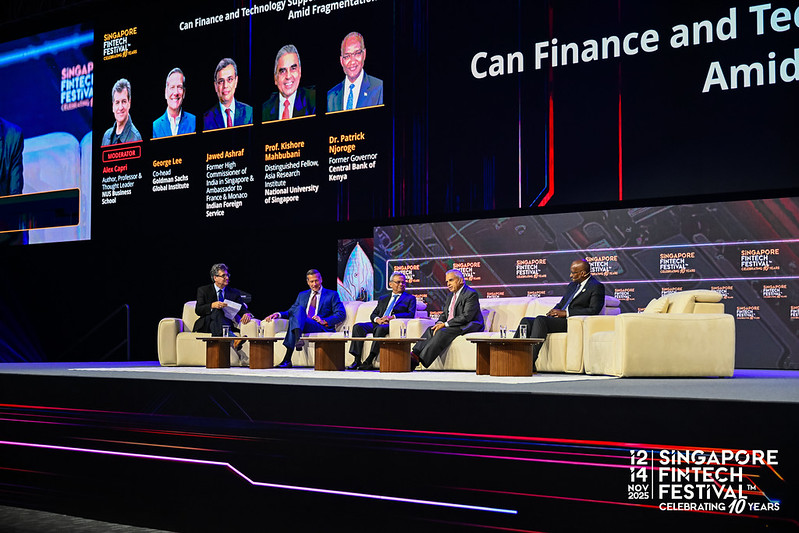
Photo credit: Singapore FinTech Festival
This theme was also echoed by another member of the same panel, Dr. Patrick Njoroge, former Governor of the Central Bank of Kenya, who described a “multidimensional world”, and emphasised the importance of greater collaboration between regulators and companies and across borders. “Regulation cannot be in a vacuum,” he said.
As a key example of this collaboration, it was also announced at the Singapore FinTech Festival that the Monetary Authority of Singapore (MAS) and the Financial Conduct Authority (FCA) of the United Kingdom would embark on a new strategic partnership on AI in finance.
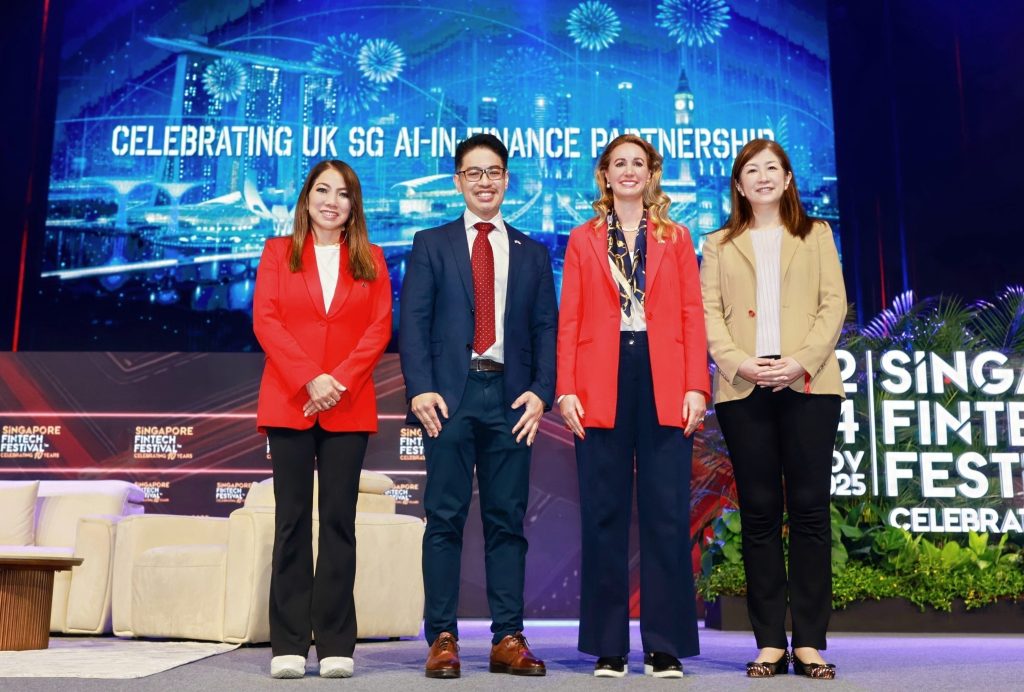
Photo credit: Monetary Authority of Singapore
Termed the UK-Singapore AI-in-Finance Partnership, it supports safe and responsible AI innovation in Singapore and the UK. Financial institutions in both countries will benefit from expanded opportunities for innovation and cross-border learning.
MAS and FCA will start this partnership by exploring joint testing of AI solutions, and the exchange of regulatory insights. The partnership will build on each country’s key AI industry programmes, MAS’ PathFin.ai and FCA’s AI Spotlight, to facilitate cross-sharing of quality solutions by participating firms.
Read Also: 10 Years Of The Singapore FinTech Festival: How It Became The World’s Largest FinTech Gathering


Street Smart
Singapore Gym Membership Price Guide (2026 Edition)


