


Amidst the global policy uncertainties this year, Singapore investment company Temasek remained focused on building a resilient and forward-looking portfolio. Last Wednesday, the company launched its annual Temasek Review 2025, reporting a record Net Portfolio Value of $434 billion.
For the first time in the history of the Temasek Review, the company has segmented its portfolio into three distinct parts – Singapore-based Temasek Portfolio Companies (TPCs), Global Direct Investments (GDIs), and Partnerships, Funds, and Asset Management Companies (PFAs).
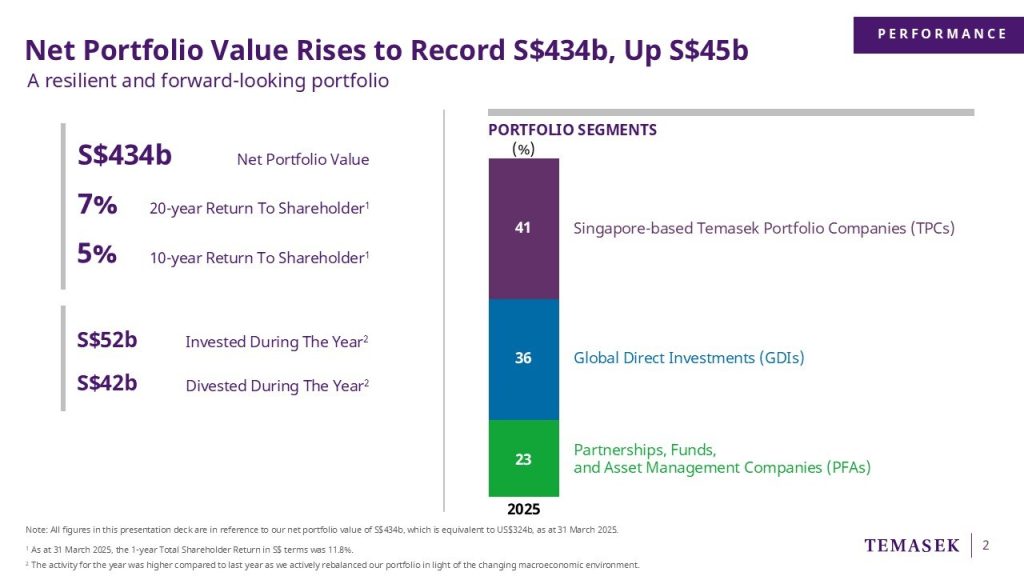
Temasek’s Three Portfolio Segments
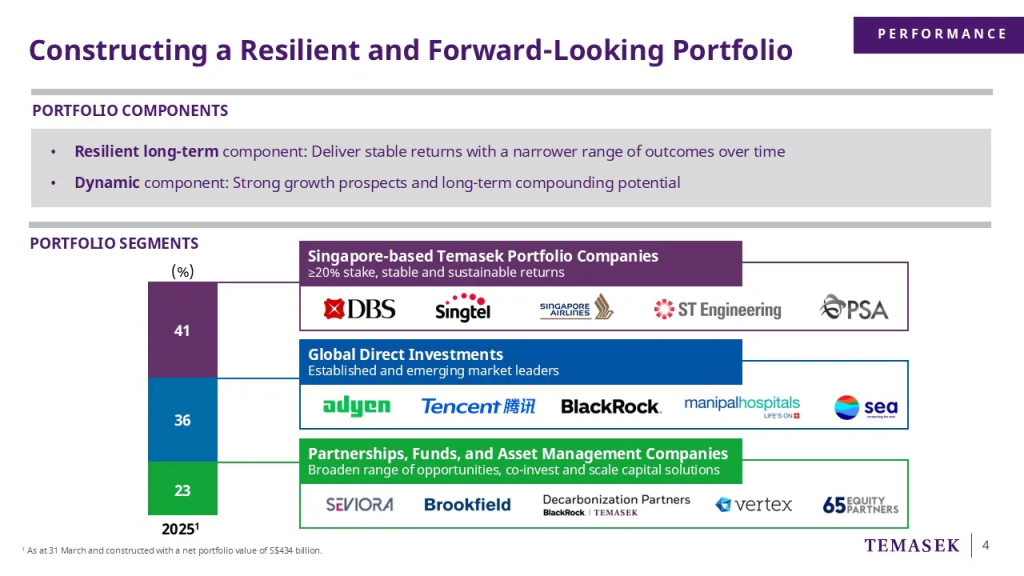
Temasek Portfolio Companies are long-term investments in Singapore-based companies. Temasek typically holds a minimum of 20% of the company’s shares. In this segment, you’ll find companies such as DBS, Singtel, Singapore Airlines, ST Engineering, and PSA. Some of these have been in Temasek’s portfolio since its establishment in 1974.
According to Temasek’s Deputy CEO Chia Song Hwee, “Following COVID, our portfolio has become more resilient compared to pre-COVID times because it was a period when our portfolio companies took very concrete steps to strengthen their business fundamentals, including the strength of their balance sheet and capital allocation, so that they could strengthen their core.”
Read Also: The OGs Of Temasek: 10 Companies That Have Been In Temasek’s Portfolio Since Inception
Global Direct Investments consists of equity investments in companies with the potential to be competitive market leaders. They are chosen by Temasek according to four structural trends – digitisation, sustainable living, future of consumption and longer lifespans. Companies include familiar names like Tencent and BlackRock, as well as Adyen, a Dutch payments company, Manipal Health Enterprises, which runs private hospitals across India, and VFS Global, a visa application and technology services company based in Dubai.
According to Temasek’s Chief Financial Officer Png Chin Yee, Temasek has been “much more focused on investing in companies with a strong cash flow, strong pricing power with resilient supply chains, and operating in one geoeconomic sphere of influence. We invest in companies that have access to big domestic markets and can be more insulated to tariffs or whatever else that is going on in the world. We build more resilience in the portfolio for long-term returns, rather than year-on-year returns.”
Read Also: Why Is Temasek Focused On Building A Resilient Portfolio For The Long Term?
The final segment – Partnerships, Funds, and Asset Management Companies allows Temasek to diversify its portfolio beyond traditional equities by providing private credit and hybrid solutions, investing in private equity funds, and uncorrelated strategies. For example, Temasek revealed that it has invested in hedge fund Citadel, reinsurance platform Prismic Life, and even Swedish company Pophouse Entertainment, which owns the music rights to KISS, Cyndi Lauper, Avicii and Swedish House Mafia’s catalogues.

Segmenting the portfolio this way provides a new framework to appreciate Temasek’s focus on resiliency, one of the key pillars of its long-term strategy. This strategy combines local and global long-term investments with stable and sustainable returns, with more dynamic, forward-looking opportunities, with strong growth prospects and the potential for long-term compounding.
How Temasek Has Pivoted Its Portfolio Over The Past 20 Years
Using this new framework also gives us a retrospective view of how Temasek has evolved steadily since 2004, when the Temasek Review was first made publicly available.
Back then, Temasek was also dealing with the aftermath of a difficult five years, from the aftermath of the Asian financial crisis of 1997, through the effects of the 9/11 attacks in 2001 and the SARS outbreak in 2003. Nonetheless, recognising new opportunities in China, India and ASEAN, Temasek took its first steps towards being a global investor, steadily increasing its exposure to Asia and the rest of the world.
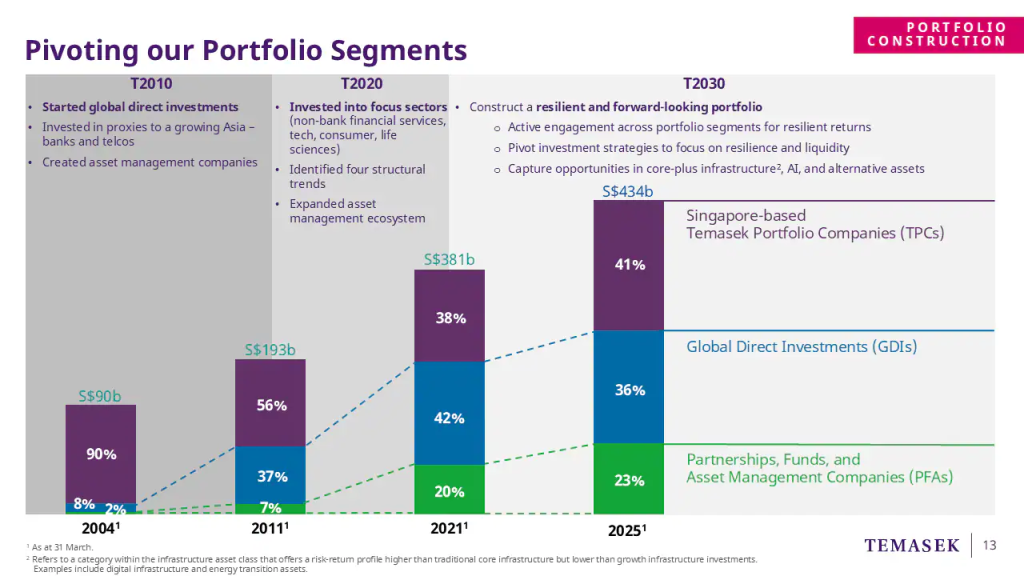
Over the next decade, Temasek would expand further afield into developed markets such as North America and Europe. It would also expand the asset management ecosystem via the creation of Fullerton Fund Management, Azalea Asset Management, and many others.
By 2021, the three segments of Temasek’s portfolio were beginning to look similar to what it looks like today. However, when asked if this was the ideal portfolio split going forward, Temasek’s Deputy CEO Chia Song Hwee noted that “there is no ideal split. Based on portfolio construction, we think the rough split would be 40/40/20, plus or minus 5%.”
“We cannot predict the bottom-up investment opportunities. In some years, some segments may have more opportunities, and when it comes to divestments, other sectors may have more. We do not think of it as a rigid percentage but as a range.”
Read Also: How Temasek Navigates Risk As A Long-Term Investor


Street Smart
Singapore Gym Membership Price Guide (2026 Edition)


