
In Singapore’s property market, freehold homes have long enjoyed a premium status, prized for their lasting value. Yet, in reality, freehold land is becoming increasingly scarce — most new plots released by the government today come with a 99-year lease.
Despite this rarity, many industry voices argue that that homebuyers do not need to worry about the freehold vs leasehold debate. The narrative is that, if you are looking to sell within 5 to 10 years, the difference between freehold and leasehold may not significantly affect resale gains. In fact, many argue that leasehold properties may fetch higher gains in this time frame.
This works to prop up leasehold property prices, and raises an important question: how much less should a leasehold property be selling for compared to a freehold property?
We compare a few freehold properties and leasehold properties that are near one another to understand the premium that freehold properties command.
Read Also: How Much You Need To Earn To Afford These Homes In Singapore [2025 Edition]
Freehold VS Leasehold In Orchard Road / Dhoby Ghaut
Tucked just behind the bustling Orchard and Dhoby Ghaut area, Mount Sophia is a small but distinctive hilltop residential enclave that offers a mix of serene greenery and city-centre convenience. The area has transformed over the past two decades into a sought-after condominium cluster, with a blend of boutique freehold apartments and larger leasehold projects.
We look at Parc Sophia, a freehold condominium, and 8 @ Mount Sophia, a leasehold condominium. We can also see that 8 @ Mount Sophia is not only a larger development, but also has a greater variety of unit sizes, while Parc Sophia mostly comprise smaller units – mostly 1- and 2-bedders. At the same time, Parc Sophia is a slightly newer development.
| Parc Sophia | 8 @ Mount Sophia | |
| Tenure | Freehold | 103-year leasehold |
| Completion Year | 2013 | 2007 |
| Total Units | 152 | 313 |
Source: PropertyGuru
Looking at the resale prices in recent months, we see that the price difference between the two condominiums aren’t so great.
In Parc Sophia, there were two units sold in July and June 2025 – and the PSF was between $1,782 to $1,828.

Source: URA
Over in 8 @ Mount Sophia, there were also two units that sold in July and June 2025 – and the PSF was between $1,486 to $1,684.

Source: URA
While the freehold unit at Parc Sophia does command a higher PSF, we can see that the unit at 8 @ Mount Sophia was less than 8% cheaper at $1,684 PSF.
Freehold VS Leasehold In Bukit Timah
Stretching from the city’s edge to the foothills of the Central Catchment Nature Reserve, Bukit Timah is one of Singapore’s most established and prestigious residential districts. Known for its tree-lined avenues, low-rise landscape, and proximity to top schools, the area has long been favoured by affluent families seeking both exclusivity and space.
While Bukit Timah is historically a freehold enclave, the arrival of newer, well-located and high-quality leasehold projects is testing how much that gap still matters.
We look at D’Leedon and Leedon Residences. In this case, Leedon Residences, while being home to 381 units is about 5 times smaller than D’Leedon – which houses 1,715 units.
| Leedon Residences | D’Leedon | |
| Tenure | Freehold | 99-year leasehold |
| Completion Year | 2015 | 2014 |
| Total Units | 381 | 1,715 |
Source: PropertyGuru
In the freehold Leedon Residence project, we can see that the PSF were between the $2,777 to $2,815. We can disregard the units that sold for about $16 million as they may have lower PSF.
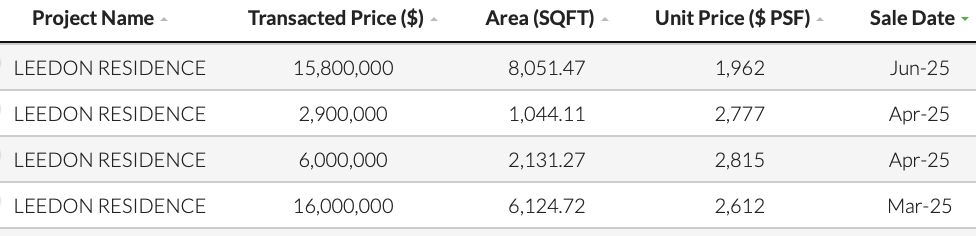
Source: URA
In D’Leedon, we took projects from further back, as the Leedon Residence units we are comparing against were sold in April 2025. Based on this, prices did not seem to shift that much in the past 6 months.
For units that were about 2,000 sqft, the PSF in D’Leedon was between $2,059 to $2,105.
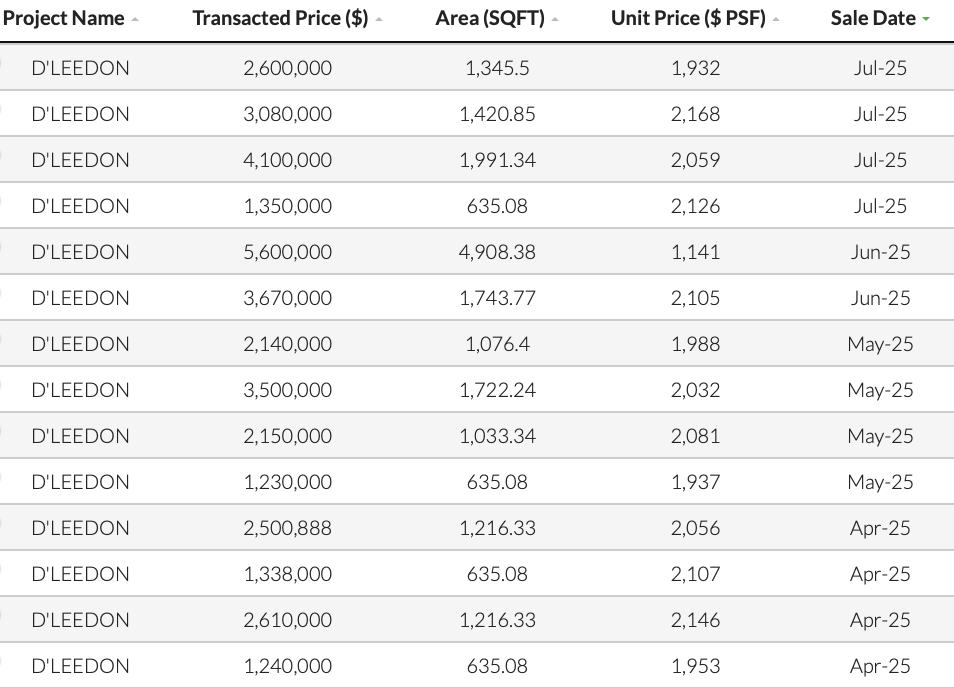
Source: URA
Comparing the two projects, we can see that many more units were sold in leasehold project at D’Leedon. While transactions were more limited at freehold Leedon Residence. This is also likely because D’Leedon has more variety of unit sizes.
Comparing the PSF for units that were about 2,000 sqft, we can see that the premium paid in Leedon Residences was about 25%. This is much bigger than the difference between the earlier projects we looked at in Mount Sophia.
Read Also: A History Of Property Cooling Measures In Singapore Over The Years
Look At The Price Difference Between Freehold VS Leasehold Projects In Different Estates
While you may have a preferred location that you want to live in, it’s worthwhile considering the price difference between leasehold and freehold projects in the vicinity as well. This can give you a good sense of whether you can consider the freehold project instead of the leasehold.
As you can see in the simplistic comparisons we made above, there is no fixed rule for how much more a freehold property should be worth compared to a leasehold one. In some estates, the gap can be surprisingly narrow, while in others, the premium remains substantial – often influenced by factors such as location, whether it is a freehold or leasehold enclave, property age, and surrounding redevelopment potential.
It may therefore be worthwhile for buyers to compare the actual price difference between freehold and leasehold properties in specific neighbourhoods, rather than relying on broad market assumptions. Or, simply thinking that there is no difference between freehold and leasehold if they intend to sell in the next 5 to 10 years.
Homebuyers can also compare between different estates. If location does not make or break a property deal for you, owning a freehold estate in a different location may serve you better than owning a leasehold property in another estate.
While we never know for sure, if we were to look in the long term, it may be that the distinction become more pronounced. This is because the Government Land Sales (GLS) programme typically releases only 99-year leasehold plots.
This will only give market players greater incentive to downplay tenure differences – shaping buyer perceptions in a way that keeps leasehold properties just as desirable in the eyes of homebuyers.


Street Smart
Singapore Gym Membership Price Guide (2026 Edition)


