

This article was sponsored by OCBC Business Banking. All views expressed in this article are the independent opinion of DollarsAndSense.sg based on our research, and is purely for informational purposes and should not be relied upon as financial advice. DollarsAndSense.sg is not liable for any financial losses that may arise from any transactions and readers are encouraged to do their own due diligence. You can view our full editorial policy.
A recent Singapore Business Federation (SBF) survey found that more than half of all businesses in Singapore generate over 40% of their annual revenue from overseas.
Unsurprisingly, Malaysia is the top overseas market for Singapore businesses, with 6 in 10 companies having a presence there. The new Johor-Singapore Special Economic Zone (JS-SEZ) will only deepen this economic relationship and encourage other businesses who have not yet done so.
The survey also found that China was the 3rd largest existing market, while ASEAN nations such as Vietnam, Indonesia and Thailand were the top three markets that Singapore businesses plan to enter.
Given Singapore’s relatively small market size, strengthening overseas revenue will increase the appetite for further overseas expansion. This cycle is made even more lucrative as our regional neighbours offer lower costs – on top of a larger market with growing relevance on the global stage.
That’s why, Singapore businesses will increasingly find themselves making international money transfers and payments in foreign currencies. Moreover, the digital landscape has made overseas-based services, such as Amazon Web Services, Microsoft, Gmail, Hubspot, Mailchimp, Adobe and many others, more accessible – and they likely charge in foreign currencies as well.
Before we make international money transfers and payments in foreign currencies though, here are some things we need to first consider.
Read Also: Scale Up: Proven Tips For Growing Your Business Internationally
#1 The Exchange Rate On Your Overseas Transfers
One of the first things that come to mind when we make overseas transfers is the exchange rate. One way to check if we are getting a fair exchange rate is simply to compare against the “Google rate”.
For example, the “Google exchange rate” between Malaysian Ringgit is MYR1:S$0.3023.

Source: Google (Taken on 14 May 2025)
If our foreign currency transfer via our business bank account offers us a similar rate, we should be quite happy. For this article, we will be using the rates listed on our OCBC Business Banking app, because we use it as our primary business bank account.
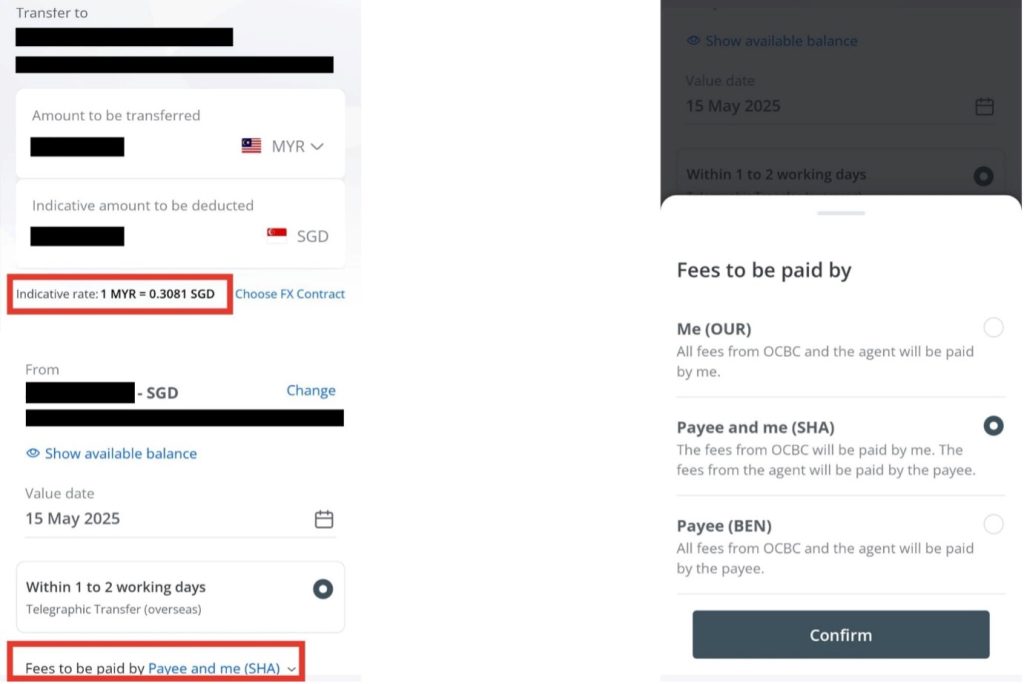
As we can see, the indicative exchange rate is MYR1:S$0.3081 – which is relatively close to the “Google rate”. It’s also an indicative rate, so, we should look out for the final rate that we receive.
Apart from just comparing against the “Google rate” at the time that we are making the transfer, businesses that need to make regular payments in foreign currencies can consider getting access to foreign currencies when they see a favourable rate. This is because currency fluctuations can impact the cost of transactions when we eventually make the transfer in the future.
For example, those who open an OCBC Business Growth Account, will also get free access to its OCBC Multi-currency Account. Companies looking to do business beyond South East Asia can consider the OCBC Multi-Currency Account, with access to trading 13 major currencies, including the Hong Kong Dollar (HKD), Offshore Chinese Yuan (CNH), the US Dollar (USD), Euro (EUR) and others.
Alternatively, we can also lock in FX contracts at live exchange rates to be paid up to two days in the future, so we do not suffer (or enjoy) from currency fluctuations – helping to manage the risk of currency fluctuations on our operational costs.

Example of an FX contract on the OCBC Business Bank app
Read Also: Tips to Manage Foreign Exchange (FX) effectively for SMEs
#2 Fees (And How Much Your Recipient Receives)
In the MYR transaction we made above, we indicated that we (i.e. DollarsAndSense) would be the ones incurring the charges. This means we will be paying $30 fee per transfer.
This is so our recipient will get the maximum amount that we intend to send, while there may also be a small charge by their receiving bank. Within the screenshot below, we can also see that there are options to share the costs or pass on the costs to the recipient in full.

| Unlock Seamless Cross-Border Transactions! To support your expanding business into Malaysia, take advantage of OCBC’s exclusive Johor-Singapore Special Economic Zone (JS-SEZ) promotion! Enjoy zero fees for Outward Telegraphic Transfers (OTT) between OCBC Singapore and OCBC Malaysia accounts until the end of 2025. |
Another option that we have is also to change the currency information. In this example, we are sending MYR. Our recipient will then receive MYR. If we are sending in other currencies, our recipient may or may not incur an exchange rate spread depending on whether they are able to accept the foreign currency in their bank account.
#3 How Long Your Overseas Transfer Will Take
Since we are using a Telegraphic Transfer, our recipient will receive the payment within 3 working days.
Obviously, if our recipient expects to get the money by 15 May 2025, we should not be making the transfer the day before, but 3 to 4 business days before (i.e. 7 May 2025).
Bank Account Information You Need When Making Foreign Currency Transfers
When we make an overseas transfer, like when we make local transfers, we will need the Payee Name (in full) and the Payee Account Number. In addition, we will need the SWIFT Code.
Depending on the type of overseas transfer we make, a regular Telegraphic Transfer (TT) or International Automated Clearing House (IACH) transfer, we will also need other information such as the Local Clearing Code, or the Payee Address.

Use A Trusted Business Bank Account As Your Partner For Overseas Money Transfers
We cannot avoid the fact that making overseas transfers is going to be an integral part of doing business. By considering factors such as exchange rates, fees, and transfer speed, we can not only save on business costs, but improve our financial efficiency.
Apart from this, navigating international payments will also require us to consider security and reliability of our overseas transfer service. On top of providing a cost-effective overseas transfer solution, a business bank account can also help us in other areas of our financial operations, including cash flow management, onboard business collection solutions, offer a Business Debit Card.
Partnering with the right business bank, like OCBC, offers significant advantages for growth. With a strong regional presence in Malaysia, Indonesia, and Greater China, OCBC supports companies expanding in Singapore and beyond. OCBC also caters to serial entrepreneurs with tailored cross-border solutions and funding support, along with financial solutions designed for various industries, including healthcare, retail, logistics, and food and beverage, ensuring businesses receive the specialized assistance they need.
Finally, businesses can gain even more support and advice when we work with a knowledgeable and responsive business banking partner. For instance, if there is uncertainty about how to effectively capitalise on opportunities within the new Johor-Singapore Special Economic Zone (JS-SEZ), OCBC offers valuable support. The bank has established a dedicated JS-SEZ Advisory Desk staffed by a team of 25 bankers located in both Singapore and Johor, ensuring that businesses receive expert guidance and assistance.
In summary, before we make international money transfers and payments, we should consider three key factors: exchange rates, fees, and transfer times. Understanding exchange rates ensures we secure a fair deal, while awareness of transfer fees maximises what our recipient receives. Knowing transfer durations is vital for managing cash flow and deadlines.
Partnering with a reliable bank like OCBC provides us with the tools to navigate international transactions effectively. By considering these factors, we enhance our financial efficiency and make informed decisions that support our global growth.
Read Also: What Businesses Need to Know About Cross-Border Payments


