
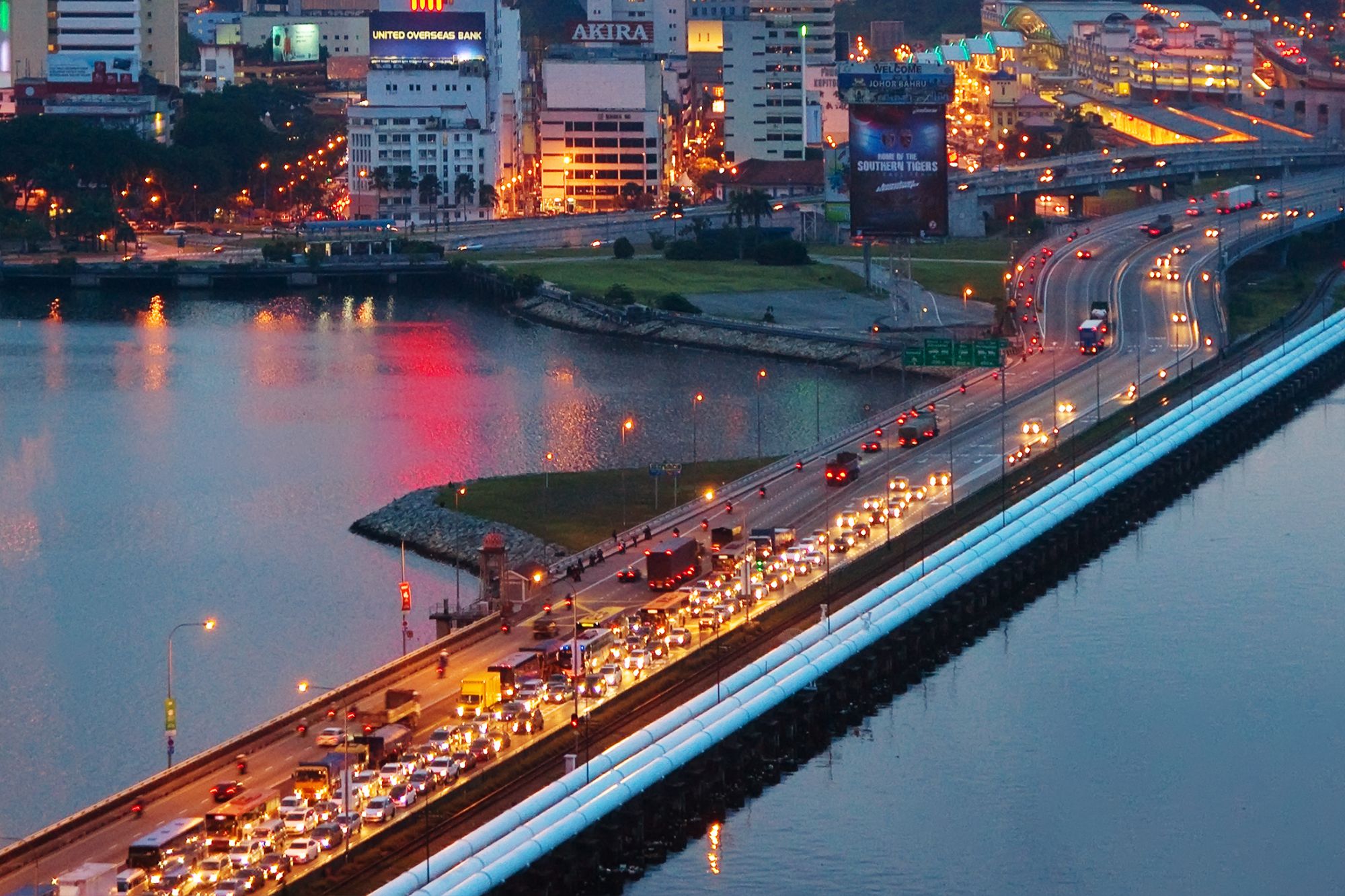
For many Singaporeans, crossing the border into Malaysia has become a regular getaway. Whether you want to enjoy lower-cost recreational activities and shopping in Johor Bahru’s malls, take fun-filled excursions to Legoland, soak up the sun at Desaru, or explore Kota Tinggi’s waterfalls or nearby hiking trails, the appeal of crossing into JB is undeniable.
This is backed up by numbers too. In June 2025, the Immigration and Checkpoint Authority (ICA) reported a record 578,000 daily crossings between Singapore and Johor – a figure that highlights just how deeply intertwined the two cities have become.
In the near future, travelling to Johor Bahru set to become even more convenient. In a joint statement by the Transport Ministry of both countries, on 5 December 2025, both Singapore-registered and Malaysian-registered taxis will soon be able to drop off passengers anywhere in the city. This has been one of the biggest bugbear in recent clampdowns on point-to-point vehicles.
Crossing Into Malaysia
The journey to JB is relatively straightforward. Besides driving up, you can also take public transport on the bus, train or taxi, as well as hire a private car.
Given the congestion and hassle of immigration queues, it’s no surprise that many travellers prefer the comfort of point-to-point, or “door-to-door,” private car services.
For families with children, this convenience is priceless: no need to shepherd kids through long queues or wrestle with luggage at checkpoints. Even for solo travellers or couples, avoiding public transport and immigration bottlenecks is worth every dollar.
The drive up can take as little as an hour, or at most two to three hours for slightly farther destinations, or if there are traffic jams at the Causeway or Second Link. Waiting in the comfort of a car is much more bearable than having to stand in line.
However, what many families may not know is that hiring a private car to cross into Malaysia may not always be legal.
Read the full article on the points below.
Read Also: Guide To Travelling From Singapore To JB Sentral Via The KTM Shuttle Tebrau
Why Door-to-Door Transport May Be Illegal Today (But Will Soon Be Legal)
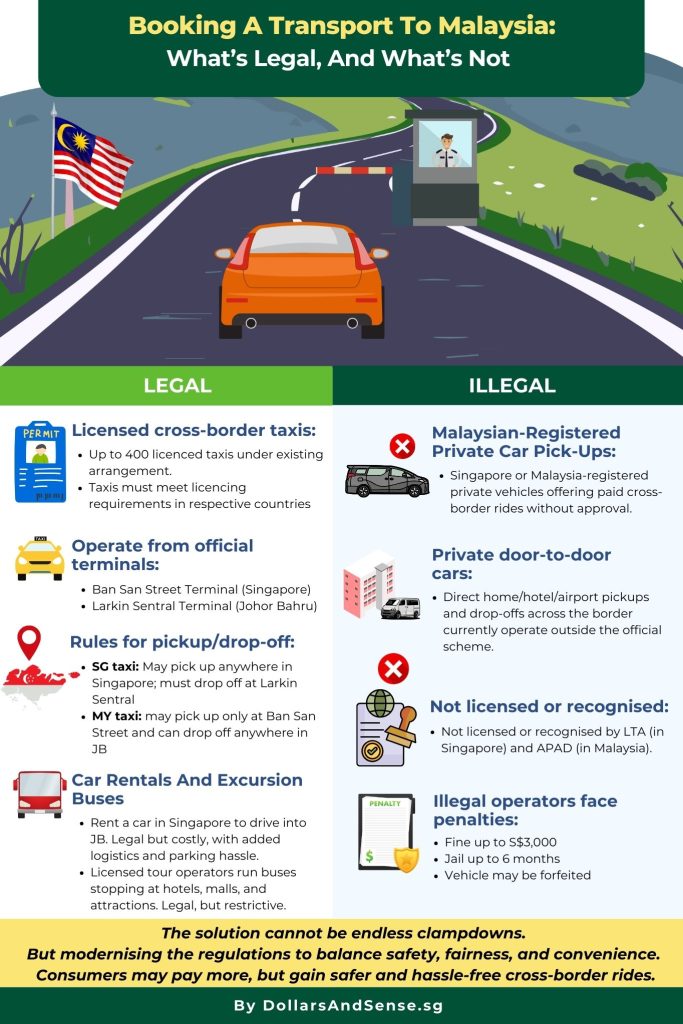
Under Singapore’s regulations, only licensed cross-border taxis are allowed to provide commercial rides between Singapore and Malaysia.
According to the LTA, Singapore-registered taxis and Malaysia-registered taxis are the only approved providers, under reciprocal agreements with Malaysia’s Land Public Transport Agency (APAD).
Malaysia-registered taxis must apply for both a Public Service Vehicle Licence (PSVL) and an ASEAN Public Service Vehicle Permit (PSVP) to provide this cross-border service in Singapore.
Singapore-registered taxis must meet Malaysia’s APAD’s requirements for permits.
What this also means is that private Malaysian-registered cars are not allowed to provide cross-border services.
Those who flout the rules face steep penalties. Under Section 101(1) of Singapore’s Road Traffic Act, offenders can be fined up to $3,000, jailed for up to six months, or both. Vehicles used in the offence may also be forfeited.
Recent clampdowns have seen dozens of drivers caught at the checkpoints, Changi Airport, and tourist hotspots, with their vehicles impounded.
As mentioned at the start of the article, both Singapore’s and Malaysia’s Transport Ministry is working towards a framework to allow licenced taxis from both countries to offer point-to-point services. This means the taxis can pick up and drop off passengers anywhere in the cities.
Some of the considerations in this new framework will include:
– foreign taxis still being limited to designated pick-up points. For example, Malaysian taxis will not be able to pick up passengers anywhere in Singapore, but only at designated pick-up points, and vice versa. For now, the only designated pick-up points are in Ban San Street in Singapore and Larkin Sentral Terminal in JB.
– licenced taxis will also need to have a vehicle plate with predefined prefix and topper. Malaysian-registered taxis will also be required to install Singapore’s ERP2 on-board unit for entry into Singapore.
– both countries are working towards improving insurance coverage of cross-border taxis, and speeding up claims processing in the event of an accident.
– both countries will gradually increase the quota for licensed cross-border taxis from the existing 200 from each country. The near-term quota is to increase this to 500 taxis from each country. At the start, 100 additional quota for licenced taxis will be prioritised for larger and more premium vehicles that can address the needs of larger groups and business travellers.
To be clear though, this framework is not yet in place, and more details will be announced in the future.
Safety, Fairness, And The Hidden Risks
The existing licensed taxis undergo rigorous checks: vehicles must pass frequent inspections to ensure safety, and drivers are subject to background checks and licensing requirements.
For now, there continue to be illegal operators offering point-to-point services that run outside these systems. This creates several risks for those making use of transport services, including insurance coverage uncertainty in an accident, being driven in a poorly maintained private vehicle, and potential lack of recourse when disputes arise. The new framework aims to work through these risks.
There’s also the fairness argument. Licensed taxi operators bear significant costs – licensing fees, insurance, membership charges, and vehicle inspections. Illegal drivers, often using privately owned Malaysian cars, can operate at a fraction of those costs. This puts licensed operators at a structural disadvantage.
Licensed Taxis Are The Legal Option
Under the cross-border taxi scheme, up to 400 taxis from Singapore and Malaysia, 200 on each side, can be licensed to pick up and drop off passengers. There are only about 300 such licenced taxis in Singapore and Malaysia today.
As mentioned, this scheme is currently being expanded to include up to 500 taxis from each country. At the start, 100 larger and more premium taxis will be prioritised, to address the needs of larger groups and business travellers.
Currently, cross-border taxis operate from two official terminals: the Ban San Street Terminal in Singapore (near Arab Street); and the Larkin Sentral Terminal in Johor Bahru.
Licensed Singapore taxis have the further option to pick up passengers anywhere in Singapore, but must drop them off at the designated point in Larkin Sentral.
Likewise, licensed Malaysian taxis can only pick up passengers at Ban San Street, but can drop passengers anywhere in Johor Bahru. They can also then pick passengers anywhere in JB but must drop them off at the Ban San Street Terminal in Singapore.
Also in the works are plans to allow foreign taxis to drop off passengers anywhere in the neighbouring city. However, they will continue to be restricted to designated pick-up points, to avoid a situation of foreign taxis providing local point-to-point services. There was no mention of expanding the number of designated pick-up points for foreign taxis in the latest announcement on 5 December, but it has been something raised in the past.
Fares are regulated too. A ride from Ban San Street to Larkin Sentral costs about $60 per taxi or $15 per passenger. You can arrange advance bookings or home pickups for a higher fare, ranging from $70–$80. Trips from Changi or Seletar airports can cost up to $120.
While the current system is legal and safe, it’s far from perfect – which is why the new framework is being mooted.
For families, the whole point of hiring a transport service to go into Malaysia is the convenience of having a door-to-door pick-up and drop-off. Being dropped off at Larkin and then having to transfer to another vehicle can be a logistical headache. Luggage, sleeping kids, and additional taxi rides all add to the hassle.
This is what makes the illegal door-to-door services far more attractive in practice. According to news sources, a two-way trip to JB can cost around $250. Although, it also states that with the recent clampdowns, costs are rising too.
In the future, illegal services may not be as attractive as there will be licensed options that provide more safety and security for passengers.
Other Legal Door-To-Door Alternatives: Car Rentals And Excursion Buses
Aside from taxis, there are a few other legal transport options in the cross-border ecosystem:
Car rental: you can rent a car in Singapore to drive into JB. However, this option may be unnecessarily costly as you are incurring a Singapore rental rate. There are also additional logistical burden and costs of picking up the vehicle and dropping off. You also have to think about parking for the car while in JB.
Read Also: 5 Singapore Car Rental Services And How Much It Costs To Drive Into Malaysia
Excursion Buses: There are tour operators run cross-border buses that stop at hotels, shopping malls, and attractions in Malaysia. These are licensed and regulated, and can provide a door-to-door feel if booked as part of a package. However, schedules can be less flexible than private transport.
There have also been news reports of some excursion buses providing express services, and thus operating more like point-to-point vehicles. This again goes against what is regulated.
The Demand Is There, But The Inefficiencies Exist
The truth is, illegal door-to-door services thrive because the licensed model feels outdated. Just as Uber and Grab disrupted the inefficient taxi industry in Singapore a decade ago, today’s door-to-door cross-border services are filling a glaring gap in consumer demand.
The authorities have acknowledged this with the new framework being worked out.
With the new framework, regulations are finally catching up with the demand for door-to-door transport services. While consumers may eventually end up paying more, they will also gain safer, regulated, and more convenient ways to get from their doorstep in Singapore to their destination in Malaysia.
Advertiser Message
Thinking Of Switching Brokers Or Consolidating Your Holdings?
Tiger Brokers is currently running a transfer-in campaign where eligible clients can receive an iPhone 17 Pro Max* when they transfer in their assets.
For SGX investors, there is also a CDP Transfer promotion with 0* commissions on Singapore stocks.
Find out more here. *T&Cs apply.




Budgeting 101
7 Ways Being Frugal Is Different From Being Cheap


Street Smart
Singapore Gym Membership Price Guide (2026 Edition)


Street Smart
Singapore Gym Membership Price Guide (2026 Edition)


