
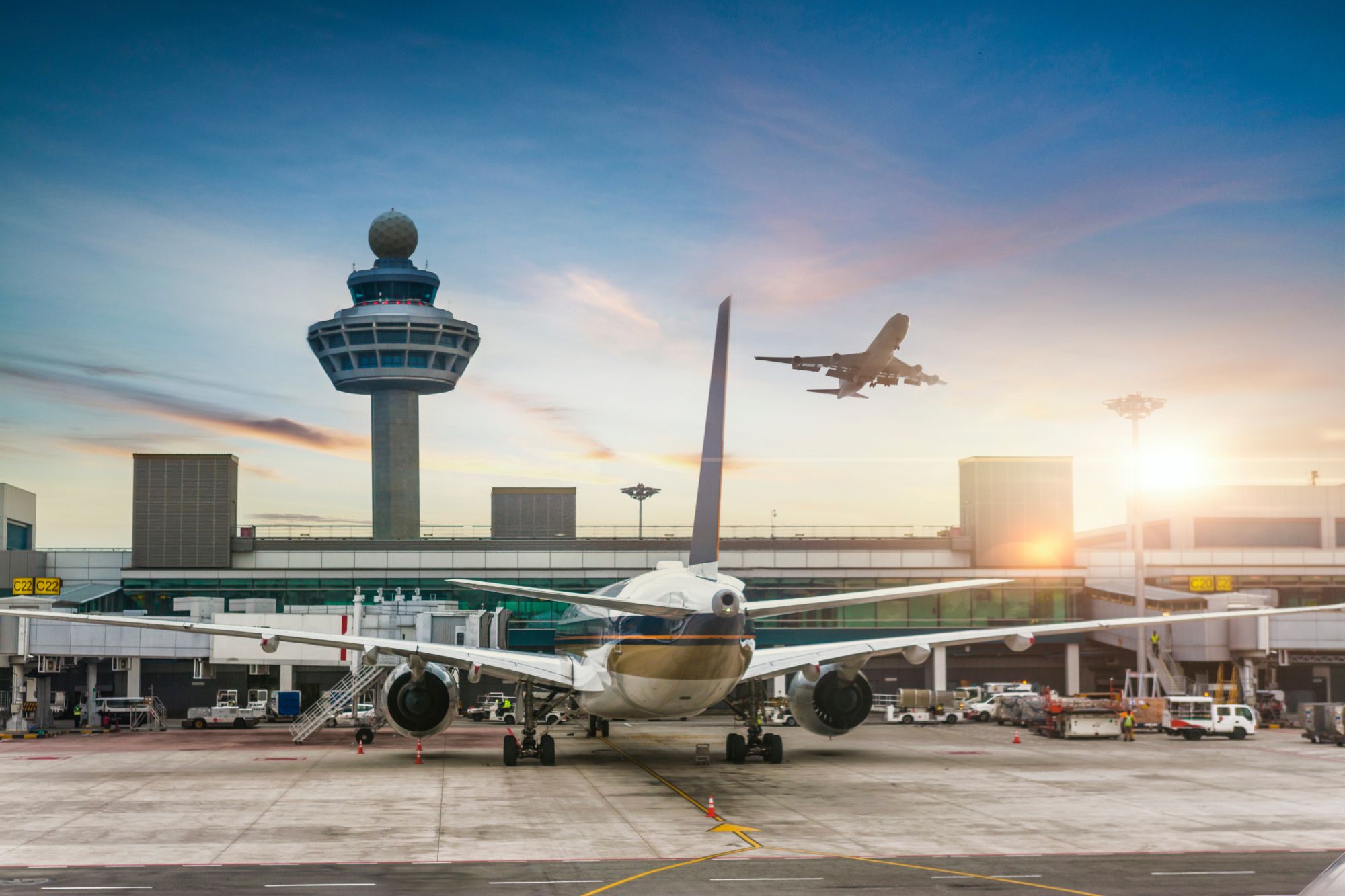
You might believe that when you buy a plane ticket, the fare you pay goes to the airline – covering the cost of getting you from one place to another, plus profits for the airlines. Yet, there is a litany of third-party fees that can make flying a pricey pursuit.
To be fair, this isn’t confined to just Singapore and it’s a global phenomenon. You pay a labyrinth of fees, charges, and levies whenever you fly. That basic fare is just the tip of the iceberg.
Governments, airport authorities, regulators, service providers, and the airlines each take a cut. In Singapore, a few of those layers are transparent: landing charges, parking fees, aerobridge fees, and security fees, to name just a few.
Let’s walk through the various costs behind the price you for the airfare – and who is passing the cost to whom.
Read Also: When Is The Worst Time To Book Plane Tickets For Your Year-End Holiday?
#1 Landing Charges And Parking Fees
Every aircraft that lands in Singapore carries a cost and these are the biggest costs. Landing charges are what airlines pay to use the runway and associated infrastructure.
Those fees are set by the airport authority or regulator in the country, and airlines often pass them on to passengers by building them into the airfare. While some airlines slap on “airport charges” to the fare, others simply display a final price.
Once on the ground, planes need a place to park. In busy hubs like Singapore, parking fees (for time on stands or at gates) can add up, especially if the turn time is long.
For example, at Changi Airport (as of November 2024), a landing, parking and aerobridge charge of $1,200 is imposed on narrow-body jets and $3,600 is charged on wide-body jets.
Every minute a plane occupies a bay or stand without moving is a resource cost, whether in lost opportunity or direct charge by the airport. This cost, which is initially borne by the airline, is reflected ultimately in the fare you pay.
#2 Passenger Service & Security Fees
In Singapore, the Passenger Service and Security Fee (PSSF) is another key component of what you pay for your plane ticket. This fee helps the airport authorities – Changi Airport Group (CAG) in this case – maintain and enhance airport infrastructure, and to fund security operations.
For flights originating from or passing through Singapore, PSSF is already baked into the ticket price you pay. As of April 2025, departing passengers pay $46.40 while transit and transfer passengers pay $6 as part of their ticket.
For departing passengers, from 1 April 2027, this will increase by $3 annually for four years (until 2031). This fee will be S$58.40 by the final increase.
What you may not see is how that fee is redistributed: part goes to maintain terminal facilities, part to security screening, part to upkeep, enhancements, and administrative costs of the airport’s operations.
So, when you go through baggage screening, security, or walk through any of Changi’s terminals, part of what you paid is underwriting those costs.
#3 Extra Levies: Aviation Levy And Airport Development Levy
In many countries, governments impose levies that are collected via air ticket prices. Singapore is no exception. An Aviation Levy (AL) is charged on tickets departing Singapore. Currently, the AL is $8 per originating passenger but this will increase to $10 from 1 April 2027.
That money goes to the Civil Aviation Authority of Singapore (CAAS) to support regulatory, safety, oversight, innovation, and sustainability tasks in aviation. It’s not a runway cost per se, but a government-level charge to support the broader aviation ecosystem.
Then there’s the Airport Development Levy (ADL), payable on every air ticket that includes a chargeable flight in Singapore.
This levy helps fund capital investments in future airport infrastructure, such as expansions (for example, the Changi East developments). Airlines collect this ADL and remit it to the airport authority or government.
Your Airfare Does Not Just Comprise The Costs + Profits For The Airlines
Combine AL, ADL, and PSSF, and you already have a visible “tax stack” built into your airfare when departing Singapore. As of late 2024, the combined departure fee stack (PSSF + AL + ADL) came out to about $65 for originating passengers.
A clear example of this is when you redeem a ticket with your KrisFlyer miles on Singapore Airlines, you still have to pay these taxes in cash and this is the visible $65 amount. This total tax is set to increase gradually to around $80 in 2027.
For the airlines, fuel is among the largest cost elements in operating any flight. Airlines may not always call them “fuel levies” per se but fuel surcharges are common. This is especially since costs may vary over time, and allows airlines to adjust accordingly.
When jet fuel prices rise, airlines often layer in a “fuel surcharge” on the fare. In addition, regulatory regimes sometimes impose a fuel levy or sustainable aviation fuel (SAF) levy to push greener adoption or tax carbon emissions.
Singapore is preparing for exactly this. From 2026, Singapore plans to impose an SAF levy on air tickets to help fund the uptake of sustainable aviation fuel.
The amount will vary by distance, so economy travellers on short-haul flights are set to pay an additional $3, for medium-haul $6, and for long-haul $16. This is to account for SAF costs.
So, when you see a fuel surcharge or, in future an SAF levy, you are footing part of the airline’s fuel risk and efforts to mitigate its carbon footprint.
Understanding What You’re Paying For In Your Airfare
At the end of the day, all you can do is just be aware. For Singapore-originating flights, know that PSSF, AL, and ADL are unavoidable components already embedded into the airfare. This is a global phenomenon, and landing and parking fees, as well as fuel surcharges, are things that you can’t escape as a passenger travelling through airports anywhere.
For reward bookings, always account for how much of your “savings” is eaten up by taxes and fees. While you might think it’s a “free” flight, that’s technically not true as you still have to pay the levies and airport fees.
Knowing where your airfare really goes doesn’t change the fact that travel is getting increasingly expensive but it does help you see the various costs involved in running an efficient airport like Changi.
Advertiser Message
Thinking Of Switching Brokers Or Consolidating Your Holdings?
Tiger Brokers is currently running a transfer-in campaign where eligible clients can receive an iPhone 17 Pro Max* when they transfer in their assets.
For SGX investors, there is also a CDP Transfer promotion with 0* commissions on Singapore stocks.
Find out more here. *T&Cs apply.



Lifestyle
15 Of The Cheapest EV Cars In Singapore


Budgeting 101
7 Ways Being Frugal Is Different From Being Cheap


Street Smart
Singapore Gym Membership Price Guide (2026 Edition)


Street Smart
Singapore Gym Membership Price Guide (2026 Edition)

Bonds and Fixed Income
Complete Guide To Buying Singapore Savings Bonds (SSB) [2026 Edition]


