In 2016, Singapore joined the worldwide Paris Agreement, with a key target of achieving net-zero carbon emissions by 2050. As part of this, they introduced a carbon tax in January 2019.
A carbon tax is a levy placed on the carbon content of fossil fuels such as coal, oil, and natural gas. This tax encourages businesses to reduce their greenhouse gas emissions, which contribute to climate change. According to the National Climate Change Secretariat (NCCS), around 70% of Singapore’s emissions come from 50 facilities in the manufacturing, power, waste and water sectors.
Read Also: Guide To Understanding Carbon Tax In Singapore
In Singapore, the carbon tax increased significantly in 2026. Since 1 January this year, it has gone up to $45 per tonne of carbon dioxide emitted (tCO2e). This is almost double the previous carbon tax of $25/tCO2e.
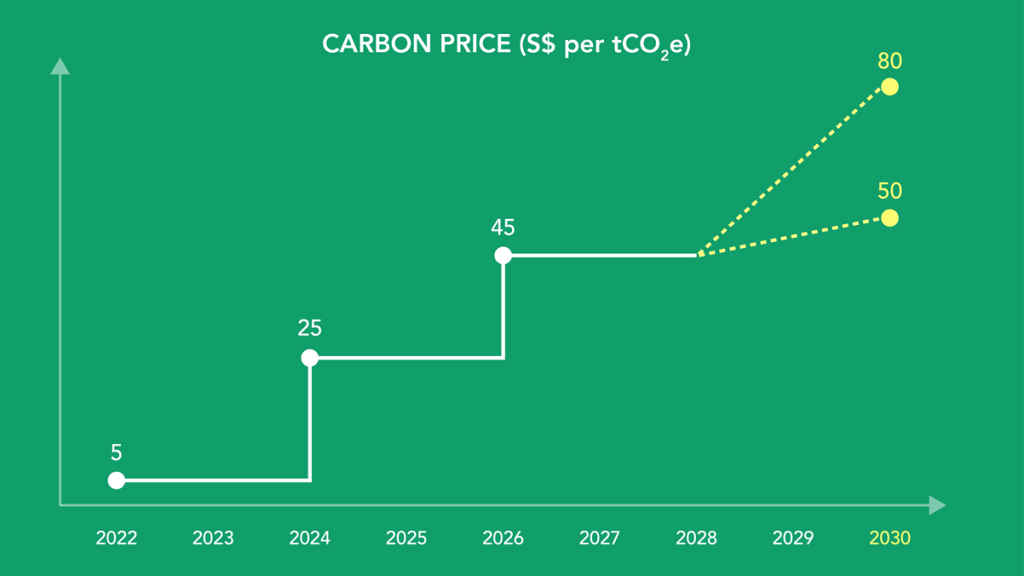
Source: NCCS
How Will The Carbon Tax Affect Household Utility Bills
While households are not directly affected by the carbon tax, the cost could be passed on to us indirectly by power companies who are paying the carbon tax. The National Climate Change Secretariat (NCCS) estimates that a $5/tCO2e increase in the carbon price could raise electricity tariffs by 1%. In 2024, this meant that the carbon tax increase to $25/tCO2e would translate into a $4 per month increase.
We observed this in 2024, when electricity tariffs increased from 28.7 cents per kilowatt-hour (kWh) in October 2023 to 29.89 cents/kWh in January 2024. This represented a 4.1% increase.
However, starting in October 2024, electricity tariffs began to fall steadily. Today they’re the lowest they’ve been since 2022, but still higher than when the carbon tax was introduced in 2019.
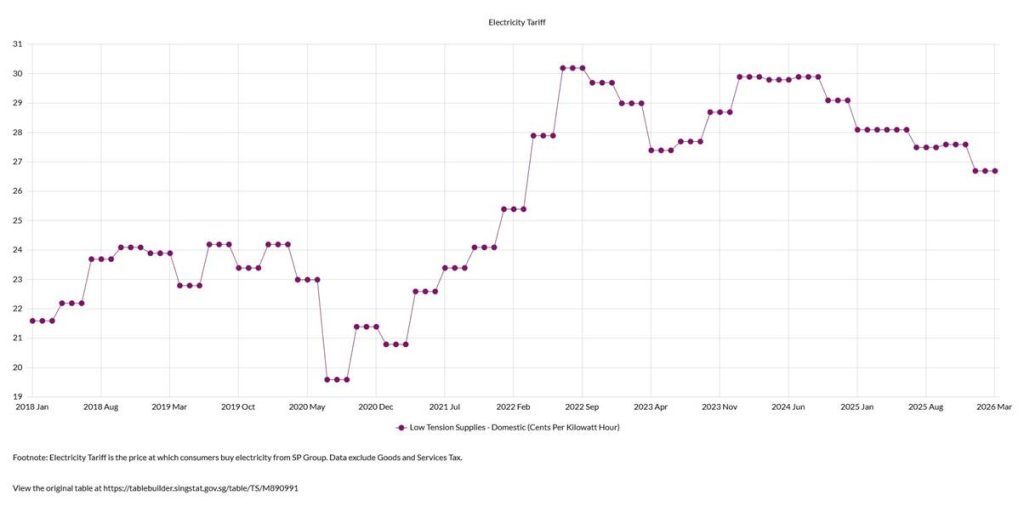
Source: SingStat with data from SP Group
This means that in 2026, while the carbon tax increase to $45/tCO2e could lead to an additional $4 monthly increase in electricity tariffs, other factors may help to keep them relatively low. The NCCS suggests that Singapore’s competitive electricity retail market discourages retailers from raising their electricity rates excessively.
Read Also: Complete Guide To Choosing The Best Open Electricity Market (OEM) Plan For Your Home
Nevertheless, the Energy Market Authority (EMA) will continue to ensure fair and efficient conduct of market players. Government agencies will also work closely with the Consumer Association of Singapore (CASE) and the Competition & Consumer Commission of Singapore to monitor the market for unfair pricing and coordinated price hikes, which are anti-competitive.
Monthly Electricity Consumption Has Also Decreased In 2025
Another piece of good news is that monthly electricity consumption is going down across the board, regardless of household size. According to the latest data from the Energy Market Authority (EMA), households consumed less electricity in 2025 than in previous years. This, coupled with the lower electricity tariff, means that utility bills would also have decreased in 2025.
Monthly Electricity Consumption (kWh)
| Type of Housing | 2023 | 2024 | 2025 |
| 1- and 2- room | 171 | 176 | 164 |
| 3-room | 269 | 276 | 259 |
| 4-room | 370 | 381 | 357 |
| 5-room and Executive | 451 | 464 | 435 |
| Private Apartments / Condominium | 515 | 522 | 480 |
| Landed Properties | 1175 | 1208 | 1137 |
Source: EMA
U-Save Rebates Have Risen Following The Carbon Tax Increase
For over a decade, U-Save rebates have been provided to help Singaporean households cope with the rising cost of living. Rebates are disbursed in quarterly tranches during each Financial Year (FY), starting in April and ending in January.
In 2023, to cushion the impact of the 2024 carbon tax increase, the government announced an additional $20 in quarterly rebates from January 2024 to December 2025. Further U-Save rebates were announced at Budget 2024 to help Singaporean HDB households “cope with increases in their utility bills”, which resulted in U-Save rebates of up to $950 for households from April 2024 to January 2025.
Total U-Save Rebates Disbursed Per Financial Year
| Type of Flat | FY2022 | FY2023 | FY2024 | FY2025 |
| 1- and 2- room | $760 | $780 | $950 | $760 |
| 3-room | $680 | $700 | $850 | $680 |
| 4-room | $600 | $620 | $750 | $600 |
| 5-room | $520 | $540 | $650 | $520 |
| Executive / Multi-Generation | $440 | $460 | $550 | $440 |
In Financial Year 2025, which ends with this month’s tranche of rebates, we went back to receiving the same rebate amounts as in Financial Year 2022. The upcoming Budget 2026 statement on February 12 should clarify whether we will receive additional rebates to mitigate the impact of the new 2026 carbon tax increase.
Advertiser Message
Thinking Of Switching Brokers Or Consolidating Your Holdings?
Tiger Brokers is currently running a transfer-in campaign where eligible clients can receive an iPhone 17 Pro Max* when they transfer in their assets.
For SGX investors, there is also a CDP Transfer promotion with 0* commissions on Singapore stocks.
Find out more here. *T&Cs apply.