
Since they were young, my kids, especially my oldest, have always been fascinated by money.
Not in the sense that they want lots of it so they can buy every toy they see, or go on holidays all the time. Neither is it in the anxious way that my parents (their grandparents) had to think about money growing up.
To them, money is simply an interesting concept.
My wife and I explain to them that we have to work at DollarsAndSense to earn money. That money is then used to pay for the things we buy as a family, such as food, gadgets, toys, our car, school-related expenses and family holidays.
It is a simple explanation. But for young children, this is often where financial education starts: understanding that money is not just something we use, but where it actually comes from.
Children Learn About Money Best When It Feels Real
One of my favourite money-related memories with my kids came from playing Monopoly a few years ago.
My oldest quickly realised that the trick to winning Monopoly is to buy all the properties as quickly as possible so you can collect rent from others.
Later on, it led to a conversation about why her grandfather (my dad) didn’t have to work. I explained to her that her “ye ye” no longer works because he collects income from his rental property, similar to the concept of Monopoly.
After hearing that, my child immediately said she wanted to be like that when she grew up, and I had to tell her, “No, you still have to work first.”
But that moment reminded me of something important. Children learn best when ideas are connected to real life. A simple board game like Monopoly can serve as a lesson in assets, rent, and financial independence without turning it into a formal lecture.
Money Is Not Just Something To Save Or Spend
As my kids grow older, they are starting to understand that money can be saved or spent.
But I also want them to experience something else: what it feels like to earn money.
This is an important lesson because most children first encounter money as something that is given to them. They receive allowance from parents, hongbao money from relatives, or the occasional treat from grandparents. While there is nothing wrong with that, it should not be the only way children experience money.
When a child has to think about what to sell, how much to price it at, how to speak to customers, and how to handle rejection when someone walks away without buying, money becomes much more real. They begin to understand that earning money requires effort, creativity and patience.
Entrepreneurship Isn’t Just About Starting A Business With An Award-Winning Idea
As an entrepreneur myself, I think entrepreneurship is one of the most useful experiences children can have. This is not because we need every child to grow up wanting to start a business. Nor is it to showcase their achievements on an ever-growing list of things they do.
Rather, entrepreneurship teaches many useful life skills that children may not always pick up from textbooks alone. They learn how to think of an idea, communicate with others and learn that not everyone will buy what they are selling. They learn how to deal with disappointment, adjust their approach, and try again.
Whether our children eventually become business owners or not, the ability to think independently, solve problems and communicate confidently will always matter.
Why We Are Letting Our Kids Take Part In The Singapore Kidpreneur Bazaar
That is why, when I first heard about the Singapore Kidpreneur Bazaar, I knew it was only a matter of time before my wife and I enrolled our kids in it.
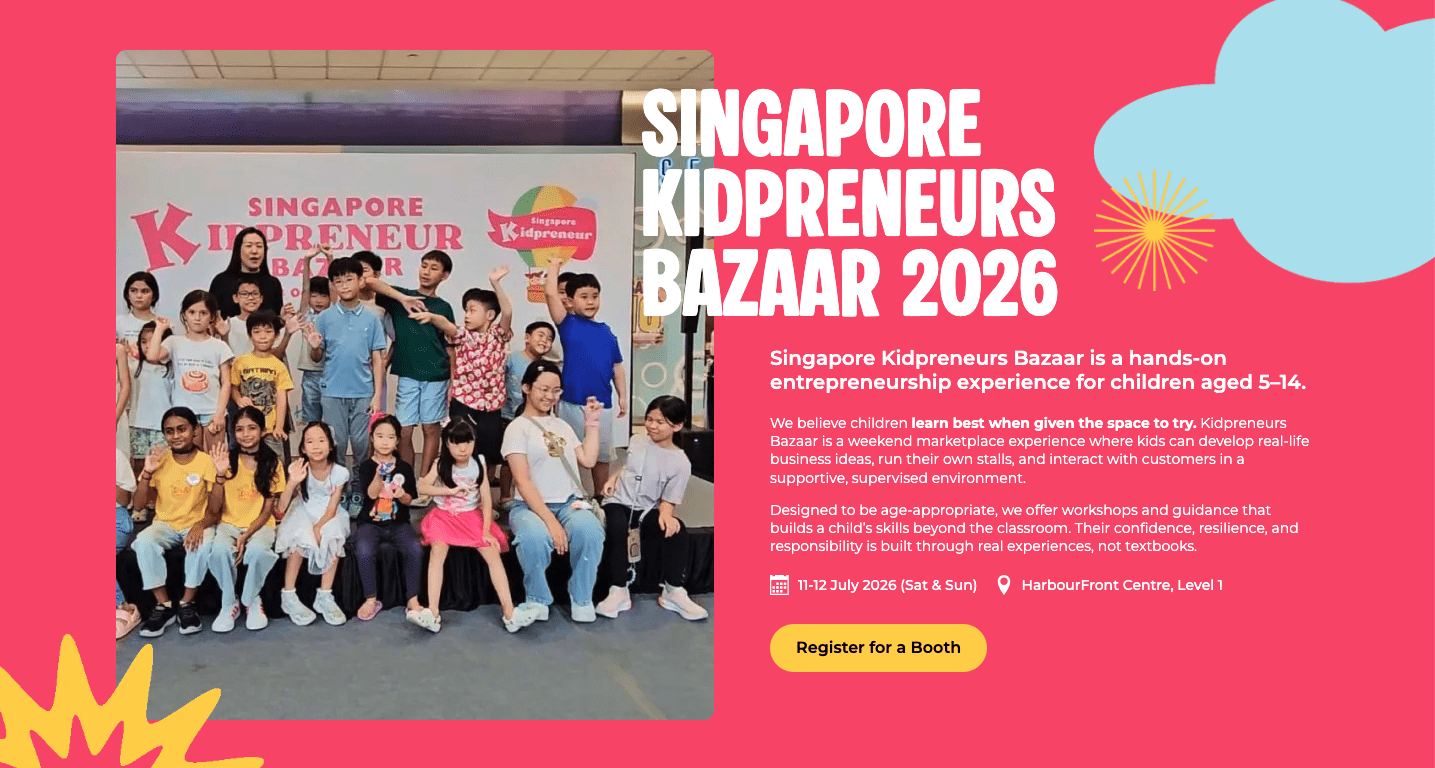
This year, I am glad to say that we will not only be enrolling our kids in it, but that DollarsAndSense is also helping to co-organise this two-day event at HarbourFront Centre from 11-12 July 2026.

At the very least, my oldest will be involved, with number 2 likely tagging along too.
Our aim is simple. We want them to think of an idea they are excited about, prepare for it and try their best. Even if they don’t make much to recuperate the cost of getting a booth, the experience of learning what it feels like to earn their own money, and how tiring and difficult it can be, will be a valuable lesson.

As parents, we often focus a lot on grades. And of course, school matters.
But I also hope my children grow up with curiosity, confidence and the courage to try things for themselves.
To me, that is what teaching entrepreneurship to children is really about. Not turning them into business owners at a young age, or making them into money-minded individuals who only care about earning money. But to help them recognise that the ideas they have, coupled with effort and the willingness to try, can lead them to achieve something very real, such as earning their own money.
Sign Up For The Singapore Kidpreneur Bazaar
If, like me, you are a parent of a child between the ages of 5 and 14, and want them to experience this too, the Singapore Kidpreneur Bazaar will be a live marketplace where children get to run their own small booths, interact with customers and experience what it means to run their own mini-business as an entrepreneur for the day.
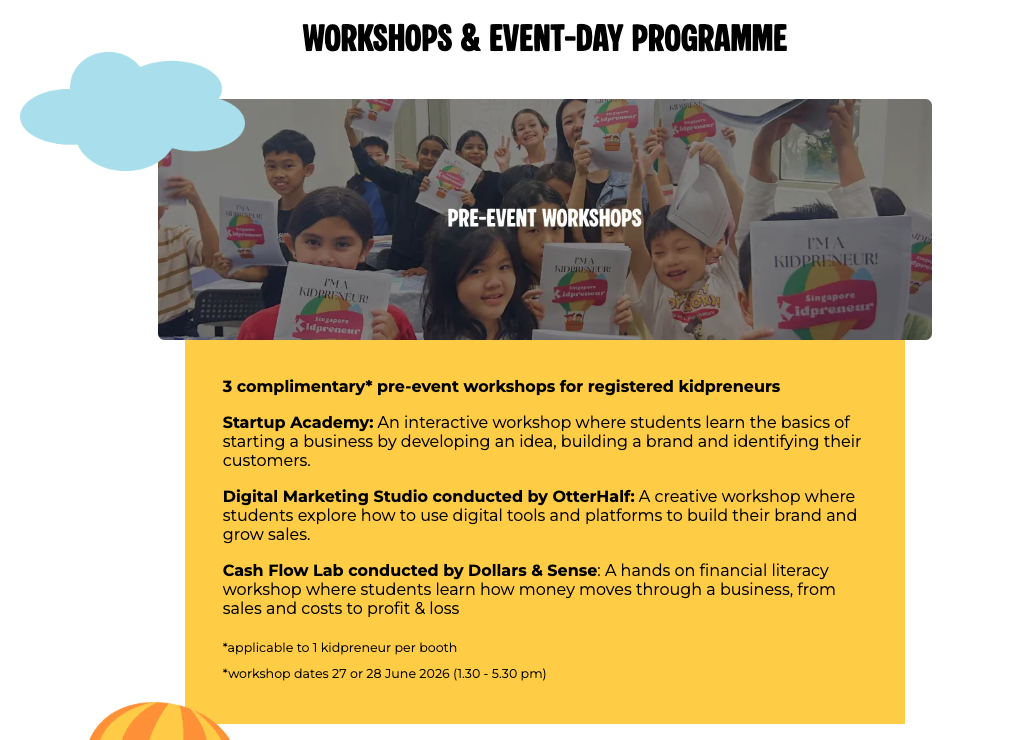
Each booth costs $325, or $275 if you sign up before 30 April 2026. This includes not just the booth space, but also three pre-event workshops designed to help children prepare for the bazaar:
Startup Academy, where they learn how to shape their business idea; Digital Marketing Workshop, where they learn how to promote it; and Cash Flow Workshop, where they learn how to manage money coming in and going out.
In other words, this is not just a one-day bazaar. It is a hands-on entrepreneurship journey where children get to learn, prepare, sell, and experience what it means to earn money through their own effort.
You can sign up here. Slots are limited, and registration will close once all available booths are taken.
Read Also: I Opened A Child’s Savings Account For My Daughter. Here’s Why We Decided To Do It “In Person”


Family Planning
Cost Guide To International School Fees In Singapore


