

China remains one of the world’s largest and most dynamic economies, yet many retail investors find it hard to access. Different share classes, listing locations, currencies, and market rules can quickly turn a simple idea like “I want China exposure”, into something confusing. This complexity is why China-focused exchange-traded funds (ETFs) are often discussed as a practical entry point.
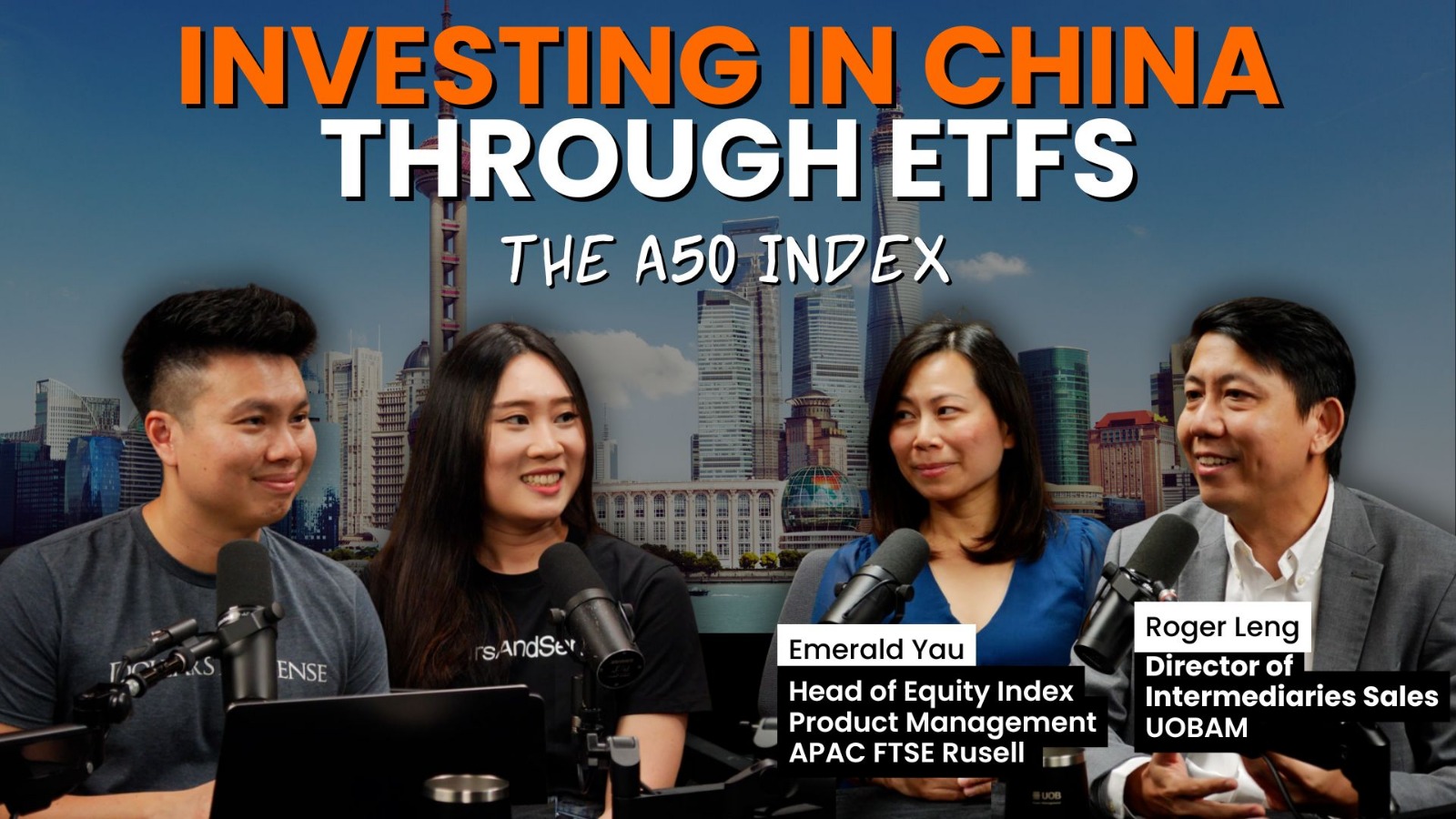
In this DollarsAndSense episode, Timothy and Feng Yi speak with Emerald Yau from FTSE Russell and Roger Leng from UOB Asset Management about how China ETFs work, what they actually track, and what investors should realistically expect.
Watch the full DollarsAndSense Podcast episode here:
China Exposure Includes Many markets, Not Just Mainland Shares
When investors talk about investing in China, they often think of companies listed on the Shanghai or Shenzhen stock exchanges. These are known as A-shares. However, China exposure goes well beyond this.
Chinese companies can also be listed in Hong Kong, Singapore, or the United States. As a result, “China equities” refers to a broad ecosystem rather than a single market. Understanding this helps explain why different China ETFs can behave very differently from one another.
One reason China investing feels intimidating is the variety of share types. These differences usually come down to three things: where the company is incorporated, where it is listed, and what currency it trades in.
For example, A-shares trade in renminbi (RMB) on mainland exchanges, while H-shares are listed in Hong Kong and trade in Hong Kong dollars. Other categories such as red chips, P-chips, S-chips, and N-shares add further layers.
The FTSE China A50 Focuses On China’s Largest A-share Companies
The FTSE China A50 Index tracks the 50 largest A-share companies listed in Shanghai and Shenzhen, using a free-float market-cap weighting. While 50 companies may sound small, these firms represent a significant share of the A-share market by value.
Although the index includes less than 1% of all listed A-share companies by number, it accounts for more than one-third of total market capitalisation, and roughly half of the large-cap segment. This makes it a concentrated but meaningful snapshot of China’s biggest players.
Buying and maintaining exposure to 50 stocks individually would be unrealistic for most investors. An index ETF simplifies this by handling stock selection, weighting, and periodic rebalancing on the investor’s behalf.
The goal of a China A50 ETF is not to outperform the market, but to replicate the index as closely as possible. For investors who want broad exposure without stock-picking, this structure removes much of the operational complexity.
Read Also: Understanding The Biggest Companies In China And How We Can Invest In Them
How Market-Capitalisation Weighting Influences Sector Exposure
Because the index is market-cap weighted, sectors dominated by large companies naturally carry more weight. At present, financials form a significant portion of the index, with technology also playing a major role.
However, the index is reviewed and rebalanced quarterly. As China’s economy evolves, sector weights and constituent companies can change. This ensures the index reflects what is large and investable at each point in time, rather than staying fixed.
The UOBAM FTSE China A50 Index ETF: A Core “Tasting Menu” Of China’s Market Leaders
The UOBAM FTSE China A50 Index ETF provides exposure to China’s largest companies as a core allocation, while allowing investors to complement it with individual stocks or thematic strategies if they choose.
China remains an emerging market, and higher volatility is part of that reality. Periods of strong performance can be followed by sharp corrections, which is why China exposure is often approached as a long-term allocation rather than a short-term trade.
As the UOBAM FTSE China A50 Index ETF is made up primarily of large-cap companies, it is generally viewed as a more measured way to access China equities. While some China ETFs may distribute dividends, they are not designed to be income-focused. Instead, China A-share ETFs are typically positioned as growth-oriented exposure within a diversified portfolio.
Watch on YouTube: DollarsAndSense Podcast Ep 42 | How You Can Start Investing In China Through ETFs?
Listen on Spotify: DollarsAndSense Podcast Ep 42 | How You Can Start Investing In China Through ETFs?


