

When Singaporeans talk about investing in local shares, the conversation almost always circles back to the big names in the Straits Times Index. The banks, the familiar blue chips and the dependable dividend payers.
That preference is understandable. Dividends are tax-free in Singapore, the companies are household names, and the STI feels safe because it reflects what has worked for decades.
But there is a catch. The STI largely represents what Singapore’s stock market has been, not necessarily what it might become over the next ten or twenty years.
That is where the iEdge Singapore Next 50 indices come in. Instead of focusing on today’s giants, they shine a spotlight on the layer just below them, the businesses that could plausibly grow into tomorrow’s market leaders.
What Exactly Is The iEdge Singapore Next 50?
The iEdge Singapore Next 50 is not a single index. It is actually a small family of indices that track the same 50 companies but rank their importance in slightly different ways.
A simple way to think about this is to think about football. The STI is the starting eleven. The Next 50 is the bench of strong substitutes. They are not unknown amateurs, but they are not yet the superstars either.
Read Also: SPDR STI ETF VS Nikko AM STI ETF: What’s The Difference Between The 2 STI ETFs Listed On SGX?
All the companies are listed on the Singapore Exchange’s Mainboard and sit just outside the top 30 stocks by market capitalisation. That means they are firmly in the mid-cap space, large enough to matter, liquid enough for institutions to invest in, but still early enough in their growth journey.
One version, the iEdge Singapore Next 50 Index, weights companies by free-float market capitalisation. Bigger companies have more influence on index performance.
The other version, the iEdge Singapore Next 50 Liquidity Weighted Index, places more emphasis on how actively a stock trades. Companies with higher trading activity carry more weight.
Both indices use transparent, rules-based criteria to remain representative of this segment of the market. Still, they offer slightly different lenses on what “importance” in the mid-cap tier means. Those lenses are either size or liquidity.
Why This Part Of The Market Matters
Historically, many of the strongest long-term stock returns came from companies that were once considered “next in line”, rather than those that were already dominant.
Large blue chips tend to offer stability and income. Growth, however, usually comes from businesses that are still expanding into new markets, refining their business models, or riding long-term structural trends such as artificial intelligence or regional consumption growth.
Singapore’s economy has been deliberately diversifying for years. Beyond banks and property developers, there is now meaningful exposure to logistics, healthcare, technology services, consumer brands, data centres, renewable energy, and regional infrastructure plays.
These themes often show up more clearly in the Next 50 universe than in the STI. For investors, this segment sits in a useful middle ground. It is generally less volatile than small caps, but offers more upside potential than mature dividend stocks.
If you already own local bank shares or an STI ETF, the Next 50 can also add genuine diversification, rather than simply doubling down on the same sectors.
A Very Different Sector Mix From The STI
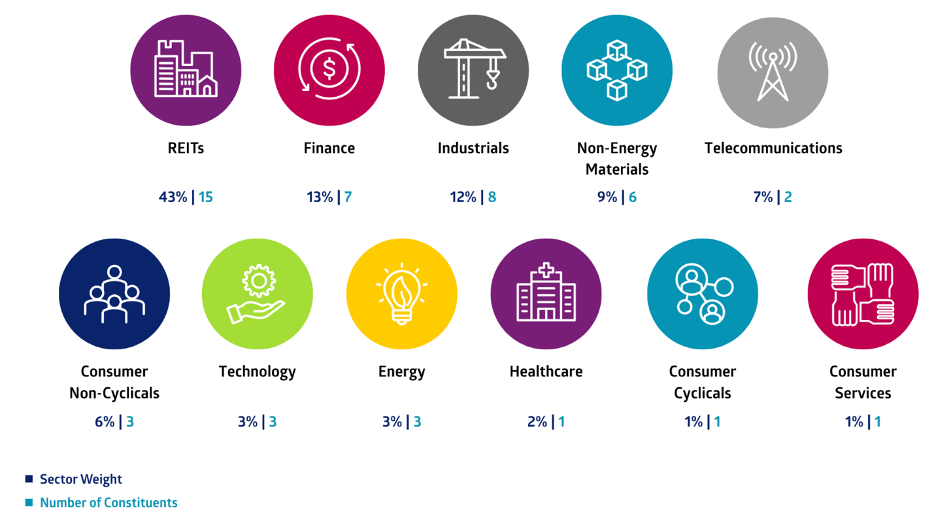
One of the most noticeable differences between the Next 50 indices and the STI is sector composition.
While financials dominate the STI, the Next 50 looks far more balanced. Industrials, consumer services, healthcare, technology-related firms, and REITs tend to take up a much larger share.
Source: SGX
This mix better reflects how Singapore’s listed ecosystem has evolved alongside regional growth, rather than relying purely on domestic banking and property cycles.
Many of these companies are also international in nature. They may be headquartered in Singapore, but generate a large portion of their revenue from Southeast Asia, China, or even further afield. That brings added opportunity and added risk, but it also means returns are not tied solely to Singapore’s domestic economy.
Tomorrow’s Potential Winners, Without Having To Guess
It is important to be clear about what the iEdge Singapore Next 50 is not. It is not a hand-picked list of guaranteed future champions. There is no promise that these companies will outperform, innovate, or become the next household names.
Some will succeed and grow into large caps. Others will stagnate, get acquired, or quietly fade away.
That uncertainty is exactly why an index approach makes sense. Instead of trying to pick the one company that will win, you gain exposure to the category of companies that historically tends to produce future leaders.
You are buying a basket of possibilities, not a single story. For most long-term investors, that is a more realistic way to access growth without taking on excessive stock-specific risk.
Read Also: How Much Dividends Do Stocks In The STI ETF Pay Out Each Year?
Photo Credit: DollarsAndSense/Raymond Quek


