

In a world increasingly dominated by artificial intelligence (AI) and automation, it may feel like the challenge is acquiring technical skills, like coding. The latest Singapore Digital Economy Report (SGDE), published by the Infocomm Media Development Authority (IMDA), showed that programming languages like Python and SQL were among the most highly sought-after tech skills in 2024. However, both employers and employees alike are increasingly recognising the importance of soft skills in today’s workplace. These include communication, critical thinking, attention to detail, and problem-solving.
A recent study conducted by the Singapore University of Social Sciences showed that both employers and younger employees believed in the importance of soft skills. The study, entitled Workplace Success and Soft Skills: Bridging the Gap Between Youths’ Perceptions and Employers’ Expectations, found a disconnect between what younger employees believe employers expect and what employers seek.
Employers Prioritise Soft Skills More Than Expected
The study reveals that employers are less concerned with technical know-how than with the human skills that make teams effective. Employers placed an even higher emphasis on soft skills than younger employees expected, with Gen Z workers, i.e. those aged 30 and below, having the largest gap between employer and employee.
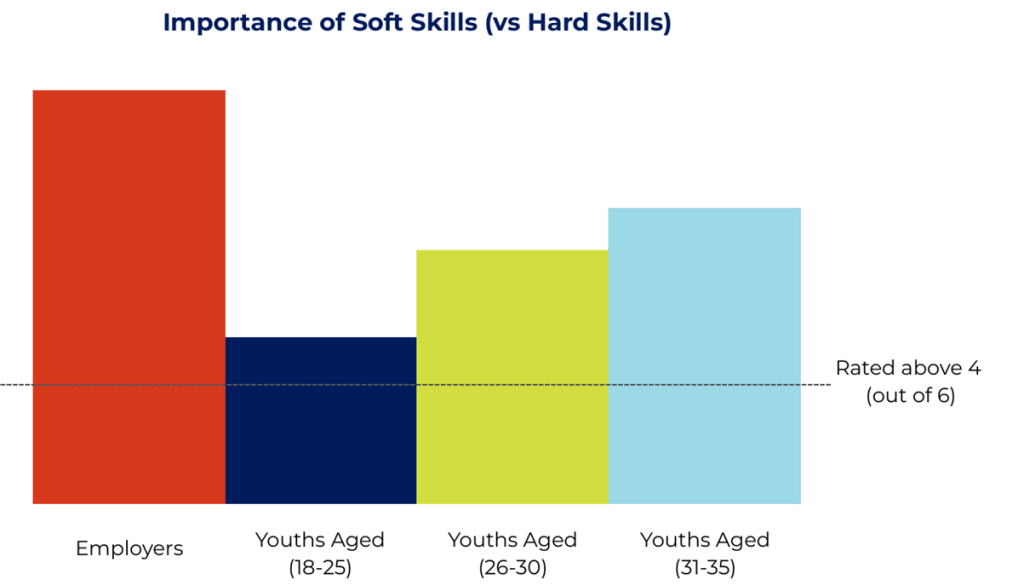
Source: SUSS
Soft skills, defined by the study as “personal attributes that enhance an individual’s interactions and their job performance”, aren’t abstract ideals. Skills like problem-solving, critical thinking, communication, and attention to detail are everyday capabilities that determine whether projects run smoothly and businesses adapt quickly.
The Soft Skills Employers Value Differs From Those Gen Z Employees Value
Yet, as Gen Z enters the workforce in greater numbers, it would appear these skills aren’t being developed at the level employers expect. Even as this generation demonstrates greater digital fluency and adaptability than before, this study shows gaps in what skills employers prioritise over what younger workers think are important.
When asked to rank four soft skills – problem solving, critical thinking, communication and attention to detail – there were clear disconnects between employers and younger workers, and even a small distinction between the youngest group of workers and their older counterparts.

Source: SUSS
Employers surveyed by the study prioritised problem-solving over critical thinking and communication. The younger workers, conversely, prioritised communication over critical thinking and problem-solving.
One possible reason for why younger workers aged 18 to 35 place the highest importance on communication is that they all see communication as their strongest skill. It is natural for one to assume that a skill you’re good at is important.
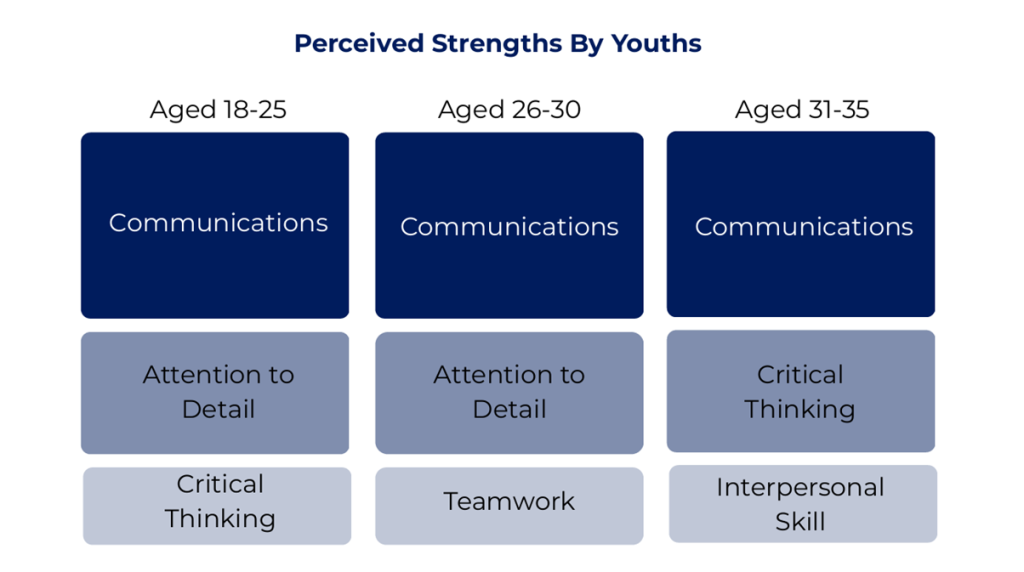
Source: SUSS
The disconnect between employers and young employees, therefore, stems from employers ranking problem-solving as the most important soft skill, while younger employees neither see it as important nor consider it a strength.
The Problem-Solving Problem
While the SUSS study doesn’t define any of the soft skills explicitly, SkillsFuture Singapore recognises it as one of 16 critical core skills (CCS) and defined it as the ability to “generate effective and efficient solutions to solve problems and capitalise on new opportunities”.
More specifically, it defines three levels of proficiency:
- Basic Problem-Solving: The ability to identify problems and implement guidelines and procedures to solve problems and test solutions
- Intermediate Problem-Solving: Determine underlying causes of problems and collaborate with other stakeholders to implement and evaluate solutions
- Advanced Problem-Solving: Anticipate potential problems to drive a culture of continuous improvement, which seeks to turn problems into opportunities across the organisation
To better align with what employers are looking for, Gen Z workers must recognise the gap between their perceptions and employer expectations. They must also take active steps to build their skills to meet the employer’s needs by acquiring and prioritising problem-solving skills before entering the workforce.
The SUSS study recognised that this is a shared responsibility. They called for policymakers and educational institutions to develop opportunities for soft skills integration, structured mentorships, and meaningful work opportunities that incorporate experiential learning into a student’s curriculum.
As for employers, they too should recognise the need to provide their younger workers with more focused development in problem-solving through in-house training and structured coaching.


