

This article was written in collaboration with SGX. All views expressed in this article are the independent opinion of DollarsAndSense.sg based on our research, are purely for informational purposes, and should not be relied upon as financial advice. DollarsAndSense.sg is not liable for any financial losses that may arise from any transactions, and readers are encouraged to do their own due diligence. You can view our full editorial policy here.
The past five years alone have delivered a steady stream of uncertainty for investors, from trade tensions between major economies to the Covid-19 pandemic, geopolitical conflicts and a sharp rise in global interest rates.
Through all of this, gold has quietly done what it has historically been known for. When markets become volatile and confidence in other assets starts to wobble, investors often turn to gold as a store of value, helping investors preserve and even grow their wealth during periods of uncertainty.
Why Do Investors Include Gold In Their Portfolios?
Unlike stocks, gold does not pay dividends, nor is it an income-generating asset. However, when markets experience sharp corrections or periods of uncertainty, gold has historically held up much better than many other assets. In some cases, it has even risen while equities were falling. This characteristic is precisely why investors often describe gold as a “safe haven”.
Recent history offers a few clear examples. During the sharp market sell-off in early 2020 at the start of the COVID-19 pandemic, global equities fell by about 21.1%. Over the same period, gold rose by roughly 5.4%. A similar pattern emerged in 2025 during Liberation Day. As stock prices declined by 5.1%, gold prices rose 11.8%.
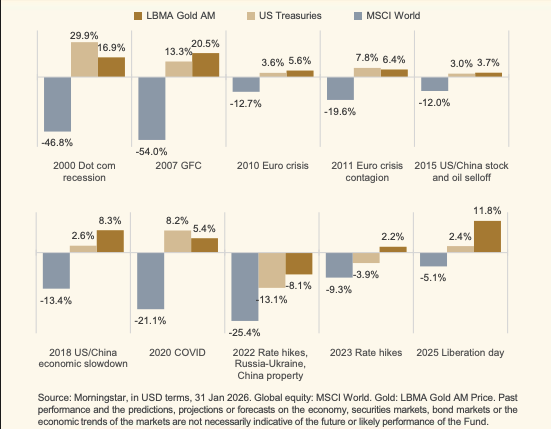
Source: Lion Global Investors, Morningstar as of 31 January 2026
This behaviour is what gives gold its reputation as a safe-haven asset. Because gold does not always move in the same direction as stocks, holding some exposure can help cushion a portfolio during periods of market stress.
Beyond short-term market swings, there is a lesser-known but important longer-term structural story supporting gold prices.
Over the past several years, central banks around the world have been steadily increasing their gold reserves. One key reason is the desire to diversify away from heavy reliance on US dollar-based assets (also known as De-dollarisation). As countries rethink how they store national reserves, gold has once again become an important part of the mix.
In fact, for the first time since 2000, gold now makes up a larger share of global central bank reserves than US Treasuries. This shift reflects more than just a temporary trend. It signals a broader change in how governments think about preserving value and managing financial risk over the long term.

Source: Lion Global Investors, Bloomberg as of 31 January 2026
Gold also plays an important role in long-term wealth preservation. Because it is not tied to any single economy or currency, gold has historically appreciated against numerous developed market and Asian currencies over time. When fiat currencies weaken due to inflation or economic uncertainty, gold has often acted as a hedge. This ability to hold value across different currencies helps explain why gold continues to be seen as a safe-haven asset for investors looking to preserve wealth over the long run.
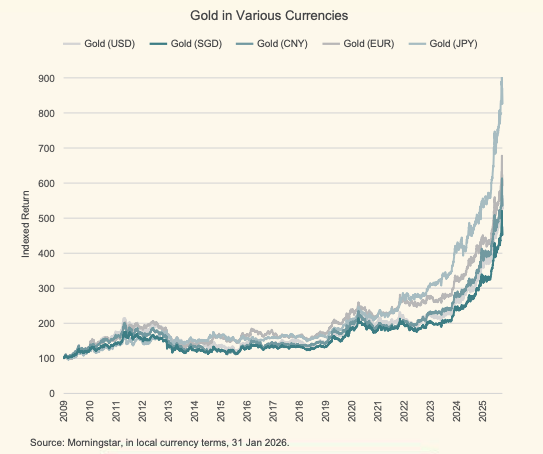
Source: Lion Global Investors, Morningstar as of 31 January 2026
The Different Ways To Own Gold
Once you have decided that you want some exposure to gold, the next question is how you wish to own it. While there are several ways you can own gold, each comes with its own pros and trade-offs.
One way is to buy physical gold directly. This means buying actual gold bars, coins or jewellery. While this gives you direct ownership of the metal itself, it also comes with practical challenges. You need to store it safely, possibly insure it, and selling it later may not be as simple as clicking a button and cashing out. You also pay bid-ask spreads as high as 20% for 1g gold bars compared to a gold ETF that only charges you 0.39% pa management fee.
Another route is by investing in gold mining companies that are listed on the exchange. Buying shares in gold producers gives you indirect exposure to gold price since these companies earn most of their revenue from extracting and selling gold. However, their share prices are influenced by more than just the price of the metal. Operational costs, management decisions and broader stock market sentiment can all affect performance.
There are also gold derivatives and futures, which allow investors to trade the gold price directly. These instruments are typically used by more sophisticated investors or traders who are speculating on short-term price movements.
Gold ETFs sit somewhere in between. They allow investors to gain exposure to gold through a listed, liquid instrument that can be bought and sold on an exchange just like a stock. The key distinction, however, lies in how the ETF tracks the gold price.
Some gold ETFs hold physical gold bars in custody on behalf of investors. Because the underlying asset is actual gold, the ETF’s price tends to track the gold price closely.
Others rely on derivatives such as futures contracts to replicate gold’s price movements. This structure can introduce counterparty risk and may lead to small tracking differences over time. For investors who want exposure that is backed by real gold rather than financial contracts, physically backed gold ETFs are often the preferred option.
How The LionGlobal Singapore Physical Gold ETF Works
For investors who simply want a straightforward way to gain exposure to physical gold, a new option is entering the market. The LionGlobal Singapore Physical Gold ETF, managed by Lion Global Investors, (asset management arm of OCBC Group and one of Southeast Asia’s leading asset managers), will list on the Singapore Exchange (SGX) on 26 March 2026.
The ETF provides investors with exposure to physical gold that is vaulted in Singapore and the ETF can be bought or sold through a regular brokerage account just like a stock. The ETF is backed by investment-grade gold bars with minimum 99.5% fineness and meets LBMA standards. This ensures the ETF is backed by high-quality physical gold that is widely recognised and accepted in global bullion markets.
One distinguishing feature of the ETF is where the gold is actually stored. It is the first gold ETF backed by physical gold that is fully insured and securely vaulted in Singapore.
If you are investing in a physical gold ETF, the location of where that gold is stored naturally matters. The vault location affects factors such as regulatory oversight, accessibility, counterparty confidence and, for some investors, even jurisdictional risk. For investors who value transparency and peace of mind, knowing that the gold is stored in a reputable and well-regulated jurisdiction can provide an additional layer of assurance.
Singapore is widely regarded as one of the most stable and trusted jurisdictions in the world. The country has strong rule of law, stable domestic politics and well-established international relationships. It is also largely insulated from natural disasters and, since gaining independence in 1965, Singapore has never imposed any form of gold confiscation. In contrast, many gold funds vault their gold in foreign markets that have seen history of gold confiscations.
Importantly, the gold is fully insured for its entire value against loss, theft and damage, both while in storage and during transit.
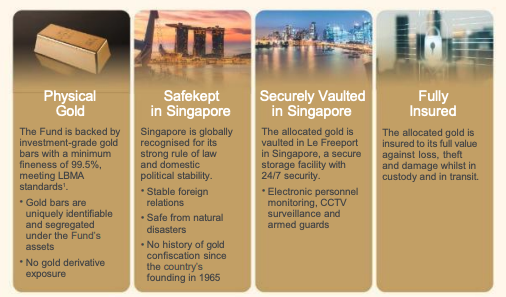
Source: Lion Global
The LionGlobal Singapore Physical Gold ETF will list on the Singapore Exchange on 26 March 2026. Before that, investors can participate in the initial offer period (IOP) from 6 to 20 March 2026 at an issue price of US$5 per unit. The ETF caps its total expense ratio (which includes management fee at 0.39% per year.
Once listed, the ETF will trade in both Singapore dollars (SGD) and US dollars (USD). Like all SGX-listed ETFs, the trading board lot is just one unit, which makes the investment highly accessible.
| Feature | Details |
| Benchmark | LBMA Gold Price AM. The ETF tracks the LBMA Gold Price AM, one of the most widely recognised global benchmarks for gold pricing. |
| Total Expense Ratio | 0.39% per year (39 basis points). This covers the management and operational costs (e.g. vaulting, insurance) associated with running the fund. |
| Trading Currency & Stock Codes | GLS – Singapore Dollar (SGD) counter GLU – US Dollar (USD) counter This dual-currency structure allows investors to trade the ETF in either SGD or USD on the Singapore Exchange. |
| Minimum Investment | 1 unit (after listing). Like other SGX-listed ETFs, the minimum investment after listing is just one share, making it accessible even for investors who want to start with a small allocation. During IOP, each Participating Dealer will set a minimum subscription quantity (e.g. 100 units at USD 5 per unit). |
Is Investing In Gold Right For You?
Gold is not suitable for every investor, and no single investment should dominate a portfolio. However, many investors include a small allocation to gold as part of a broader diversification strategy.
Because gold often behaves differently from equities, it can act as a hedge during periods of uncertainty and serve as a counterweight when stock markets become volatile. In that sense, gold is usually not meant to be a core growth engine, but rather a stabiliser within a portfolio.
What the LionGlobal Singapore Physical Gold ETF offers is a straightforward and relatively low-cost way for Singapore investors to gain exposure to physical gold that is vaulted and insured in Singapore. Instead of dealing with the storage challenges of physical bullion or navigating overseas-listed products, investors can now access gold through a familiar local exchange using their existing brokerage account.
How Investors Can Subscribe During The Initial Offer Period (IOP)
Before the ETF officially lists on the Singapore Exchange on 26 March 2026, investors can subscribe during the Initial Offer Period (IOP) from 6 to 20 March 2026, at an issue price of US$5 per share.
Investors will get the full allotment of all ETF units they subscribe to during the IOP. For example, an investor who subscribes for 1 million units will be allocated 1 million units.
Investors can subscribe in the LionGlobal Singapore Physical Gold ETF through participating brokers including:
- OCBC Securities
- POEMS (Phillip Securities)
- Moomoo Singapore
- Tiger Brokers Singapore
- FSMOne (iFAST)
- DBS Vickers
- Maybank Securities
- Lim & Tan Securities
Promotions Available During The IOP
Selected brokers are offering promotional incentives for investors who subscribe during the IOP period.
- POEMS (Phillip Securities): SGD 12 cash credit for every USD 5,000 invested (capped at SGD 600) for the first 400 clients
- FSMOne (iFAST): SGD 10 cashback for every SGD 10,000 invested (capped at SGD 100) for the first 200 clients
- Tiger Brokers Singapore: Cash coupons ranging from SGD 5 to SGD 20 for the first 300 clients, depending on investment amount
Do refer to the respective broker platforms for full promotion details and terms.


