With the Singapore dollar appreciating against several overseas currencies, there’s even more reason to plan an overseas trip this year – not that many of us need further encouragement.
A stronger Singapore dollar makes overseas purchases even more affordable, and helps maximise your spending power while travelling.
This is when the question of when is the best time to exchange your money comes up. Traditionally, just before a trip, travellers would head to a “good” moneychanger, read the board rates, and queue up to exchange your money.
As this is both tedious and time-consuming, we typically never question if we should return when rates are better.
Now, though, with so many multi-currency accounts and wallets, like YouTrip, available in Singapore today, we have the convenience of checking currency exchange rates and making the exchanges on our app on-demand.
This gives us the ability to take a dollar-cost averaging (DCA) approach with foreign exchange – eliminating doubts on the best time to exchange our money.
DollarsAndSense Exclusive:
Use the promo code DNS5 during your YouTrip registration to receive a welcome credit of $5 in your YouTrip account.
Using Dollar-Cost Averaging For Currency Exchange?
Dollar-cost averaging, or DCA, is a popular investment strategy where small but consistent investments are made. This method helps investors build a strong portfolio over time, while mitigating the risks of timing the market. DCA standardises the amount you invest at a fixed intervals so that you aren’t consistently trying to guess when to invest.
Read Also: Advantages Of Exchanging Foreign Currencies In Advance (Vs Right When You Need It)
Should You DCA When Overseas Currency Is Appreciating Against SGD?
Let’s see how the same approach can be used to mitigate fluctuations in the currency exchange market. Our first example is using the Japanese Yen (JPY), which has been appreciating against the Singapore Dollar (SGD) in recent months.
In the screenshot below, we can see that the JPY has appreciated 3.42% against the SGD in the past 6 months.

Source: Yahoo! Finance
Let’s assume that at the start of the year, we had planned to travel to Japan in June. While we do not know what the exchange rate will be a few days before leaving, we can see that the current exchange rate is SGD1 : JPY 111.988. If we exchanged $5,000 now, we will get JPY559,940.
If we had used the DCA strategy to exchange a total of $1,000 a month over the past five months, we would end up with:
| Date | SGD/JPY Exchange Rate | SGD | JPY |
| 10 Jan 2025 | 115.0 | 1,000 | 115,000 |
| 10 Feb 2025 | 111.9 | 1,000 | 111,900 |
| 10 Mar 2025 | 111.0 | 1,000 | 111,000 |
| 10 Apr 2025 | 109.8 | 1,000 | 109,800 |
| 10 May 2025 | 112.0 | 1,000 | 112,000 |
| Total | 111.9 | 5,000 | 559,700 |
Using DCA, we would have received a total of JPY 559,700 by exchanging $1,000 each month from January to May. This gives us an average SGD/JPY exchange rate of 111.9 – which is very close to what we can get today (i.e. 10 May 2025 in our example). While we would have been best off exchanging our money in January, we also have to remember that we would be worse off if we exchanged all our money in March or April.
The lesson here is that we will only know what the best exchange rate will be in hindsight. If we were waiting for a better rate in January, we would be cursing our decision. By using a DCA strategy, we would have enjoyed some of the best rate in January. And, in this case, still enjoy a similar average rate to the current exchange rate.
Read Also: Complete Guide To Getting The Best Foreign Exchange Rates At The Money Changers In Singapore
Should You DCA When Overseas Currency Is Depreciating Against SGD?
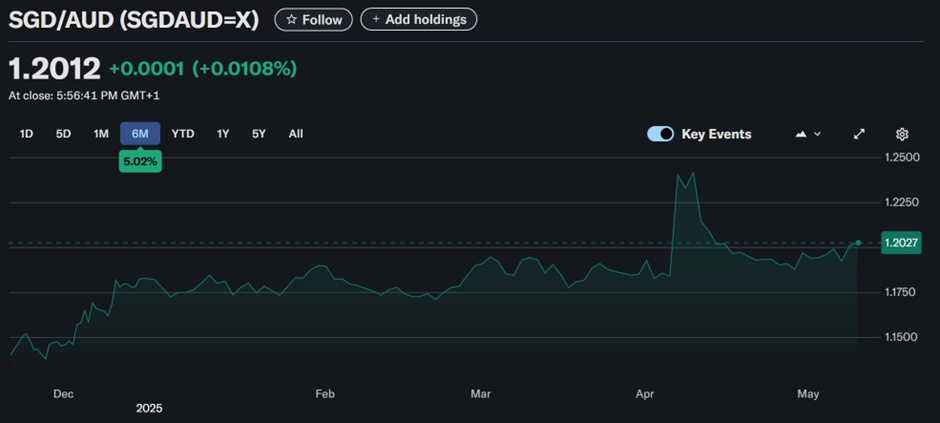
For this example, we will look at the Australian Dollar (AUD), which has been depreciating steadily against the SGD in recent months.
Source: Yahoo! Finance
Assuming we are planning a trip to Australia in June and used DCA to exchange $5,000 for AUD over the past five months. Once again, we’ll be using the arbitrary date of the 10th of each month when exchanging currency.
| Date | SGD/AUD Exchange Rate | SGD | AUD |
| 10 Jan 2025 | 1.18 | 1,000 | 1,180 |
| 10 Feb 2025 | 1.18 | 1,000 | 1,180 |
| 10 Mar 2025 | 1.19 | 1,000 | 1,190 |
| 10 Apr 2025 | 1.21 | 1,000 | 1,210 |
| 10 May 2025 | 1.20 | 1,000 | 1,200 |
| Total | 1.19 | 5,000 | 5,960 |
Using the DCA method, we would have exchanged $5,000 over the past five months for a total of A$5,960 , or an effective exchange rate of almost 1.19. This is better than if we had exchanged only once in January or February – when we first planned the trip.
In contrast, if we had exchanged all our currency in April or May, we would have earned more than the DCA rate.
Unsurprisingly, this is the opposite scenario of the Japanese Yen scenario. If the overseas currency is depreciating against the Singapore Dollar, it would probably be better to wait till the last second to maximise your currency exchange rate. But, again, we will only know this in hindsight.
Using the DCA strategy, we remove the “unfortunate” scenario of exchanging at the worst possible time (or best possible time) – and get the average exchange rate.
Should You DCA When Overseas Currency Is Volatile Against SGD?
Perhaps, the best example of the DCA approach is when the investment is volatile, making it extremely difficult to see a trend of appreciation or depreciation lasting several months.
In this example, we use the Malaysian Ringgit (MYR).

Source: Yahoo! Finance
Let’s assume this time we are planning a trip to Malaysia in June and used DCA to exchange $5,000 for MYR over the past five months.
| Date | SGD/MYR Exchange Rate | SGD | MYR |
| 10 Jan 2025 | 3.28 | 1,000 | 3,280 |
| 10 Feb 2025 | 3.28 | 1,000 | 3,280 |
| 10 Mar 2025 | 3.31 | 1,000 | 3,310 |
| 10 Apr 2025 | 3.33 | 1,000 | 3,330 |
| 10 May 2025 | 3.31 | 1,000 | 3,310 |
| Total | 3.30 | 5,000 | 16,510 |
With the DCA approach, we would exchange $5,000 over five months, for a total of MYR 16,510. This is an effective exchange rate of about 3.30. This is better than if we had exchanged in January or February, but slightly poorer if we had exchanged in April.
We can therefore see that when the exchange rate is fluctuating more, like in the case of the Malaysian Ringgit, the DCA approach can help us avoid the poorest rates. By choosing an arbitrary date and consistently exchanging the same amount of money each time, the DCA method effectively overcomes the need to time the foreign exchange market.
Read Also: Why Is The Singapore Dollar (SGD) Constantly Appreciating Against The Malaysian Ringgit (MYR)?
Is It Practical To DCA For Overseas Currency Exchange?
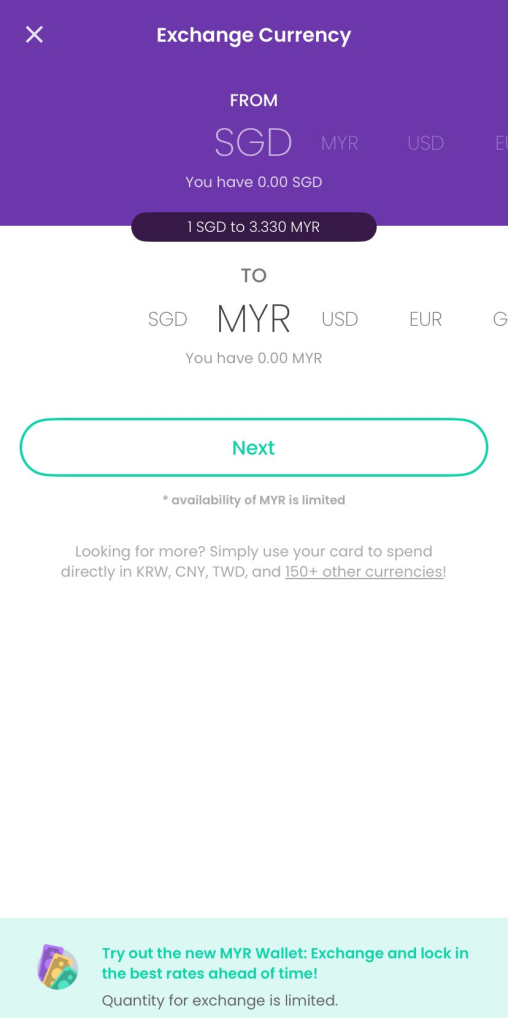
One of the top concerns of using dollar-cost averaging for currency exchange is whether you will incur a platform fee each time you exchange currency. For the popular multi-currency e-wallet, YouTrip, there is no fee for exchanging SGD with up to 11 overseas currencies, including JPY, AUD and recently MYR.
As you can see, the exchange rates that you can get on YouTrip is also very close to the ones you can find online – making it not only more convenient, but also perhaps even more competitive.Best time to make foreign currency exchange
Source: Screenshot from YouTrip app
If you don’t have a YouTrip account yet, sign up using the promocode DNS5 during registration. You’ll get a S$5 welcome credit in your YouTrip account.
No platform fees when exchanging currency means you can apply the DCA approach without worry whenever you want. You may even want to increase the frequency of exchanging currency, especially when the currency is volatile. This method ensures you never need to “time” the foreign currency exchange again.
Read Also: 8 Things You Need To Know Before Heading To The Money Changer
Advertiser Message
Thinking Of Switching Brokers Or Consolidating Your Holdings?
Tiger Brokers is currently running a transfer-in campaign where eligible clients can receive an iPhone 17 Pro Max* when they transfer in their assets.
For SGX investors, there is also a CDP Transfer promotion with 0* commissions on Singapore stocks.
Find out more here. *T&Cs apply.