
Electricity is one of those household costs we usually ignore until the bill starts creeping up. But with oil prices jumping after the Iran conflict, some Singapore households may now be wondering whether this is the right time to lock in an Open Electricity Market (OEM) plan rather than stay with SP Group’s regulated tariff.
That is a fair question. On 27 March 2026, Brent crude traded above US$100 a barrel, and prices have been volatile from day to day. Since fuel costs remain a major component of Singapore’s electricity tariff, a sustained rise in global energy prices could cause electricity bills to rise in the coming quarters
Why Electricity Users In Singapore Should Pay Attention Now
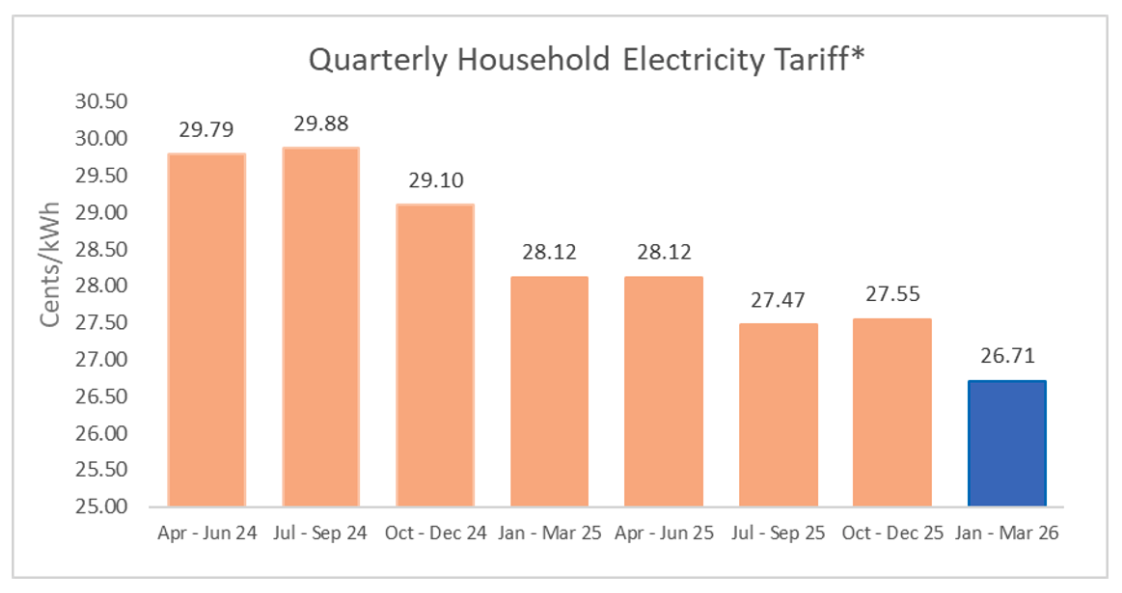
For the current quarter, from 1 January to 31 March 2026, SP Group’s household electricity tariff is 29.11 cents per kWh inclusive of GST, or 26.71 cents per kWh before GST. That was actually lower than the previous quarter, following SP Group’s announcement of a 3.0% reduction due to lower energy costs at the time.

Figures above exclude 9% GST
As we can see, the electricity tariff for Jan – Mar 2026 was actually significantly lower than earlier quarters.
Electricity tariffs in Singapore are revised every quarter, and more than 75% of the tariff is tied to energy costs. In other words, when global fuel prices move sharply, local electricity prices are likely to follow.
What OEM Providers Are Charging Today
In our latest guide to the Open Electricity Market (OEM) Plan, we observe that fixed-price plans across OEM retailers are currently about 29.00 cents/kWh for a 12-month plan. This is marginally lower than the current SP electricity tariff of $29.11/kWh. For some, the savings may appear negligible.
But the main argument for locking in today is not really about immediate savings. It is about hedging against price increases in the future months. If fuel costs remain elevated and the regulated tariff rises in the next quarter or two, fixed-price plans available later may also become more expensive. That is the real decision households have to make.
A 12-Month Plan May Be The Middle Ground
For households that expect electricity prices to rise in the near term but do not want to commit for too long, a 12-month plan may be the most balanced option.
A one-year contract provides some protection if tariffs rise over the next few quarters, while still leaving room to recontract relatively soon if energy prices calm down later.
At around 29.00 cents per kWh inclusive of GST, a 12-month plan is currently priced very close to the regulated tariff. That means the upside is not immediate savings, but insulation against further increases.
A Longer Contract May Appeal To Those Who Want Greater Certainty
A 24-month plan can make sense for households that value bill certainty more than flexibility. Current market rates of around 28.80 cents per kWh, inclusive of GST, are slightly below the regulated tariff. More importantly, this locks in the rate for a longer period.
The attraction of a longer fixed contract is straightforward: if tariffs rise over the next few quarters, your rate stays the same. For families who prefer predictability in their monthly household bills, that peace of mind can be valuable.
Still, the trade-off is clear. If the conflict eases and fuel prices fall back, regulated tariffs may come down again. In that scenario, a household on a longer fixed contract could end up paying above-market rates.
Staying With SP Group Is Still A Reasonable Choice
There is also nothing wrong with doing nothing.
Some households may prefer to stay on the regulated tariff and wait for the next quarterly revision. That keeps flexibility intact. If the geopolitical situation improves and fuel prices ease, they could benefit from lower tariffs without being tied to a contract.
The downside, of course, is that this is effectively the floating-rate option. If energy prices remain high or climb further, regulated tariffs may rise as well, and households that waited may find that the next batch of fixed-price plans has also moved up.
Existing Customer Offers Can Sometimes Be Better Than Public Rates
One practical point worth highlighting is that existing customer recontracting offers may sometimes be better than the headline rates you see on a retailer’s website.
For example, I am currently paying 27.09 cents per kWh on my existing OEM plan, and the retailer is offering me a recontract rate which is similar to this price. This is substantially lower than the current regulated tariff of 29.11 cents per kWh
How Much Certainty Do You Want?
There is a reasonable case for locking in an OEM plan now, but it depends on what you are trying to optimise.
If your priority is flexibility, staying with SP Group and waiting for the next tariff revision is sensible. If your priority is certainty, then locking in a fixed plan now may be worth it, even if the immediate savings are small. And if you have access to a recontract offer that is clearly below both the regulated tariff and current market rates, that may be the strongest case of all.
A good way to think about it is this: staying on the regulated tariff is like leaving your mortgage floating, while locking in an OEM plan is like fixing your rate. One gives you flexibility. The other gives you peace of mind. In a period of energy uncertainty, either choice can be reasonable. What matters is choosing the one that fits what makes sense to you.
Read Also: Complete Guide To Choosing The Best Open Electricity Market (OEM) Plan For Your Home


