

The Ukraine Crisis which has dominated news headlines in the past week is truly devastating. It has led to the loss of lives and put millions in danger. There is much that is at stake, and the financial market is just one area where we have already seen a significant impact from the unfolding event.
Following Russian President Vladimir Putin’s announcement of a military operation in Ukraine, we have seen much volatility in the stock markets as investors digested the latest developments. Within the short timeframe of a week, Brent crude oil jumped to above US$100 per barrel as investors were concerned about the impact of the crisis on Russian oil exports. This has further flamed inflation fears which have been growing prior to the Crisis.
The Russian Ruble has also seen a sharp decline following sanctions announced by the US and its Western allies which will block some Russian banks from the SWIFT global payments system.
Closer to home, Singapore has also imposed sanctions on Russia, including export controls on items that can be used directly as weapons in Ukraine, as well as blocking certain Russian bank and financial transactions connected to Russia.
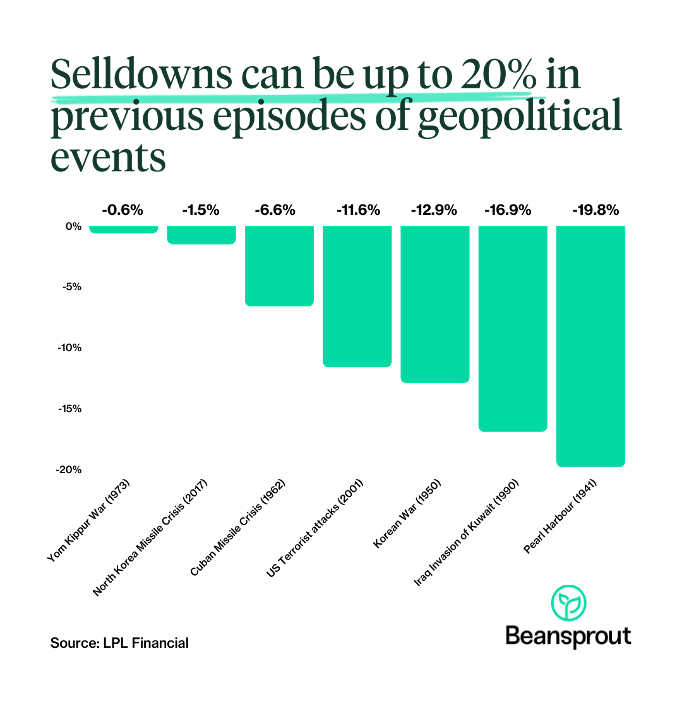
In our article “What does the Ukraine Crisis mean for markets”, we looked back at previous episodes of geopolitical tensions to understand their impact on stock market performance. The maximum selldown in the US market has ranged from just about 1% during the Yom Kippur War (1973) and North Korean Missile Crisis (2017), to as much as 17% when Iraq invaded Kuwait (1990), and 20% during the Pearl Harbour attacks (1941).
With time, the financial markets appear to be less concerned about the impact of geopolitical events. Looking back at 12 previous episodes of geopolitical events, Truist Securities found that 12-month returns on the US market were positive for 75% of events. The exceptions would be the Suez Canal crisis, Arab oil embargo, and the 2001 terrorist attacks.
Flight To Safety Evident
In times of market uncertainty, investors would typically look for “safe havens” to put their money in.
One area which has seen renewed interest is gold, which has risen to close to US$1,900/oz as of end-February. This is more than 10% above its level this time last year, but still below its highs of above US$2,000/oz in August 2020.
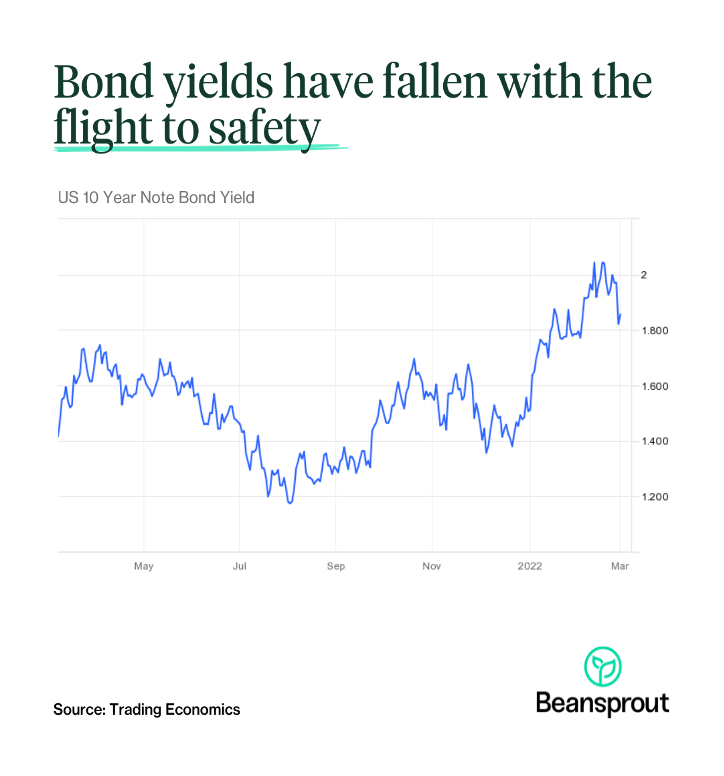
The other asset which has benefitted from the flight to safety would be US government bonds. On this note, the yield on the 10-year treasury note has fallen from above 2.0% at the height of Fed interest rate hike fears in mid-February, to below 1.9% at the end of February.
As the market absorbs the developments from the Ukraine crisis, investors are now just expecting five rate hikes in 2022, down from six previously. This marks a reversal from earlier expectations that there could be as many as seven rate hikes this year!
Singapore REITs Might Be Worth A Look
Against this backdrop of rising macro uncertainty and moderating expectations of rising interest rates, Singapore REITs (S-REITs) might also be seen as being defensive. Notably, S-REITs have underperformed the broader market with the FTSE ST REIT index down by close to 3% in January 2022, versus a 4% gain for the broader Straits Times Index (STI).
This is largely due to market concerns about how their distributions could potentially be impacted by rising interest rates. On this front, it might be worth knowing that most of the existing borrowing by the REITs are based on fixed interest rates, which would help to cushion the impact from higher interest rates.
In addition, a gradual improvement in local economic activity has also helped to improve prospects for growing the REITs’ rental income. If you have been to a retail mall recently, you would have noticed the crowds even as the Omicron variant has led to a higher number of Covid-19 cases in Singapore.
As a whole, retail sales rose by 6.7% YoY in December 2021, and are expected to rise further this year as Singapore moves towards treating Covid-19 as endemic. This could help to improve the occupancy of retail malls and allow landlords to raise their rents.
Within the office sector, we have seen more people going back into offices as work-from-home is no longer the default. This could lead to better rental prospects for landlords of office buildings.
More importantly, it is worth noting that the average dividend yield for Singapore REITs is now higher than the STI. Based on data from the Singapore Exchange (SGX), the dividend yield on the FTSE ST REIT Index was 4.5% as of 31 Jan, compared to just 3.1% for the STI.
This presents an opportunity for investors who are looking for a place to hide as we await to see how the situation unfolds. If you are interested to find out more about investing in REITs, make sure you check out our guide on what to look out for. We also share 3 REITs that you might want to add to your watchlist. Do also follow us on Instagram for the latest investment insights.
Read Also: The War For Ukraine: 4 Stocks That Could Be Affected
Gerald Wong, CFA, is the Founder and CEO of Beansprout, Singapore’s next-generation investment advisory platform licensed by the MAS. He has more than 13 years of experience in investment advisory, and was previously the Head of Singapore Securities Research at Credit Suisse. Gerald believes in empowering investors to make smarter decisions by providing them with customized insights, and has been actively involved in raising awareness of the Singapore equity market. He runs a Beansprout Telegram Chat Group where he shares his market insights with passionate investors.


Street Smart
Singapore Gym Membership Price Guide (2026 Edition)


