In recent years, many of us would have noticed a growing number of videos on social media featuring well-dressed property agents giving home tours of the properties they are marketing. In some of these videos, they are also seen driving luxury cars or wearing high-end watches.
This raises the question: How much do property agents in Singapore earn, and is the industry truly as lucrative as it appears on social media?
How Property Agents in Singapore Earn Their Income
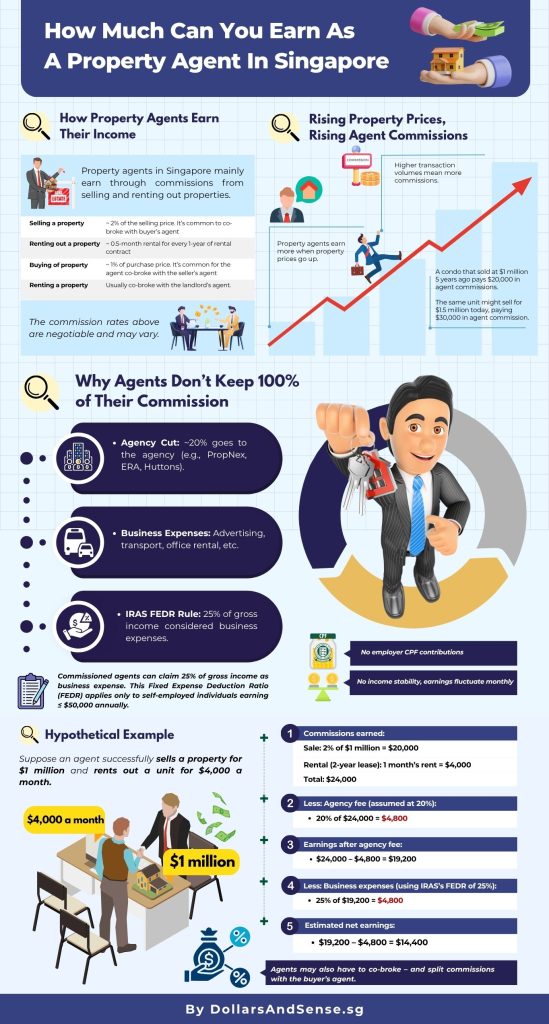
Most of us are already aware that property agents in Singapore earn primarily through commissions from the deals they close. There is no fixed rate for these commissions, as they are typically negotiated between the agent and their clients. That said, there are industry norms that give us a general idea of what to expect.
| Selling of property | ~ 2%. Property developers tend to pay more to agents for the sales of new launch units. |
| Renting of property | ~ 0.5 month rental for a 1-year contract. 1 month rental for a 2-year contract |
| Buying of property | ~ 1% of property. It’s common to also have the agent co-broke with the seller’s agent |
| Renting a property | Usually co-broke with the landlord’s agent. |
To reiterate, the commission rates mentioned above are not fixed and can be negotiated between property agents and their clients. Rates may also vary from agent to agent, depending on their level of experience and the scope of services they offer.
Rising Property Prices, Rising Agent Commissions
Since an agent’s earnings are a function of the deal they close, this also means that, with all things being equal, property agents will generally earn more when property prices go up.
For example, five years ago, a condo unit may have sold for $1 million, generating a commission of about $20,000 for the agent. Today, if the same unit sells for $1.5 million, the agent will generate a commission of $30,000. The same logic applies to rental units. When rent goes up, commission becomes larger. In other words, if the pie becomes bigger, property agents earn more.
The other fact is the number of transactions. The higher the number of transactions in the market (usually a function of prices going up quickly), the higher the commissions earned.
With property prices in Singapore rising quickly since 2020, it’s no surprise that agent earnings have gone up, thus attracting even more agents into the industry. According to the Council for Estate Agencies, the number of agents reached a record high as of 1 January 2025, with 36,058 registered property agents in Singapore.
Why Agents Don’t Keep 100% of Their Commission
Just because a property agent receives a $10,000 commission doesn’t mean they get to keep the entire amount. There are significant costs involved in being a property agent.
To begin with, agents must pay a portion of their commission to the agency they represent, such as PropNex, ERA, or Huttons. This agency fee varies depending on the agent’s sales volume and experience, but a common estimate is around 20%.
As self-employed individuals, property agents also incur various business expenses during their work. These can include advertising costs, transport, and even office rental. While the actual expenses will differ between agents, the Inland Revenue Authority of Singapore (IRAS) provides a simplified method to account for them: the Fixed Expense Deduction Ratio (FEDR).
Under the FEDR, IRAS allows self-employed individuals to treat a fixed percentage of their gross annual income as business expenses. For commission-based agents such as property agents, this percentage is set at 25%. In other words, IRAS considers 25% of an agent’s gross income as business expenses, offering a straightforward way to estimate costs.
Note: The FEDR is only applicable to self-employed individuals with annual incomes not exceeding $50,000. However, we will set that condition aside for the purposes of this article.
Hypothetical Example
Let’s illustrate this with a hypothetical example.
Suppose an agent successfully sells a property for $1 million and rents out a unit for $4,000 a month.
Commissions earned:
Sale of property: 2% of $1,000,000 = $20,000
Rental of property (based on a 2-year lease): 1 month’s rent = $4,000
Total commission earned: $24,000
Less: Agency fee (assumed at 20%):
- 20% of $24,000 = $4,800
Earnings after agency fee:
- $24,000 – $4,800 = $19,200
Less: Business expenses (using IRAS’s FEDR of 25%):
- 25% of $19,200 = $4,800
Estimated net earnings:
- $19,200 – $4,800 = $14,400
This simplified example shows how the gross commission figure can differ significantly from what the agent ultimately takes home as their income.
It’s easy to see why becoming a property agent can be potentially lucrative, especially with the sharp rise in property prices over the past five years. As the selling prices of condominium units and even some HDB flats now exceed $1 million, the commissions earned by property agents have naturally increased. For instance, selling a single luxury condominium unit worth $5 million could yield a gross commission of $100,000, an amount comparable to what many people earn in an entire year.
However, it’s essential to recognise that property agents, as self-employed individuals, do not enjoy the same income stability as salaried employees. While they may earn more in a particular month, their income can fluctuate significantly monthly. Additionally, property agents do not receive employer CPF contributions.
To put this into perspective: a property agent earning $9,360 a month after expenses effectively takes home a similar total compensation as an employee earning $8,000 a month, once the 17% employer CPF contribution is factored in.
Read Also: How Much Does Your Property Agent Friend Really Earn When They Achieve Property Awards?
Here’s a handy infographic summarising the commissions that a property agent earns: