

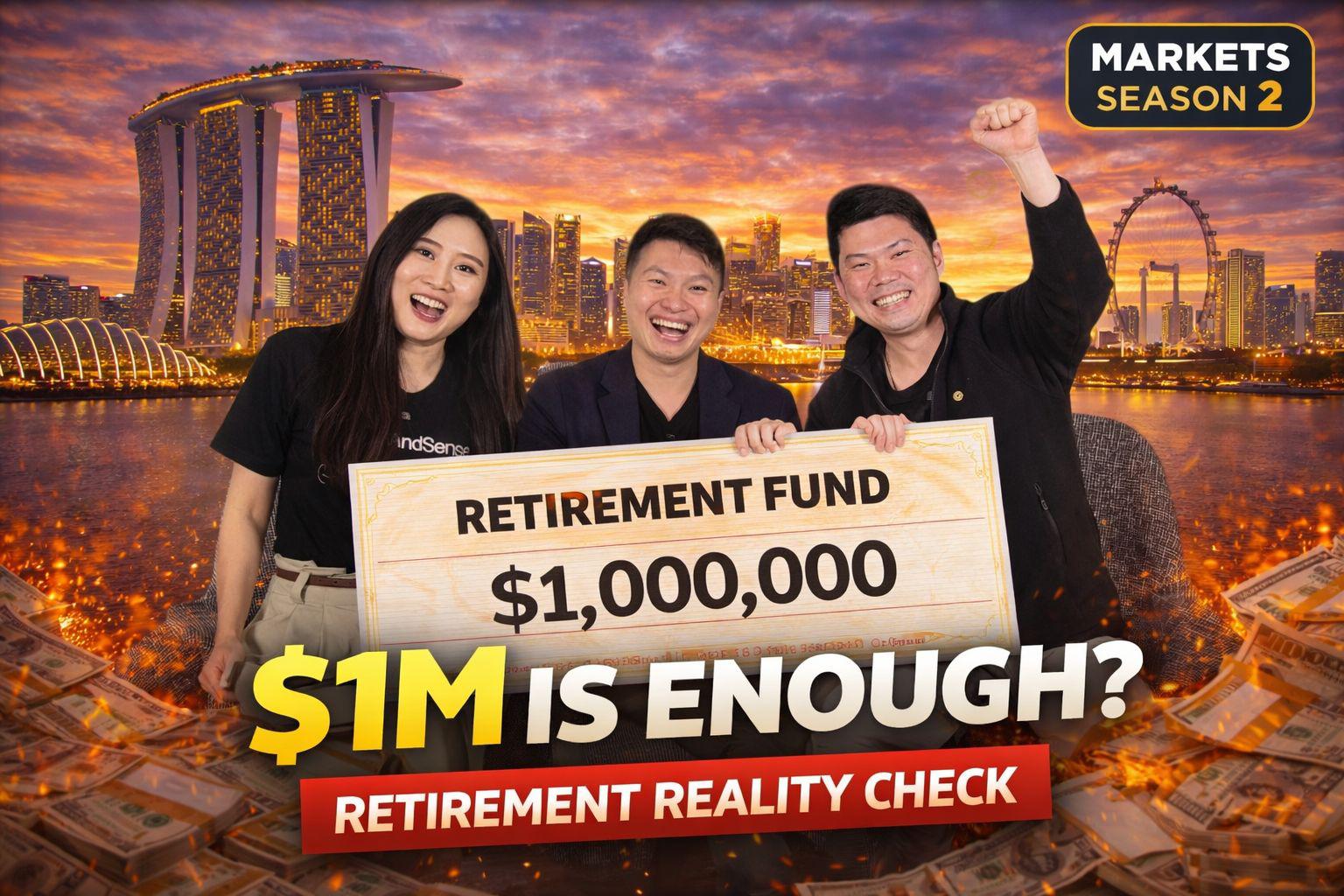
Reaching $1 million is often seen as a major financial milestone. It suggests security, independence, and for some, the option to stop working.
This idea is also reinforced by what we see around us. On social media, images of luxury homes, high-end cars and comfortable lifestyles can make it seem like once we reach our first million, we have “made it”.
But in Singapore, where living costs are high, life expectancy is longer, and healthcare expenses can rise as we age, $1 million may not automatically translate into a comfortable retirement.
In this episode of the DollarsAndSense Podcast, Feng Yi and Timothy are joined by Yu Sheng from Maybank Securities to unpack whether $1 million is really enough to retire in Singapore, and what investors need to think about beyond the headline number.
Watch the full DollarsAndSense Podcast episode here:
Why $1 Million May Not Stretch As Far As Expected
The idea of $1 million is powerful. It is often linked to financial freedom and the ability to retire without worrying about money.
However, retirement is not defined by a single number. It depends on your lifestyle, how long you expect retirement to last, how much you spend each month, and how you manage your money after you stop working.
As Timothy shared in the episode, $1 million may sound like a lot in most parts of the world. But Singapore is not like most places. Apart from rising living costs, retirees also need to factor in the possibility of living longer and spending more on healthcare as they grow older.
In other words, the risk is not just whether you can retire. The bigger risk is whether your savings can last for the rest of your life.
Breaking It Down: How Long Can It Last?
Looking at the numbers more closely can be revealing.
If someone spends about $3,000 a month, $1 million could last around 27 years, excluding investment returns. On paper, this may sound sufficient.
But this simple calculation does not include inflation, healthcare costs, or unexpected expenses. It also assumes your spending remains the same throughout retirement, which may not always be the case.
Timothy also gave a simple comparison in the episode.
Imagine two people who are both 55 years old and expect to live until 85. The first person keeps the full $1 million in a savings account and withdraws about $40,000 a year, or around $3,300 a month. In this case, the money would last about 25 years.
The second person invests in a balanced portfolio of 50% stocks and 50% bonds, and uses a 4% withdrawal approach. In this example, the portfolio may last about 30 years after accounting for inflation.
The point is not that every retiree should follow this exact portfolio or withdrawal rate. Rather, it shows that the way we manage our retirement money can make a meaningful difference to how long it lasts.
Read Also: Singapore Retirees Share How They Maintain Their Lifestyle Amid Inflation
Managing Money Matters As Much As the Amount
This is why retirement planning is not just about hitting a target sum.
Keeping all your retirement savings in cash may feel safe, but regular withdrawals can deplete the money over time. At the same time, investing too aggressively in retirement can expose you to unnecessary risks.
The balance matters.
Yu Sheng shared that investment education is important because it helps investors understand how different investments work, the potential returns they may offer, and the risks involved. This allows investors to have a clearer sense of the return on investment they may need, and how much time they have to reach their goals.
For example, a retiree may think about income-generating assets, such as REITs or dividend-paying stocks, while also considering more stable instruments such as bonds. Each option plays a different role, and the right mix depends on the investor’s needs, risk appetite and stage of life.
As discussed in the episode, retirement is not just about preserving money. It is also about making sure the money continues to work hard enough to support your lifestyle.
Lifestyle Choices Shape Retirement Needs
One reason the answer differs from person to person is that retirement spending can vary widely.
In the episode, Feng Yi referred to household expenditure figures showing that spending can range from around $1,000 to over $3,000 per household member.
Timothy pointed out that households living in smaller one- or two-room flats may spend around $1,000 per person each month, while those living in private property may spend slightly above $3,000 per person.
For households made up of people aged 65 and above, the range can be even wider. At the lower end, some spend below $500 per household member each month. At the higher end, spending can go above $3,000 per person.
This explains why two people with the same $1 million retirement fund can have very different outcomes.
Someone who owns a fully paid HDB flat, eats simply and has modest lifestyle needs may find that $1 million goes quite far. Another person who wants to travel frequently, support family members, live in a private property, or maintain a more expensive lifestyle may find that the same amount runs down much faster.
The Impact of When You Retire
When you retire also makes a big difference.
If you retire at 65, CPF LIFE may provide a stream of monthly payouts to support your retirement expenses. This can reduce the amount you need to draw from your savings and investments each month.
But if you want to retire earlier, say at 50, you need to fund the years before CPF LIFE payouts begin.
In the episode, Tim gave the example of someone who wants about $3,400 a month in passive income from age 50 to 65. Using savings alone, that would require about $612,000 over 15 years.
If that person also wants to set aside funds for CPF retirement planning, such as the Enhanced Retirement Sum, the total amount needed could exceed $1 million.
This is why early retirement can be more expensive than it looks. The issue is not just how much you need after 65. It is also how you will fund the years before your retirement income streams begin.
Building $1 Million Takes Time and Discipline
Accumulating $1 million is rarely achieved overnight.
For most people, it comes from years of saving, investing and making trade-offs. Yu Sheng described one of the biggest obstacles as “distractions”.
In a consumption-driven environment, there are always reasons to spend. A new phone, a holiday, a luxury watch, or the next lifestyle upgrade can all compete with the money that could otherwise be saved or invested.
This is especially relevant when people receive bonuses or extra income. As Timothy pointed out, most people do not budget their regular monthly expenses around their year-end bonus or 13th-month payment. This means that bonus payouts can be a useful opportunity to invest more, if we choose to set them aside instead of spending them immediately.
Yu Sheng also highlighted three important factors: time, discipline and return on investment.
Starting early allows investments more time to compound. Staying disciplined helps investors keep setting aside money regularly. Understanding return on investment helps investors make better comparisons between different options, such as REITs, bonds or stocks.
Timothy also compared investing to fitness. Many people want quick results, but the outcome often comes only after years of consistency. The same applies to investing. One common mistake is not giving investments enough time to compound.
At the same time, investors should still track their portfolio. The caution is not to check it every day or every week and react emotionally to short-term movements. A more practical approach may be to review progress periodically and assess whether the portfolio remains aligned with the retirement goal.
The episode also touched on the importance of investing across markets.
Yu Sheng shared that some Singapore investors prefer the local market because the companies feel familiar. They may understand local banks, telcos, REITs and other listed companies because these are businesses they see or use in daily life. Singapore also has no capital gains tax and no dividend withholding tax, which can be attractive for investors building dividend income.
At the same time, overseas markets give investors access to global companies. For example, many of us use Apple products, but Apple is listed in the US. Similarly, a telco such as Singtel is listed in Singapore and may appeal to investors who understand its recurring subscription-based business model.
The broader point is that investors should understand what they are investing in, whether it is a local or overseas company.
Yu Sheng also addressed the question of timing the market versus time in the market. While everyone wants to buy low and sell high, it is difficult to do consistently. For long-term retirement planning, investing regularly over time may be more practical than trying to find the perfect entry point.
For those who start late, the trade-offs become harder. Timothy explained that investors can only adjust a few factors: how much they invest, the returns they aim for, and the time they have. If time is limited, some may be tempted to take on more risk to chase higher returns. But that may not always be suitable, especially when they are closer to retirement.
In such cases, increasing the amount invested may be the more realistic lever, even if it is not the most exciting answer.
Retirement Is a New Phase, Not an End Point
Reaching $1 million does not mean financial planning is complete.
Instead, retirement marks a transition. Before retirement, the focus may be on growing wealth. After retirement, the portfolio has to preserve wealth, generate income, and still keep up with inflation.
Yu Sheng shared that many retirees may shift from a more aggressive investment approach to a more conservative one because wealth preservation becomes more important. After spending years accumulating wealth, the priority is often to avoid losing it too quickly.
However, he also noted that some experienced investors may continue to take more active positions because they have built up the knowledge and confidence to do so.
For many retirees, income becomes a priority. This is where REITs and dividend-paying stocks can play a role. Yu Sheng explained that REITs are often used by investors looking for regular income because they distribute income and are backed by rental-generating properties.
He also brought up the concept of Weighted Average Lease Expiry (WALE), which gives investors a sense of how long the leases in a REIT’s portfolio are expected to last. This can provide some visibility on future rental income, although investors still need to assess the REIT’s overall quality, gearing, sector exposure and interest rate risks.
Retirees may also rebalance their portfolios over time. For example, if a REIT has risen significantly in price and delivered capital gains equivalent to multiple years of yield, some investors may choose to take profit and redeploy the funds into other opportunities.
Fixed income can also play a role, especially for investors who want more stability. But as discussed in the episode, if investment-grade bonds offer yields of around 3%, retirees still need to consider whether that is sufficient after accounting for inflation.
This is why asset allocation matters more during retirement. Withdrawing money from a portfolio while still trying to preserve and grow it requires discipline. Investors may also need to avoid common mistakes such as selling winners too quickly while holding on to losing investments for too long.
A More Nuanced Answer Than Yes or No
So, is $1 million enough to retire in Singapore?
The honest answer is: it depends.
It depends on how much you spend, when you retire, how long your retirement lasts, whether CPF LIFE forms part of your income, how healthcare costs evolve, and how your savings are invested.
For some Singaporeans, $1 million may be enough. For others, especially those who want to retire earlier or maintain a higher-cost lifestyle, it may fall short.
As Timothy summed up in the episode, real financial security does not come from a jackpot or a single number. It comes from understanding your needs, being thoughtful about your investments, and staying flexible as life and markets change.
For newer investors, one possible starting point is to invest regularly through a diversified approach, such as dollar-cost averaging into broad-based ETFs. Over time, as investors gain more knowledge, they may choose to make more active decisions in companies, sectors or markets they understand better.
Yu Sheng also emphasised that investors who do well tend to read extensively. They understand companies, sectors and the broader macro environment. In investing, there is no free money. Better decisions often come from compounding knowledge, not just capital.
Ultimately, retirement planning is not about chasing a magic number. It is about building a plan that can work in the real world, through inflation, market cycles, healthcare costs and changing life circumstances.
For investors who want to access market insights and monitor their portfolios, the Maybank Trade SG app brings together curated research ideas, custom alerts, portfolio monitoring and real-time market information in one platform. As with any investment decision, investors should understand the risks involved and consider whether the investment suits their needs.


Street Smart
Singapore Gym Membership Price Guide (2026 Edition)


