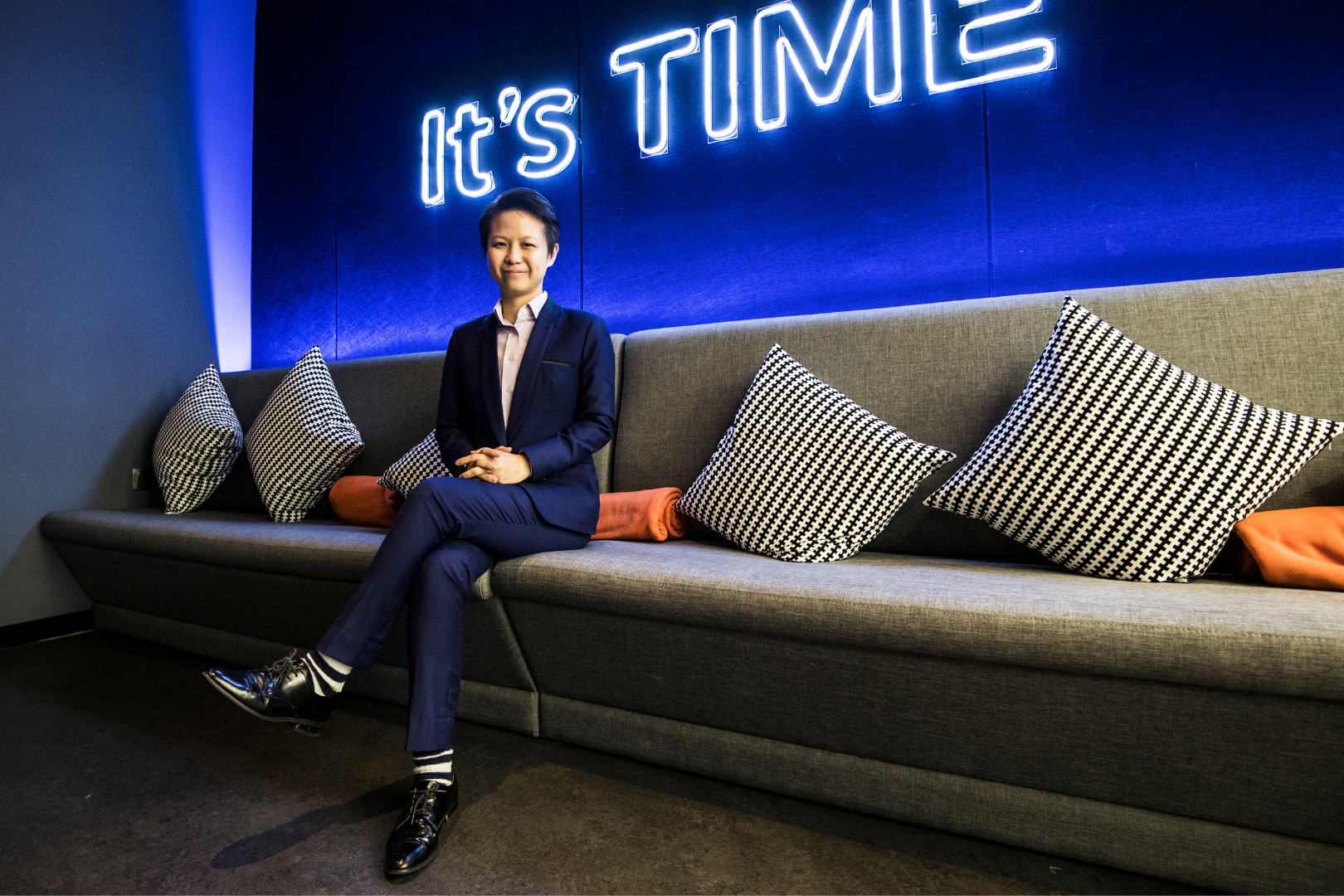
Joewin Tan is a business advisor, professional speaker and the CEO of Quant Consulting Group, where she works closely with SME founders on cashflow, sustainability and leadership. She is also a community board member at ACE.SG’s Women Entrepreneurship Committee and People’s Association PAssion Wave Advisory Committee, and currently serves as a mentor at UOB Finlab Womenpreneur Programme and Singapore Fintech Festival, supporting business owners who are navigating the pressures of growth, responsibility and uncertainty.
Beyond spreadsheets and strategy decks, Joewin is deeply involved in leadership development and community initiatives through speaking and mentorship work. In a quieter corner of her life, she plays the drums and rescues abandoned and sick stray cats with her partner.
It is a life that reflects stability, purpose and control. But Joewin’s relationship with money, risk and long-term thinking was shaped in a very different environment — one where appearances did not match reality, and where survival often took precedence over planning.
Growing Up In “Hidden Poverty”
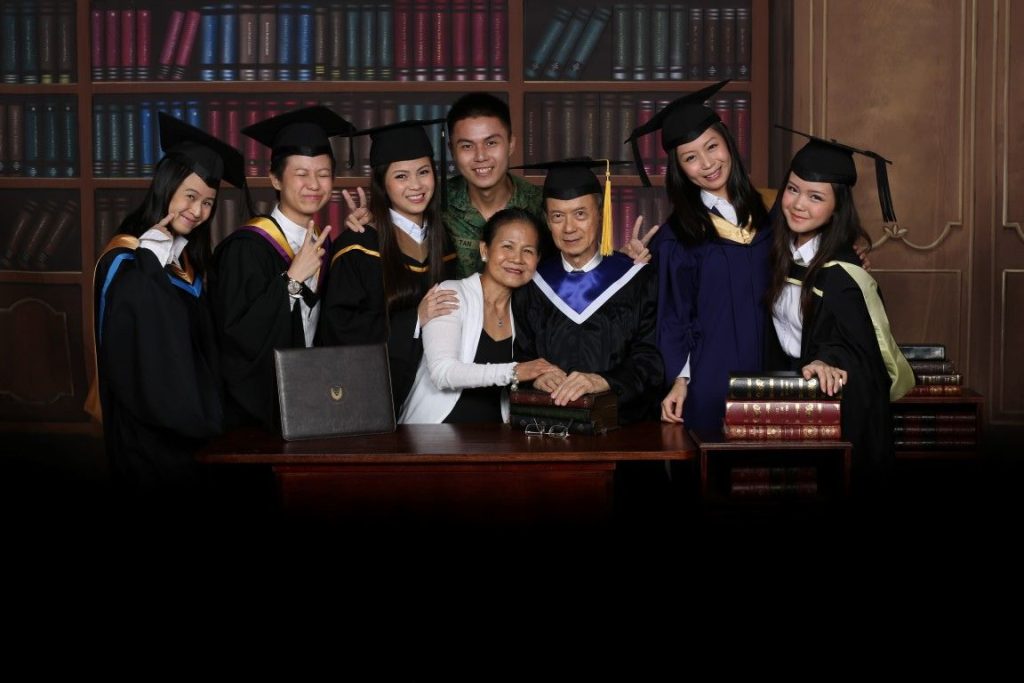
Joewin with her close-knit family
From the outside, Joewin’s childhood looked comfortable. Her father held an MBA, worked in director-level roles, lived in a condominium and drove a Mercedes. Yet behind closed doors, her family struggled to make ends meet.
“There were days when our electricity and water were cut off,” she recalls. “We looked like we were doing fine, but we were living hand to mouth.”
Risk, to her, was never an abstract concept. It was something her family lived with daily. At the same time, the fear of others finding out about their financial difficulties felt greater than the fear of missing the next bill payment. Image and survival were constantly in tension.
Watching her father shoulder the responsibility of being the sole breadwinner for a large family left a deep impression. No matter how overwhelmed he was, he never walked away from his role.
“That shaped how I see responsibility,” Joewin says. “When I take on a client today, it’s not just about their business. It’s about their family’s livelihood and the families of their employees too.”
This sense of duty now underpins how she runs her advisory work. Her firm conducts rigorous financial health checks before taking on clients, and even offers guarantees to ensure businesses recover at least what they pay in fees. For Joewin, resilience matters more than impressive growth stories.
When Long-Term Thinking Felt Like A Luxury
Ironically, growing up in financial instability also delayed her ability to think long term.
“When you’re focused on surviving the next month, planning ten years ahead feels like a privilege for rich people.”
Joewin attended an elite school, where the contrast between her life and her classmates’ lives was stark. While others spoke about overseas holidays, she took her first flight only at 17, on a budget airline. She even remembers once asking what “Switzerland” was, not realising it was a country.
It was only much later, after experiencing business failures, turnarounds and personal loss, that she began to understand the value of building for endurance rather than short-term wins.
“Today, whether in business or life, I focus less on upside and more on resilience,” she says. “Cashflow matters more to me than valuation. Sustainability matters more than speed.”
Redefining What “Investing” Means
Through her work with founders, Joewin has come to see that investing is not just about money.
“To me, investing is simply choosing what I’m willing to exchange today for a better outcome later,” she explains. “Sometimes that exchange is money. Very often, it’s time, energy, attention or even pride.”
She has met founders who run profitable companies on paper but cannot pay themselves a salary. At that point, she believes the question becomes uncomfortable but necessary: would they be better off as employees who bring home a steady paycheck and sleep better at night?
“If an investment gives you great returns but robs you of sleep, damages your relationships or wrecks your mental health, I’m not convinced it’s a good investment at all.”
This perspective has led her to make deliberate choices in her own life — choosing depth over breadth in friendships, investing less in status and more in mental well-being, and aligning her commitments with her values rather than external expectations.
Learning About Trade-Offs Early
Her first “investment”, she jokes, happened in primary school. She once used her 50-cent recess allowance and went hungry to pay her younger sister to complete her Chinese handwriting homework.
“It was my first lesson in trade-offs,” she laughs. “I exchanged money and food for time and convenience. Totally worth it.”
It was a simple but telling example of how investing, at its core, is always about choice and sacrifice.
Investing In Time, Attention & Mental Health
Some of Joewin’s most impactful investments have been non-financial.
In 2024, she turned off all WhatsApp notifications — no sounds, no vibrations, no unread message badges. At first, the silence triggered anxiety and fear of missing out. Over time, she found that she had reclaimed her attention.
“I could focus deeply without the constant mental noise. If something is urgent, people can call. Everything else can wait until I’m available.”
After her divorce at 33, she also began investing intentionally in herself. Growing up, she had always prioritised responsibility over personal wants. The separation forced her to ask what she had postponed for years.
She got braces, learned to play the drums, and started an annual tradition of taking her parents on a trip together. More importantly, she invested in counselling at a time when she could barely afford it.
“I used to think counselling was for the weak,” she shares. “What I learned is that sometimes you just need the right person to ask the right questions so you can organise the chaos in your head.”
It remains, in her words, the best investment she has ever made.
Lessons From Poor Investments & Painful Losses
Joewin does not shy away from talking about failure. Across companies, people and financial products, she estimates that she has collectively lost seven figures. The biggest lesson was not about trying to be right all the time, but about designing life and business without a single point of failure.
In relationships, she invests across family, friends and partners, instead of centring her entire world on one person. In business, she ensures that no single product or venture is so critical that its failure would collapse the entire organisation.
“The goal is not to avoid failure completely,” she explains. “It’s to make sure that when something fails, it doesn’t take you out of the game.”
The Everyday Investor Takeaway
For Joewin, investing is already happening every day. We invest our time, health, energy and attention, whether consciously or not. The real challenge is ensuring those investments align with our life purpose.
Knowing that emotions can cloud judgement, she has built a simple rule: for big decisions, slow down. Sit on them. Let emotions settle before committing.
Her advice to those just starting out is grounded and timeless. Consistency compounds. Avoid get-rich-quick schemes. Invest patiently, intentionally, and in ways you can live with.
In a world that celebrates speed, scale and visible success, Joewin Tan’s story is a reminder that the most meaningful investments are often quiet and deeply personal. They are measured not only in dollars, but in resilience, mental clarity and the ability to build a life that can withstand stress — not just one that looks impressive on the surface.
Advertiser Message
Thinking Of Switching Brokers Or Consolidating Your Holdings?
Tiger Brokers is currently running a transfer-in campaign where eligible clients can receive an iPhone 17 Pro Max* when they transfer in their assets.
For SGX investors, there is also a CDP Transfer promotion with 0* commissions on Singapore stocks.
Find out more here. *T&Cs apply.