
During the Committee of Supply (COS) 2023, Dr Tan See Leng, Minister for Manpower, emphasised the strength of the Singapore labour market in 2022. Total employment increased by over 200,000, and resident employment grew to 4.4% (surpassing 2019 levels), while the nominal median income of full-time employed residents saw a remarkable 8.3% growth.
However, he mentioned that the uncertain global economic environment, global inflation and geopolitical challenges may have a bearing on the labour market going forward. Building upon Budget 2023, MOM will implement various measures to equip Singaporean workers to seize opportunities in the new era, build their retirement adequacy, and improve the working environment.
Launch Of CareersFinder Will Provide Personalised Jobs And Skills Insight For Better Job Matching
Job seekers can look forward to CareersFinder, a new personalised jobs and skills recommender tool that will be launched in beta in Q3 2023 on the WSG’s MyCareersFuture portal.
With the CareersFinder tool, the information and services across MyCareersFuture, the Skills Framework, and MySkillsFuture are brought together in one place. Using artificial intelligence and data on skill adjacencies and job transitions in the labour market, it will help jobseekers identify potential career opportunities, personalised to each individual based on a series of quiz questions.
This will improve job matching and provide all jobseekers with a better plan on the steps they need to take, be it taking a course, making a career switch, or how they can progress in their career.
Read Also: Top 9 Job and Internship Portals For Employers Hiring In Singapore
Boost In Retirement Adequacy For Middle-Income Workers
The CPF monthly salary ceiling, which sets the maximum amount of CPF contributions payable for Ordinary Wages earned in a month, will be raised from $6,000 to $8,000 by 2026. The first round of the increase to $6,300 will take place from 1 September 2023.
This will help more middle-income Singaporeans accumulate CPF savings for their housing, retirement, and healthcare needs. For example, when fully implemented in 2026, a 45-year-old worker earning $8,000 a month can receive up to an additional $130,000 in his combined CPF balances when he reaches 65.
Despite changes in the CPF contribution rates, the CPF annual salary ceiling, which sets the maximum amount of CPF contributions payable for all wages in a year, is maintained at $102,000.
Read Also: How Much More Will Employers Have To Pay For CPF Contributions Following Singapore Budget 2023
Enhanced Support To Help Senior Workers Work Longer And Save More For Retirement
With more Singaporeans living longer, having sufficient savings for retirement is a concern among seniors. The government implemented various measures to help senior workers work longer and save more for their retirement.
Among those measures is the extension of the Part-time Re-employment Grant and Senior Employment Credit (SEC), which provide wage offsets to employers hiring Singaporeans over 60 and earning up to $4,000 a month, from 2023 to 2025. This would enable employers to receive up to 7% in wage support offsets in 2024 and 2025 when hiring workers aged 68 and above.

The CPF contribution rates to the Special Account (SA) savings for senior workers aged 55 to 70 will also be raised by up to 1.5% from 1 January 2024. For example, a senior worker aged 55 in 2022 and earning median wages can expect to receive up to an additional $200,000 in his SA balance when he reaches 65.

Employers hiring senior workers will receive a one-year CPF Transition Offset in 2024, equivalent to half the increase in the employer CPF contribution rates.
Read Also: Senior Worker CPF Contribution Rates And CPF Transition Offset Scheme: What Businesses Need To Know
Uplifting Of Lower-Wage Workers Through Progressive Wage Model And Enhanced Workforce Skills Support Scheme
To build a more inclusive and cohesive society, the government would implement all the recommendations by the Tripartite Workgroup on Lower-Wage Workers by July 2023. This includes setting a minimum salary through the Progressive Wage Model (PWM) introduced to uplift local lower-wage workers. By 2023, it would apply to 9 sectors, such as cleaning, security, food services, and administrators, benefiting up to 9 in 10 full-time, lower-wage workers. For example, a general cleaner who earned a monthly salary of $1,312 in 2022 could expect to earn up to $2,420 (or an increase of 84% in wages) by 2028.
To support employers on the progressive wage move in 2023, the government will increase the Progressive Wage Credit Scheme (PWCS) co-funding share from 50% to 75% for wages up to $2,500 and from 30% to 45% for wages above $2,500 up to $3,000.
Additionally, as part of the wider support measures, the Workfare Skills Support (WSS) scheme will be enhanced from 1 July 2023 which will approximately benefit 70,000 lower-wage workers. These enhancements include: (1) lowering the eligibility age from 35 to 30 years old; (2) increasing the qualifying income cap from $2,300 to $2,500 per month; (3) increasing the Training Commitment Award (TCA) Full Qualifications from $500 to $8000; and (4) introducing an hourly Absentee Payroll (AP) cap of $13 to be disbursed to employers.
Read Also: Progressive Wage Credit Scheme (PWCS): What Businesses Need To Know
More Protection And Support For Platform Workers To Boost Their Retirement Savings
The recommendations from the Advisory Committee on Platform Workers will be implemented in the second half of 2024 to provide greater support for Platform Workers. One such measure is the requirement for all Platform Companies and Platform Workers aged below 30 to make CPF contributions in 2024 (optionally for other age groups), which will be phased in evenly over 5 years.
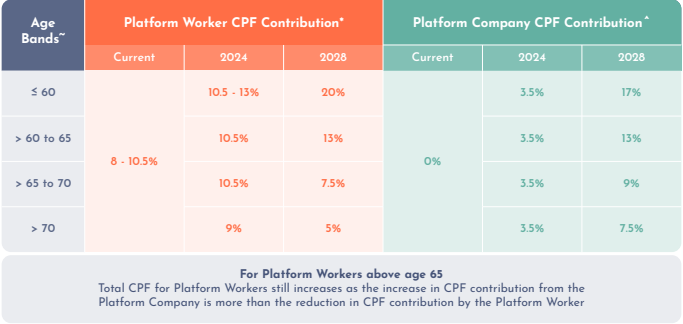
During this transition period from 2024 to 2027, the Platform Workers CPF Transition Support (PCTS) will offset part of the increase in CPF contribution to the Ordinary and Special Account for workers earning $2,500 or less a month.
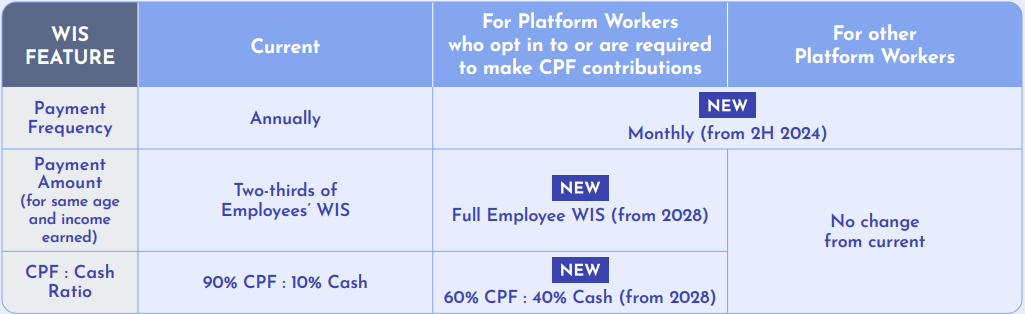
Additionally, from 2H 2024, all eligible Platform Workers would receive the Workfare Income Supplement (WIS) monthly instead of annually. From 2028, eligible Platform Workers on aligned CPF contribution rates would permanently receive higher WIS, the equivalent of an employee with a higher cash ratio of 40% instead of 10% currently.
Platform Companies will also be expected to purchase work injury compensation insurance for Platform Workers as they will be entitled to the same scope and level of work injury compensation as employees under the Work Injury Compensation Act (WICA).
Read Also: Complete Guide To Employer’s CPF Contributions In Singapore (2023)
Building A Secure, Fairer And More Progressive Workplaces
Meritocracy is one of the core founding principles of modern Singapore. Building on this, stronger protections for common and familiar forms of workplace discrimination, including new legislation against retaliation for reporting discrimination and harassment at work, will be introduced to support a fair workplace environment.
The Tripartite Guidelines on Flexible Work Arrangements will be introduced in 2024 to promote and support flexible work arrangements. Additionally, the employment credit to support employers hiring persons with disabilities and ex-offenders will be enhanced to a wage offset of 20% for the first nine months.
Read Also: “Best Workplaces” Surveys Don’t Really Mean They Are Actually The Best For Employees
Subscribe To The DollarsAndSense Business Pass
Enjoy what you are reading and want more? Join The DollarsAndSense Business Pass and unlock access to valuable tools, exclusive networking opportunities, and tap into the wisdom of industry experts to fuel your business expansion!