
Over the past few years, Singapore has been progressively uplifting our lower-wage and senior workers. This has come in various forms, including higher CPF contributions for senior workers and Platform workers, a higher Local Qualifying Salary (LQS) to hire foreign workers, and a pathway to higher salaries via the Progressive Wage Model.
As a society, this is a collective goal we should all work towards. However, businesses may find it hard and need more time and support to adjust to the wage increases.
To help businesses transit, the Government introduced the Progressive Wage Credit Scheme (PWCS) in 2022 – to co-fund wage increases for eligible employees from 2022 to 2026. The PWCS has been enhanced at least twice since then – including during the recent Budget 2025 announcement.
Read Also: Progressive Wage Model: How Much Will Singapore Employers Have To Pay Their Workers
Which Employees Qualify For The Co-Funding Of Wage Increases?
Employers will automatically qualify for wage increases are given to employees who:
- Are Singapore Citizen and Permanent Resident
- Received CPF contributions from a single employer for at least 3 calendar months in the preceding year. The contributions need not be in consecutive months
- Have been on the employer’s payroll for at least 3 calendar months in the qualifying year (i.e. employer must have paid CPF contributions to employees for at least 3 calendar months in qualifying year). The contributions need not be in consecutive months
- Have an average gross monthly wage increase of at least $100 in the qualifying year
- Have wages below the stipulated wage ceiling of $4,000 for 2025 and 2026
Employers do not need to apply for the Progressive Wage Credit Scheme (PWCS) and can expect to receive their PWCS payouts for each year by the first quarter of the following year. Payouts will be titled “Progressive Wage Credit Scheme” (GIRO) or “GOVT” (PayNow Corporate) in your bank account – and there will not be any payouts made via cheques.
As the scheme is intended to support wage increases for employees, wages paid to business owners i.e. sole proprietors of sole proprietorships, or partners of a partnership, or both a shareholder and director of a company, will not be eligible for PWCS.
Companies on the employer exclusion list are also not eligible for PWCS:
- Local Government Agencies including Organs of State, Ministries and Departments, Statutory Boards
- Government and Government-Aided Schools
- PA Services and Grassroot Units
- High Commissions, Embassies, Trade Offices, Consulate
- Unregistered Local/Foreign Entities
- Foreign Military Units
- Representative offices of Foreign companies, Foreign Government Agencies, Foreign Trade Associations/ Foreign Chambers/ Foreign Non-profit Organisations/Foreign Law Practices
- Bank Representative Offices/Insurance Representative Officers/Other Financial Representative Offices (registered with MAS); News Bureaus (which are representative offices);
- International Organisations
- Entities which pay CPF but are not registered in Singapore
Read Also: Progressive Wage Model: How Much Will Singapore Employers Have To Pay Their Workers
Government Provides Progressive Wage Credit Scheme (PWCS) Co-Funding For Wage Increases
While the Progressive Wage Credit Scheme was introduced during Singapore Budget 2022, it has been enhanced at least fours times – in June 2022 and at the Singapore Budgets 2023, 2024 and 2025.
For 2025, the co-funding level was enhanced to 40% (from 30%), and for 2026, the co-funding level was enhanced to 20% (from 15%). To calculate how co-funding support an employer will get under the Progressive Wage Credit Scheme in 2025 and 2026, you can use the following formula.

Changes To PWCS That Was Made In Budget 2025
In Budget 2025, the Government enhanced PWCS co-funding support in the qualifying year 2025 and 2026.

For those interested in how the Progressive Wage Credit Scheme (PWCS) worked in prior years, you can refer to this table:
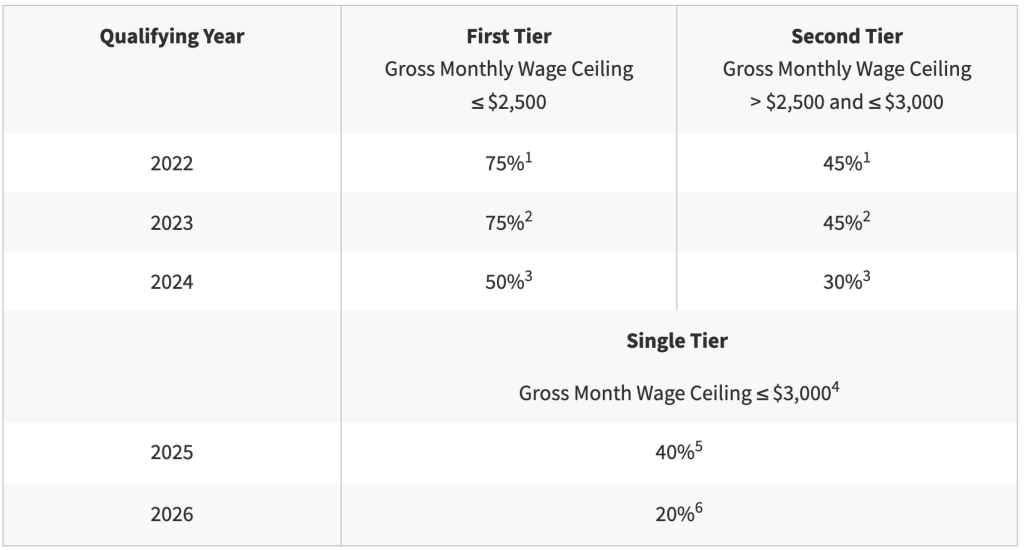
The footnotes refer to the various enhancements to the scheme since it was first introduced in 2022:
1 Co-funding support in 2022 was increased from 50% to 75% for the first tier, and from 30% to 45% for the second tier (announced on 21 June 2022)
2 Co-funding support in 2023 increased from 50% to 75% for the first tier, and from 30% to 45% for the second tier (announced during Budget 2023)
3 Co-funding support in 2024 increased from 30% to 50% for the first tier, and from 15% to 30% for the second tier (announced during Budget 2024)
4 The gross monthly wage ceiling for PWCS co-funding increased from $2,500 to $3,000 in qualifying years 2025 and 2026 (announced during Budget 2024)
5 Co-funding support in 2025 increased from 30% to 40% (announced during Budget 2025)
6 Co-funding support in 2026 increased from 15% to 20% (announced during Budget 2025)
7 For qualifying year 2022, there is no sustained gross monthly wage increase in preceding year, as 2022 was the first year of the Scheme. For qualifying year 2026, wage increases will only be co-funded for one year, since 2026 is the last year of the Scheme
Wage Increases In Each Qualifying Year Is Supported For 2 Years Under Progressive Wage Credit Scheme (PWCS)
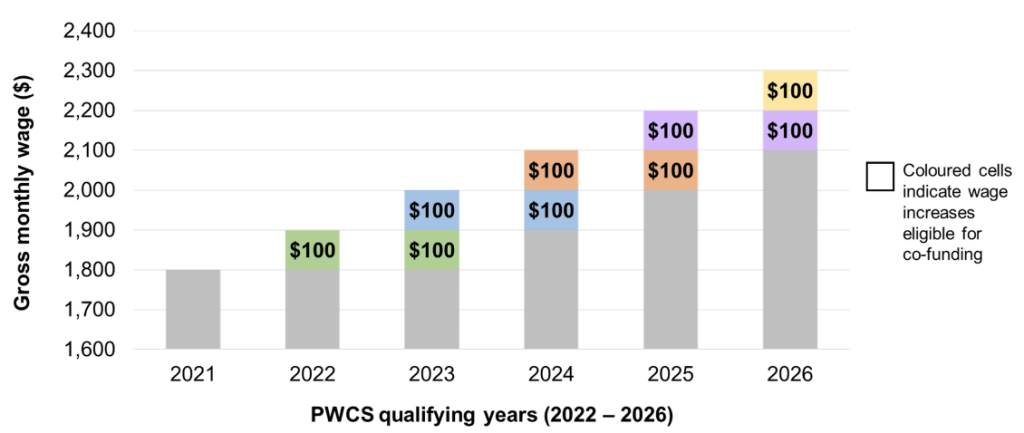
To help employers manage the compounding effect of wage increases year on year, the government is co-funding wage increases in each qualifying year for two years.
For example, an employee earns $1,800 in 2021 and is given an $100 increment annually from 2022 to 2026 (the qualifying period of PWCS). This employee would automatically qualify for the First Tier support in 2022 and 2023, the standardised support from 2024 to 2026.
The 2022 wage increase will be supported at 75% in qualifying year 2022, and this 75% support will continue in 2023, even if there is no additional salary increments.
In 2023, as the wage increases again from $1,900 to $2,000, the new wage increase will also be supported. Similarly, this support will be for two years and will continue into 2024, even if there was no further salary increments.

Employers Will Receive Progressive Wage Credit Scheme (PWCS) Payouts Automatically
There is no need for employers to apply for PWCS, as the wage information is automatically computed. Eligible employers will receive the payouts through the employers’ GIRO bank account for Income Tax/GST. For those without GIRO accounts, the payout will be credited to their bank account that is registered with PayNow Corporate. Employers who are not already on these direct crediting modes will have to sign up for these modes to receive their payouts.
For each qualifying year, eligible employers will be notified by IRAS of the PWCS payout payable to them and the payout will be disbursed by Q1 of the subsequent year.
| Qualifying Year | Payout Period |
| 2022 | Q1 2023 |
| 2023 | Q1 2024 |
| 2024 | Q1 2025 |
| 2025 | Q1 2026 |
| 2026 | Q1 2027 |
Read Also: 5 Ways Businesses Need To Think About Hiring In 2022 (After Budget 2022 Statement)
Subscribe To The DollarsAndSense Business Pass
Enjoy what you are reading and want more? Join The DollarsAndSense Business Pass and unlock access to valuable tools, exclusive networking opportunities, and tap into the wisdom of industry experts to fuel your business expansion!


