

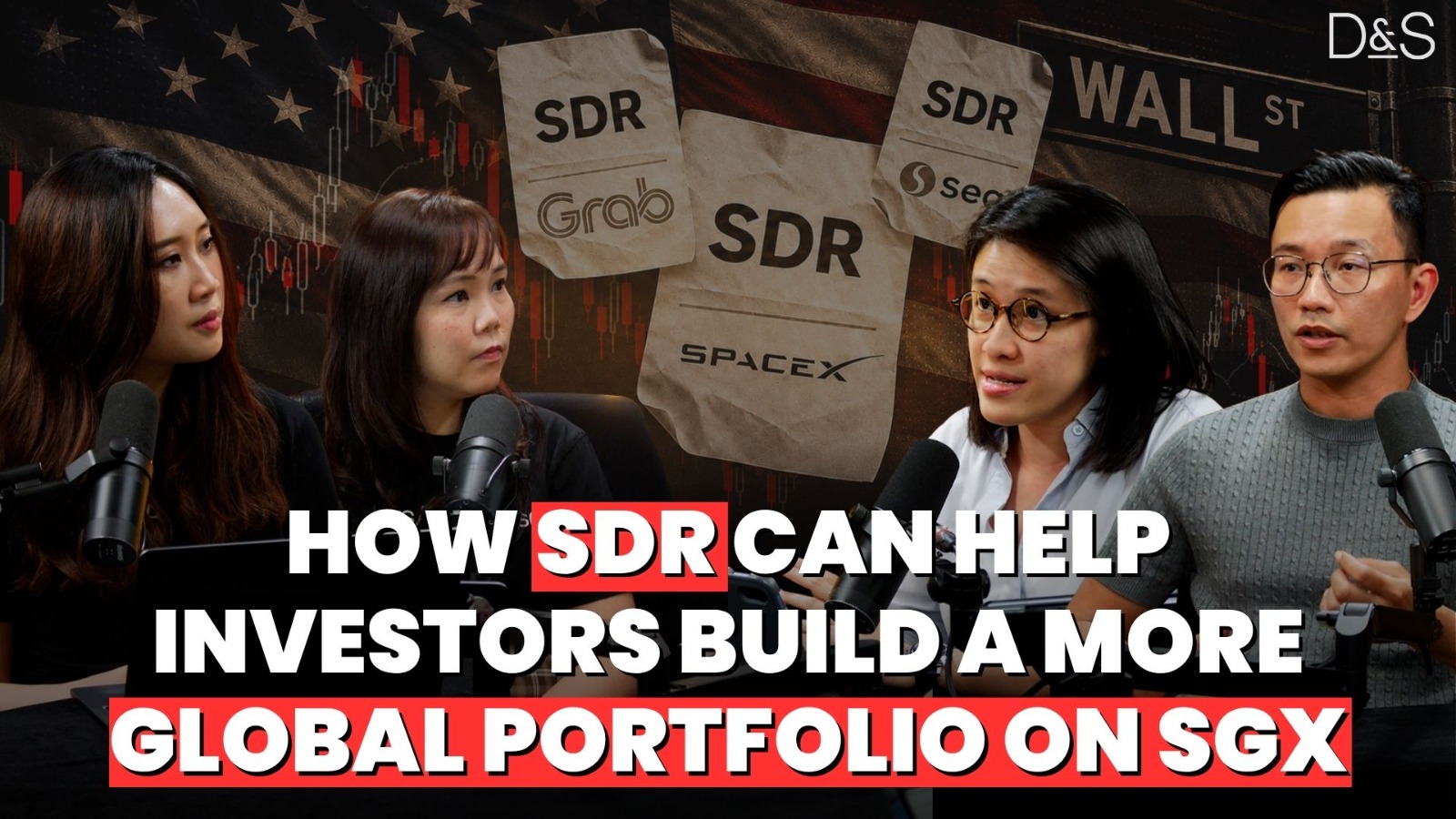
Singapore Depository Receipts give investors another way to access selected overseas companies while trading in Singapore dollars and during SGX market hours.
For many Singapore investors, SGX is closely associated with banks, REITs and other familiar local companies. Singapore Depository Receipts, or SDRs, broaden that universe by allowing investors to gain exposure to selected overseas-listed companies without having to trade directly on their home exchanges.
In this episode of the DollarsAndSense Podcast, Feng Yi and Deanna speak with Bernice, SGX’s product manager for SDRs, and Han Hui, a trading representative from UOB Kay Hian, about how SDRs work, who they may suit and what investors should understand before buying them.
Watch the full episode of DollarsAndSense Podcast here.
What Are You Actually Buying With An SDR?
An SDR is not the same as directly owning the overseas-listed share.
Bernice describes it as a product that represents shares of an overseas-listed company and gives investors exposure to the economic performance of those shares.
“You can think of it like a mirror of the underlying shares,”
This means SDR holders can benefit from changes in the underlying share price, eligible dividends and certain corporate actions. However, they generally do not have direct voting rights because they do not own the underlying shares themselves.
There is also a conversion ratio, which determines how many SDR units correspond to one underlying share. This can make higher-priced overseas stocks more accessible in smaller amounts.
For example, if 100 SDRs represent one underlying share worth around S$155 after currency conversion, each SDR would have an indicative value of about S$1.55.
Why Some Investors May Prefer SDRs
For Han Hui, SDRs are not meant to replace direct overseas investing. Instead, they offer investors another option.
“Different investors have different preferences. Some are comfortable trading directly on foreign exchanges, while others value convenience and simplicity.”
SDRs are traded in Singapore dollars during SGX market hours. For investors interested in US companies, that means they do not have to stay up late to trade during regular US market hours.
The smaller trade size can also make a difference. Bernice notes that many SDRs can be traded with investment amounts below S$300, while buying a standard board lot in some overseas markets can require several thousand dollars.
This can give investors greater flexibility in managing position sizes. It may also appeal to younger investors or those who prefer dollar-cost averaging, where they invest smaller amounts regularly over time.
However, Bernice cautions that a lower minimum investment does not mean the underlying company is more attractively valued. Investors still need to assess the company’s business, growth prospects and valuation.
Diversifying Beyond Singapore’s Main Sectors
Many Singapore portfolios naturally lean towards banks, REITs and dividend-paying companies. While these businesses can provide income and relatively stable cash flows, they also mean local portfolios may be concentrated in certain sectors.
Han Hui sees SDRs as one way to complement those holdings with industries that are less represented on the Singapore market, including artificial intelligence, electric vehicles, e-commerce, robotics and cloud computing.
Among his own clients, names such as Alibaba, Tencent, BYD, CATL and SMIC have attracted interest. Some investors are drawn to individual companies, while others use them to gain exposure to broader long-term themes.
The introduction of US SDRs may also attract investors to familiar businesses such as Grab and Sea. But Han Hui warns against confusing familiarity with investment quality.
“One of the biggest mistakes investors can make is to assume that being a customer of that company makes that company a good investment.”
Investors should still ask how the business makes money, whether revenue is growing, whether it is profitable or moving towards profitability, and whether its current valuation already assumes significant future growth.
Singapore-Dollar Trading Does Not Remove Currency Risk
One misconception investors should avoid is assuming that trading an SDR in Singapore dollars eliminates foreign exchange risk.
It does not.
The underlying shares are still denominated in foreign currencies. If the Singapore dollar strengthens or weakens against the relevant currency, the value of the SDR can be affected even if the underlying share price remains unchanged.
SDRs simplify the transaction because investors trade and settle locally, but the foreign currency exposure remains.
Han Hui also encourages investors to compare more than brokerage commission when deciding between SDRs and direct overseas shares. Foreign exchange costs, market-specific taxes, clearing fees and other charges can all affect the overall cost.
What Are The Trade-Offs?
Convenience comes with some differences that investors should understand.
The underlying foreign shares generally have deeper liquidity because they trade on their primary exchanges. SDRs instead rely on market makers to provide liquidity and help keep prices aligned with the underlying shares.
Trading hours can also matter. If the overseas market is open while SGX is closed, investors cannot immediately adjust their SDR positions in response to market-moving news.
Bernice also points out that SGX regulates the SDR issuer, not the underlying overseas company. Investors therefore still need to follow company announcements and disclosures through the relevant home exchange.
Dividends may also be treated differently. The SDR issuer may receive a foreign-currency dividend, convert it into Singapore dollars and then distribute it to SDR holders. The final amount can be affected by withholding tax, currency conversion and issuer fees.
Who Might Find SDRs Useful?
There is no single right choice between SDRs and direct overseas investing.
Han Hui says SDRs may appeal to investors who value Singapore market hours, Singapore-dollar trading and smaller position sizes. More active investors who want deeper liquidity, a wider selection of securities or more advanced trading strategies may still prefer foreign exchanges directly.
Some investors may even use both.
Bernice sums up the role of SDRs neatly:
“Your investment ideas are global, but your trading habits are local.”
For investors who fit that description, SDRs can be another way to diversify beyond Singapore without completely changing how they invest.
Read Also: Investing In Overseas Stocks: What’s The Difference Between SDRs And Buying Overseas Directly?


Family Planning
How Much Does It Cost To Raise A Child In Singapore Till Age 18?

Family Planning
Complete Guide To Childcare Operator Fees In Singapore


