According to the Ministry of Manpower’s Job Vacancies report, employers have faced less difficulties filling their job openings. Undoubtedly, one of the reasons was due to the lifting of border restrictions – and employers were able to backfill positions vacated by non-residents.
We read the Job Vacancies report, and here are 5 things we learned about the state of job vacancies in Singapore.
#1 Record Low Vacancies Unfilled For At Least 6 Months
The proportion of job vacancies that were unfilled for at least 6 months fell to a record low of 27% in 2022. Comparatively, it was at 35% in 2021. This was mainly a result of firms backfilling openings in the Manufacturing and Construction sectors after border restrictions were significantly lifted.
Non-PMET vacancies registered a sharper decline than PMET vacancies. This highlighted that employers are facing fewer challenges filling non-PMET roles. The report also suggested that this is a reflection of efforts to redesign non-PMET jobs to make them more attractive to resident job seekers.
Even over the longer term, the difficulties in filling non-PMET roles has been on a downtrend – from over 55% in 2012 to 34% today. Conversely, the difficulties in filling PMET roles have slightly increased in the past decade.

Nonetheless, it remains easier to fill PMET job openings compared to non-PMET ones (21% vs 34%).
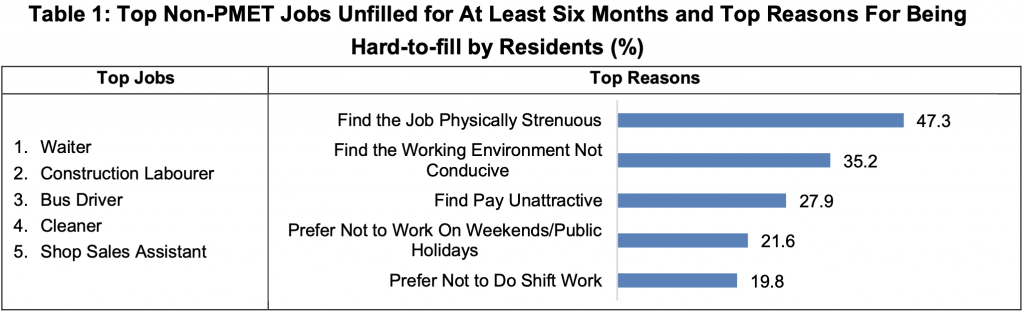
The majority of non-PMET roles that remain unfilled after 6 months were for jobs such as waiters, construction labourers, bus drivesr, cleaners and shop sales assistants. Many of these job scopes currently already fall under the Progressive Wage Model (PWM) – where the government is championing and supporting the uplifting of salaries.

Read Also: Top 9 Job and Internship Portals For Employers Hiring In Singapore
#2 Skilled Manpower (PMETs) Continue To Be Highly Sought After
PMET vacancies continue to form the majority of available positions, with a 56% share in 2022 compared to a 53% share in 2021.
We can see in the chart below that there had been a rising demand (line in blue) for PMET roles until the pandemic in 2020. And now, post-pandemic, this looks to be a normalisation of the trend.

This underscores the continued demand for skilled manpower in Singapore, especially in growth sectors such as 1) Information & Communications, 2) Financial & Insurance Services, 3) Professional Services and 4) Health & Social Services.
Moreover, technology-related skills such as software, web & multimedia developer and software & applications manager were highly sought after. This is on the back of ongoing digitalisation trends.
Employees with business development and sales experience also continue to be in demand. As was the case for healthcare professions, such as registered nurses, as the healthcare sector continue to be in demand.
#3 Increasingly, Academic Qualifications Do Not Rank A Candidate Ahead
For 74% of job vacancies, academic qualifications was not the main determinant of hiring. This is higher than 67% in 2017 – and largely driven by PMET roles.
For PMET roles were academic qualification was not the main determinant, skills and work attitude of the applicant were the key considerations. For non-PMET roles, academic qualifications were expectedly not the main consideration. Instead, relevant work experience and skills were most crucial to recruiting the candidate.
#4 Only 21% Of Job Vacancies Involve Work That Can Be Done Remotely
The proportion of job vacancies that involve remote work fell to 21% in 2022 – compared to 31% in 2021. This is a reflection of the normalisation of remote work trends, especially as economic activities gain momentum and pandemic-related restrictions eased in 2022.
Also, due to the nature of work in certain sectors, remote working is more available to PMET roles compared to non-PMET roles. In 2022, 37% of PMET vacancies were for roles that could be done remotely, while only 3% of non-PMET roles were for remote work.
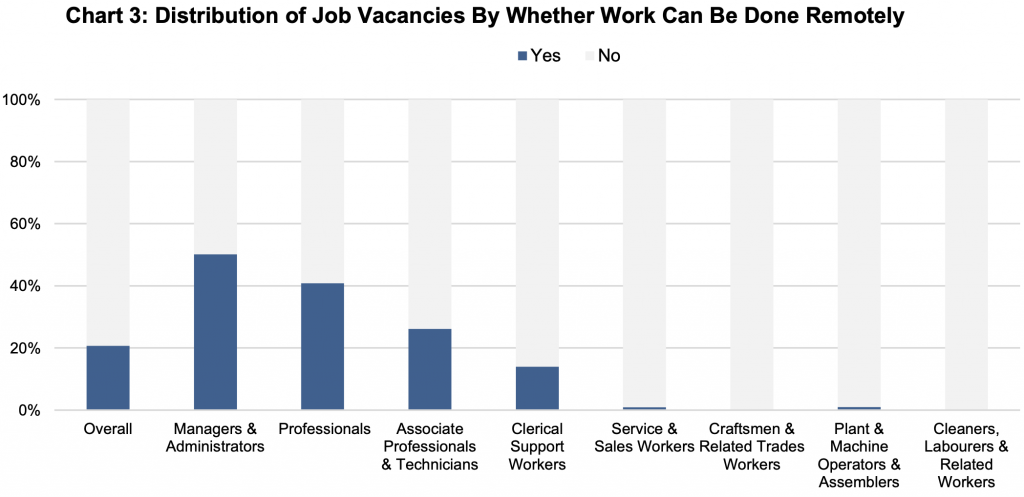
As we can see, even though remote work is more possible for PMET roles, even at the highest rate (for Managers & Administrators), only about half of the roles were for remote work.
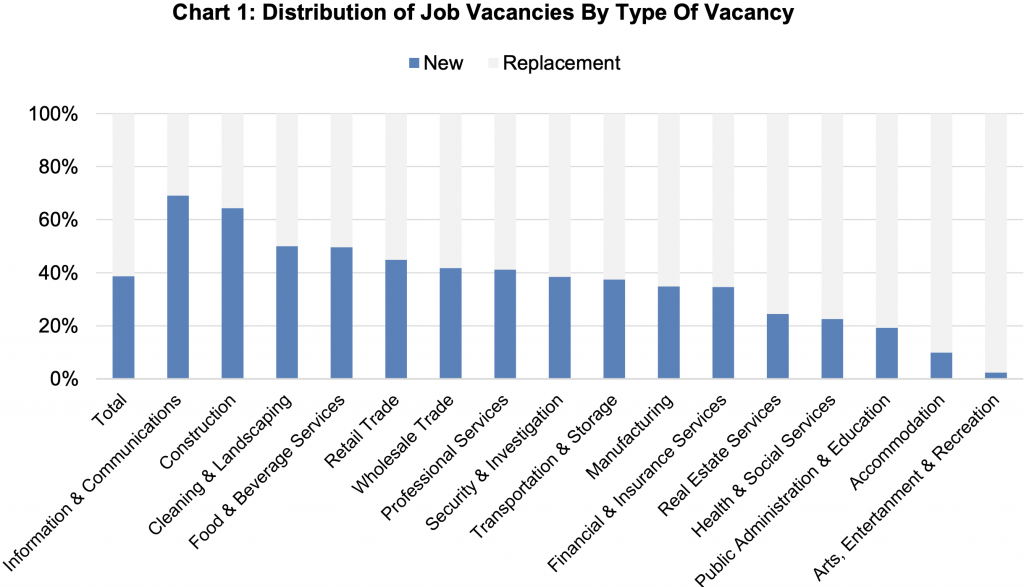
#5 39% Of The Job Vacancies Were For Newly Created Positions
Job vacancies can be for positions that are newly created or replacements for employees who leave. In 2022, openings that were for newly created positions fell to 39%, from 44% in 2021.
One of the reasons, highlighted in the report, is that employers prioritised filling positions that had been left vacant during the pandemic. This is logical as pandemic-related work and border restrictions eased and workplace activities gained traction.
The Information & Communications sector had the highest proportion of vacancies for new positions. Traditionally non-PMET sectors such as the Food & Beverage Services, Retail Trade and Cleaning & Landscaping also saw higher vacancies for new positions.
We can also see in the chart that many sectors are still looking to just fill up replacement vacancies.
Read Also: Progressive Wage Model: How Much Will Singapore Employers Have To Pay Their Workers
Subscribe To The DollarsAndSense Business Pass
Enjoy what you are reading and want more? Join The DollarsAndSense Business Pass and unlock access to valuable tools, exclusive networking opportunities, and tap into the wisdom of industry experts to fuel your business expansion!