Singapore’s employment rate has demonstrated resilience and adaptability. In 2023, the employment rate of residents aged 25 to 64 was at the elevated level of 82.6%, higher compared to a decade ago when the employment rate was just under 80%.
Moreover, residents generally saw an increase in wages over the past few years. This reflects Singapore’s forward-thinking approach to labour market development, characterised by initiatives that promote upskilling, industry transformation, and support for both local and global talent.
The Singapore Public Sector Outcomes Review (SPOR), published biennially by the Ministry of Finance (MOF), serves as a vital pulse-check for the country’s progress across key areas of development. It provides a comprehensive analysis of achievements and challenges from both citizen and business perspectives, ensuring transparency and accountability on both sides.
The SPOR 2024 highlights Singapore’s resilience in the face of global disruptions, including economic uncertainties and the rapid evolution of industries.
Reading it, here are 5 insights we gained on the policies shaping Singapore’s labour market and the transformative strategies anchoring its status as a global hub.
#1 Real Value-Added (VA) Per Worker Grew 2.4% Annually From 2016 To 2023
One of Singapore’s most notable achievements has been the consistent rise in labour productivity. The Industry Transformation Maps (ITMs) are strategic frameworks launched by the Singapore government to drive transformation across 23 key industries.
They are grouped into six clusters (Manufacturing, Built Environment, Trade and Connectivity, Essential Domestic Services, Modern Services and Lifestyle). These ITMs aim to enhance productivity, foster innovation, develop skills, and support businesses in internationalisation.
Introduced as part of the $4.5 billion Industry Transformation Programme in 2016, ITMs take an integrated approach, involving collaboration among the government, industry players, unions, and educational institutions.
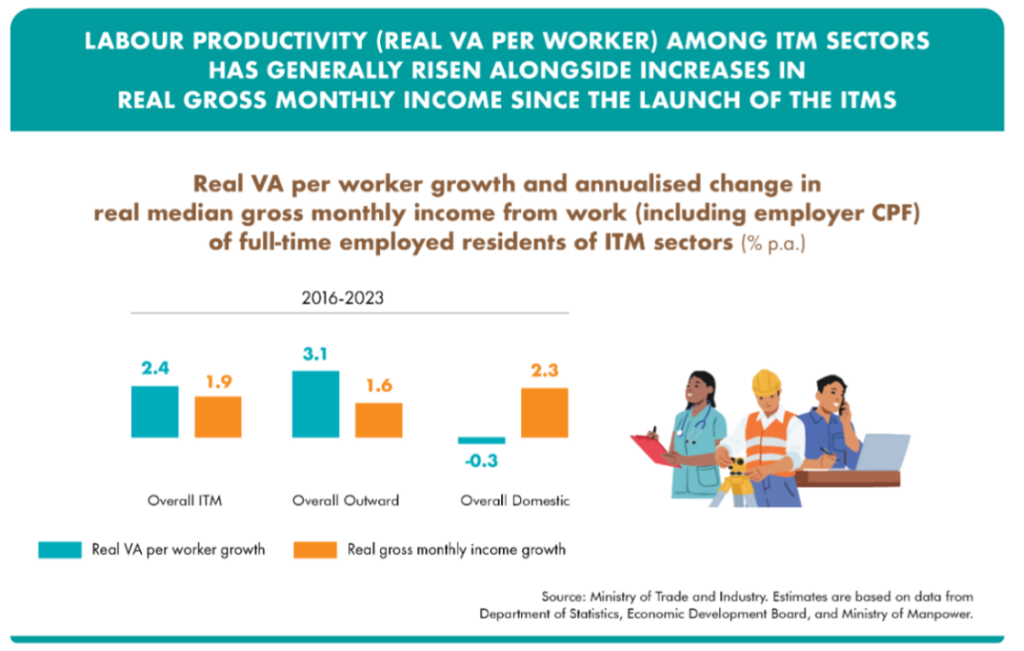
ITM sectors recorded an average annual productivity growth of 2.4% from 2016 to 2023, with industries oriented towards external markets outperforming domestic ones. This reflects the country’s commitment to fostering globally competitive sectors.
Higher productivity has had a direct impact on workers’ incomes. Real median income rose at an annual average rate of 1.9% during the same period, benefitting employees across various industries. This aligns with Singapore’s broader goal of ensuring that economic growth translates into tangible benefits for its workforce.
Source: spor.performancereports
While productivity gains are promising, adapting to automation and digitalisation remains a key focus. Efforts to integrate technology while upskilling workers ensure that employees remain relevant in an evolving labour landscape.
The government introduced targeted programmes like the Productivity Solutions Grant (PSG). This scheme provides financial support for IT solutions and equipment which enables businesses to adopt advanced technology and improve operational efficiency.
#2 Over 220,000 Workers Received Training In 2023
Singapore consistently ranks among the world’s most competitive nations for talent. In 2023, it achieved second place in INSEAD’s Global Talent Competitiveness Index and maintained a strong position in the International Institute for Management Development (IMD) World Talent Ranking in 2024. These rankings underscore Singapore’s success in creating an environment conducive to talent attraction, development, and retention.
To address rapid changes in technology and business practices, Singapore has prioritised workforce development through initiatives like SkillsFuture. Over 220,000 workers received training in 2023, focusing on digital literacy, cybersecurity, and sector-specific competencies. This initiative also emphasises lifelong learning, equipping workers with tools to adapt to diverse challenges.
SkillsFuture’s Queen Bees programme, in particular, has been transformative. By collaborating with larger firms, it empowers SMEs to enhance their workforce capabilities. Since its inception, the programme has supported over 3,500 businesses.
The rise of digital and green economies has prompted Singapore to expand training capacities. In 2023, new courses were introduced in sustainability, data analytics, and green financing. By pre-emptively addressing these growth areas, Singapore ensures its workforce is future-ready.
Read Also: Complete Guide To SkillsFuture Credits – And How Singaporeans Can Use Them
#3 Multiple Initiatives To Develop Singaporeans As Global Leaders
Programmes such as the International Postings Programme (iPOST) and the Global Business Leaders Programme (GBLP) are designed to develop Singaporeans as future leaders in a globalised world.
These initiatives offer invaluable overseas exposure, fostering cross-cultural understanding and managerial expertise. By building a robust leadership pipeline, Singapore aims to enhance its presence in international markets.
Schemes like the Overseas Markets Immersion Programme exemplify Singapore’s commitment to developing local talent.

Source: wsg.gov.sg
By subsidising training costs for businesses to support their employees in international work environments, these schemes strengthen Singapore’s workforce while enhancing its global connectivity.
The nation’s workforce policies encourage lifelong career growth. Career conversion programmes and mid-career pathways offer support for workers transitioning to new industries, ensuring that individuals remain employable and versatile.
#4 Various Schemes To Attract & Integrate Global Talent Into Singapore
As of June 2024, over 1.5 million foreign workers were employed in Singapore, accounting for approximately 40% of the workforce. Which shows that global talent plays a vital role in complementing Singapore’s local workforce.
Policies such as the Complementarity Assessment Framework (COMPASS) ensure that foreign professionals, managers, executives, and technicians (PMETs) fill their respective critical skills gaps while integrating seamlessly into the labour ecosystem.
COMPASS evaluates applications holistically, aligning foreign employment with Singapore’s long-term economic priorities.

Source: Ministry Of Manpower
In 2023, the Overseas Networks and Expertise (ONE) Pass was launched to attract top-tier international talent. This pass offers flexibility in employment arrangements, making Singapore an
attractive destination for highly skilled professionals. By January 2024, over 4,200 applications had been approved, with many talents contributing to cutting-edge fields like the green economy and advanced manufacturing.
Singapore’s approach ensures that the integration of global talent benefits local workers. By fostering knowledge exchange and collaboration, foreign professionals contribute to upskilling the country’s workforce, enhancing its overall competitiveness.
Read Also: How Singapore Is Competing Globally In The War For Talent
#5 Digital Economy, Healthcare And Green Industries To Play Key Role In Workforce Transformation
Workplace learning has emerged as a cornerstone of workforce development. The National Centre of Excellence for Workplace Learning (NACE) has supported over 2,500 businesses, helping them establish structured on-the-job training systems. This approach reduces reliance on external courses, improves employee retention, and fosters a culture of continuous learning.
The digital economy, healthcare, and green industries are key drivers of Singapore’s workforce transformation. In 2023, the government expanded training offerings for these sectors, addressing critical gaps and preparing workers for the future.
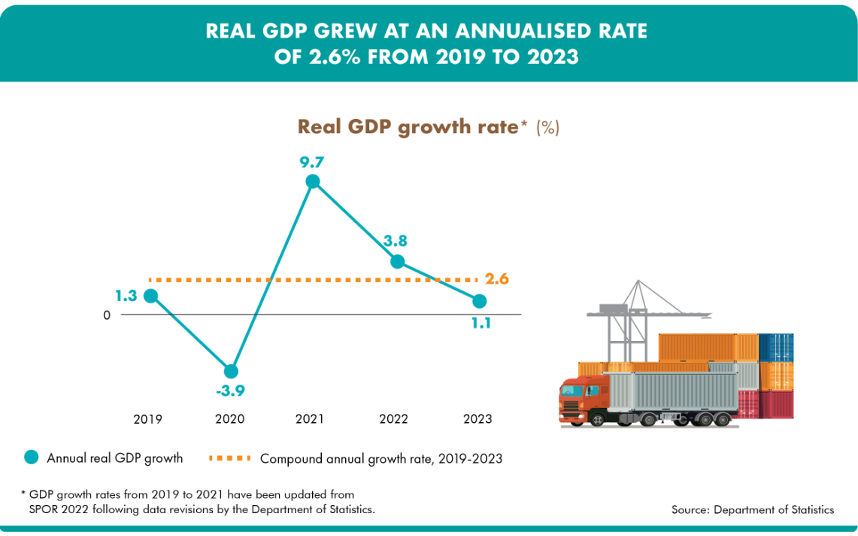
Especially for the digital economy as real GDP is expected to grow by 2.0% to 3.0% in 2024, supported by a gradual pickup in the manufacturing and trade-related sectors on the back of robust electronics demand.
Source: Singapore Public Sector Outcomes Review
The healthcare sector, for instance, saw an increased focus on eldercare training, reflecting the needs of Singapore’s ageing population.
Singapore’s push for digitalisation extends to workforce training. AI and virtual reality tools are increasingly integrated into training programmes, offering immersive learning experiences that enhance skill acquisition.
Rocky Road Ahead, But Singapore Businesses And Her Workforce Are Resilient
Singapore faces challenges in managing economic uncertainties while sustaining workforce development. Global disruptions, such as technological shifts and supply chain disruptions, demand agile responses.
The government’s proactive strategies, including risk-sharing schemes (such as the Special Risk Sharing Initiative) and financial support goes some way towards mitigating these challenges.
While government initiatives are pivotal, active collaboration with industries is equally essential. Businesses must play a proactive role in implementing training programmes and adopting inclusive hiring practices. Partnerships between public and private sectors remain a cornerstone of Singapore’s labour market strategy.
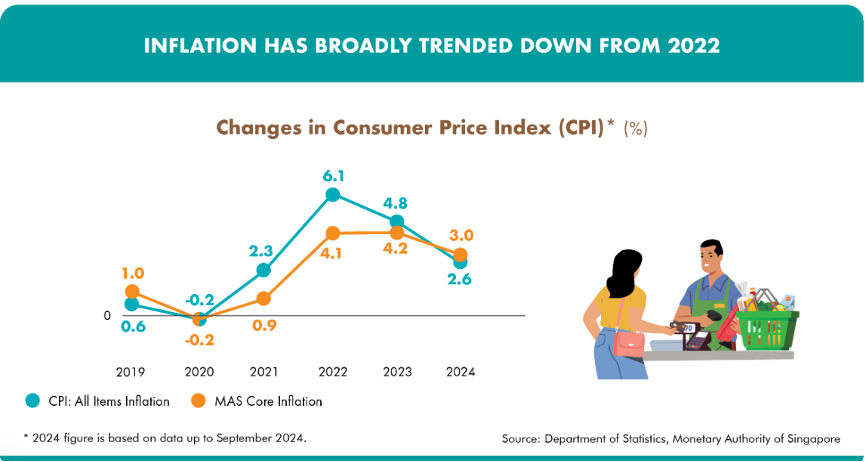
In addition to economic productivity, worker well-being is gaining attention. Programmes addressing mental health, workplace flexibility, and work-life balance are being prioritised to enhance job satisfaction and retention. And due to dissipation of labour market tightness as a factor, Inflation had remained elevated in 2023 but had slowed significantly over 2024.
Source: Singapore Public Sector Outcomes Review
The 2024 SPOR reaffirms Singapore’s commitment to fostering a dynamic, skilled, and inclusive workforce. From robust upskilling initiatives to targeted programmes bridging local and global talent, Singapore’s policies exemplify thoughtful planning in a rapidly evolving world.
Singapore is not only preparing its workforce for the future but also cementing its reputation as a resilient and thriving economy. For more information on the latest Singapore public sector outcomes review, visit the SPOR 2024 website.
Subscribe To The DollarsAndSense Business Pass
Enjoy what you are reading and want more? Join The DollarsAndSense Business Pass and unlock access to valuable tools, exclusive networking opportunities, and tap into the wisdom of industry experts to fuel your business expansion!