
As the economy recovers and workers return to office, the labour market has been enjoying a resurgence. Most of Singapore’s labour market has returned to or are performing better than pre-COVID levels, including real median income increased by 2.1% in 2022.
Yet, there is one startling statistic in MOM’s 2022 Q3 Labour Market Report: retrenchment increased by 35%.
Retrenchment Increased By 35% To 1,120 In 3Q2022
While the percentage increase in retrenchment is high (35%), the number of retrenchments in 3Q 2022 is 1,120, an increase from the record low of 830 recorded in 2Q 2022. This is below the peak retrenchment during the start of the pandemic and is lower than the pre-pandemic period.
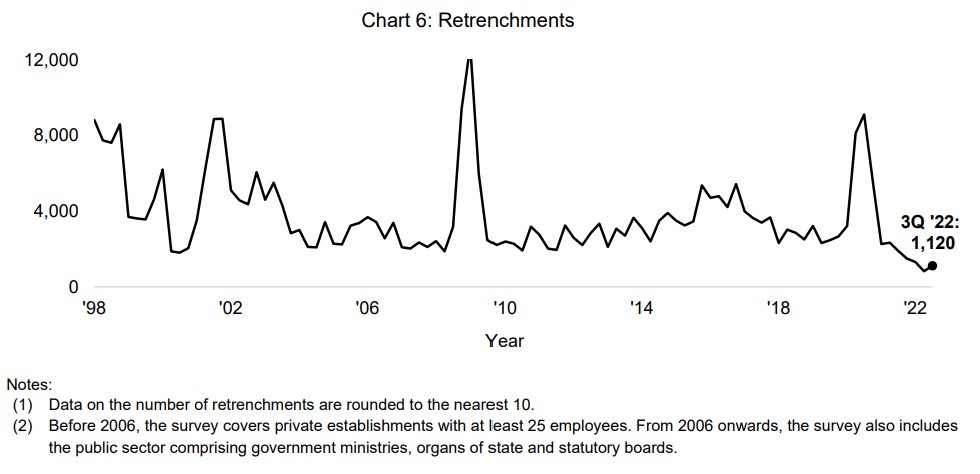
The increase in retrenchment is driven by layoffs in the Information & Communication sector. This is a reflection of restructuring and cost-cutting measures that a number of prominent tech firms (including Sea) are undergoing.
However, retrenchment numbers have remained relatively low as retrenchment in other sectors such as Accommodation and Construction stay low due to strong hiring in the third quarter.
Read Also: The Twitter Retrenchment: Why Labour Unions Are Still Relevant Today
A Typical Retrenched Worker In 3Q2022 Is A Younger PMET Degree Holder
Unlike the common stereotype of a retrenched worker, a worker who is in a PMET role, holds a degree and aged below 40 is more likely to have been retrenched in 3Q2022. This profile of workers matches that of those working in tech firms in the Information & Communication sector.
On the positive, many workers are able to find another job within six months. Re-entry into employment rate for retrenched residents at 64.8% remained higher than pre-pandemic (the quarterly average in 2018 and 2019 was 63.6%). However, this is down from the peak of 71.5% in the first quarter of 2022.
Job vacancies for Information & Communication sector also remained high. 32% of job vacancies in September 2022 came from the growth sectors of Information & Communications, Financial & Insurance Services, Professional Services and Health & Social Services.
Overall Labour Market Remains On A Growth Trajectory
Total resident employment is 4.4% above the pre-pandemic levels. Total employment growth was higher in 3Q 2022 (75,900) than in 2Q 2022 (66,500) of which 4,800 was resident employment.
The Financial Services, Professional Services, and Information & Communications sector hired the most resident employees while the Accommodation sector had a seasonal increase in resident employees due to the F1 Grand Prix.
Most of the non-resident employment increase was due to the Manufacturing and Construction, sectors. Food & Beverage Services and Arts, Entertainment & Recreation sectors also hired more non-residents.
On the flip side, unemployment rates have also returned and remained at around pre-pandemic levels. The seasonally adjusted unemployment rates were 2.0% for overall, 2.8% for resident and 3.0% for citizen. The resident long-term unemployment rate (LTUR) has also returned to its pre-COVID quarterly average of 0.7% in 2018/198 since June 2022.
Read Also: Singapore’s Unemployment Falls To A 6-Year Low But Is The Labour Market As Rosy As It Seems?
MOM expects overall employment growth in the next quarter to remain robust, growth could be uneven across sectors. As hiring for the festive season steps up, tourism-related sectors such as Accommodation and Food & Beverage Services should see higher employment growth. However, outward-facing sectors like Manufacturing may experience subdued growth due to the challenging economic climate.
While this labour market retains its growth in 3Q2022, there are signs that the overall economic outlook is less rosy. MTI’s latest GDP forecast in November 2022 puts the GDP growth forecast for Singapore at “around 3.5%” for 2022 and “0.5% to 2.5%” in 2023. For employers and employees, this lowered economic forecast for 2023 may mean changes in the overall positive labour market environment in the year ahead.
Subscribe To The DollarsAndSense Business Pass
Enjoy what you are reading and want more? Join The DollarsAndSense Business Pass and unlock access to valuable tools, exclusive networking opportunities, and tap into the wisdom of industry experts to fuel your business expansion!