For most of us, this instruction is familiar:
“Put your own oxygen mask on first before helping others to do so.”
It’s what you’re told in an aircraft emergency. The logic is straightforward. You cannot support someone else if you’re struggling to breathe yourself.
But if we extend that metaphor to mental health, another question emerges: how much turbulence does it take for the masks to even drop? And what happens when support doesn’t arrive in time?
In Singapore, navigating mental healthcare often means long waits and high costs. A subsidised appointment to see a psychiatrist can take months. Private sessions might be faster, but they come with a price tag—often ranging from $80 to $200 or more per session. These obstacles can discourage help-seeking altogether.
Meanwhile, those in distress tend to lean on the people closest to them—friends, co-workers, teachers, and family. But while most of us want to help, few of us are equipped to do so effectively.
Where Help Usually Starts
Before a person reaches a professional, they usually turn to someone they trust: a friend, a teacher, a parent or a colleague. These first points of contact matter. But most people in these roles don’t feel equipped to help. They may not know how to respond or what to say. The intention is there, but the tools are often missing.
This is the gap that the Over-The-Rainbow (OTR) Academy is aiming to fill. The Academy offers structured, accessible training & certification for individuals who want to support others but lack the formal background. Instead of waiting until someone is in crisis, the Academy prepares people to step in earlier, with the skills, empathy and confidence.
Its approach doesn’t aim to replace professional therapy or psychiatric care. It complements them and strengthens the support system deep in the community – where and when it’s needed most.
Grounded In Experience
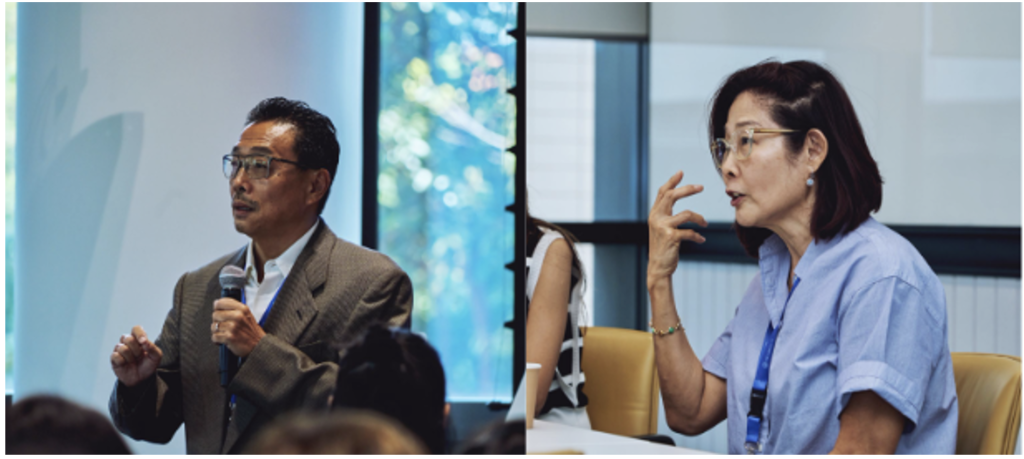
The founders of OTR, Yen-Lu and Yee Ling Chow, created the OTR Academy in response to a simple but urgent need. People are struggling, and the traditional system, while necessary, is stretched. By empowering individuals in the community to support one another, OTR hopes to lighten that load and offer an earlier, more human layer of care – one is by the community, for the community.
The training is practical. The philosophy is simple. The impact, if scaled, could transform how mental health support looks in schools, homes, and workplaces across Singapore.
Community-Led, Science-Backed Support
The OTR Academy’s program is a two-tiered model: entry-level tier Wellbeing Champions and a more advanced tier of Wellbeing Mentors. These are not professional therapists. They are everyday individuals – parents, educators, co-works, peers – who wish to contribute meaningfully to the mental wellbeing of their communities.
Participants undergo a structured course that combines live classes, guided self-study and practicum experience over three to four months. The curriculum includes foundational topics such as mental health literacy, self-care, empathic communication and the science of wellbeing. Sessions are offered in a hybrid format, with a mix of virtual and in-person modules to accommodate different schedules.
The training is evidence-based and practical. It is designed to be accessible in terms of both cost and time. Courses are priced affordably and require only a few days of structured instruction, followed by a practicum that can be completed with a flexible schedule.
What graduates leave with is not just knowledge and skills, also a wellbeing toolkit, and a clear sense of how to support others without neglecting themselves.
Self-Care As The Starting Point
At the heart of the OTR Academy’s model is a deceptively simple idea: before you can help someone else, you need to take care of yourself. This isn’t about bubble baths or retail therapy. OTR defines self-care as an inner practice—one that includes emotional regulation, mental awareness, and even spiritual grounding.
The spiritual dimension is approached from a non-religious angle. It focuses on personal meaning, inner purpose and self-awareness. These qualities may not always be visible, but they often shape how someone responds under pressure or shows up for others.
The Academy’s view is that sustainable support begins with personal wellbeing. It is not enough to be willing to help. A person also needs the clarity, presence and grounding to do so effectively.
Building The Circle Of Care
OTR Academy’s long-term goal is to build what it calls a “circle of care”, a network of individuals who are trained, steady, and present in their communities.
When someone gets certified as a Wellbeing Champion or Wellbeing Mentor, they bring with them the skills and knowledge which form the heart of their own circle of care support ecosystem and anchor of resilience in the community. As the community of these wellbeing practitioners grow, OTR envisions these individual “circles of care” rippling outward to form a community-powered mental health network across schools, workplaces, and neighbourhoods.
This approach doesn’t replace professional therapy or psychiatry, but complements it. It recognises that the system, as it stands, is under strain and over stretched. And when appointments take months and cost hundreds of dollars, having a certified wellbeing mentor in your immediate network who knows how to listen empathetically and point you to resources can make all the difference.
The Academy’s mission is to train and certify 10,000 wellbeing practitioners over the next 5-10 years. It is an ambitious goal, but one rooted in more than a decade of work. Over-The-Rainbow has spent 13 years leading mental wellness initiatives for youth, parents and community members. The Academy builds on that experience by offering a formalised, scalable version of what the organisation has been doing for years.
A Small Step With Big Potential
Enrollment is now open. Anyone can apply, though the programme is especially suited for parents, teachers and those in community or workplace leadership roles.
Participants don’t need prior experience in psychology. They only need a willingness to learn and a commitment to their own wellbeing. Because before anyone can help someone else, they need to be steady themselves.
For those interested in joining, more details are available at https://otrlistens.net/academy
This article was shared to us by Alpha Story.
Subscribe To The DollarsAndSense Business Pass
Enjoy what you are reading and want more? Join The DollarsAndSense Business Pass and unlock access to valuable tools, exclusive networking opportunities, and tap into the wisdom of industry experts to fuel your business expansion!


