It’s not surprising to know that the government has placed a great emphasis on protecting and creating jobs in 2020. On the back of the COVID-19 pandemic, Singapore is expected to witness the worst economic contraction on record – between -6.5% to -6.0%, according to the Ministry of Trade and Industry (MTI).
To give local residents and businesses a better grasp of the jobs market and business sentiments, the Ministry of Manpower (MOM) has been issuing regular Jobs Situation Reports every week or so, as well as updated monthly unemployment statistics.
In the latest Jobs Situation Report (15th Edition), the healthcare sector came into focus – with the government underlining its 3-pronged approach to support careers in the sector.
Read Also: 10 Ways COVID-19 Impacted Singapore Workers: MOM Labour Force In Singapore Advance Release 2020
Singapore’s Healthcare Sector: Offering Second Highest Number Of Opportunities
Supported by more than 100,000 workers, Singapore’s healthcare sector is well-regarded regionally and internationally. Given the fact that the current economic downturn is related to a health crisis means the healthcare sector has come under the spotlight – with temporary labour shortages.
While much of the shortage of labour are short-term in nature, the long-term needs of a robust healthcare system is bolstered by an ageing population, rising chronic diseases and regional healthcare demand.
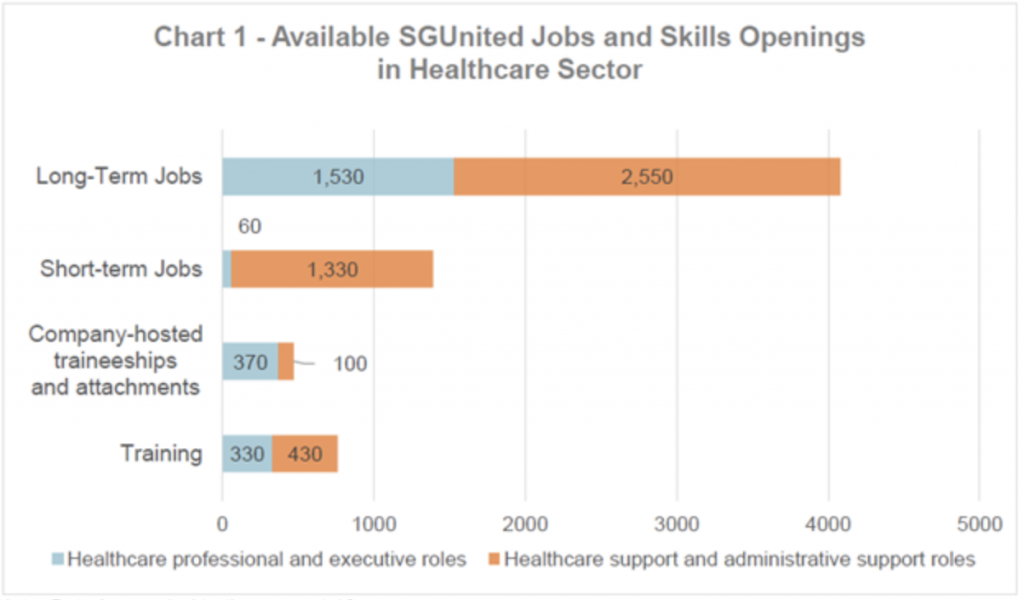
The healthcare sector has also yielded the second-highest demand for SGUnited Jobs & Skills openings and placements – behind only the technology sector.
Read Also: 5 Things To Know About Singapore’s Tech Sector: MOM’s Jobs Situation Report 14th Edition
As at the end of November, there were 6,700 such openings for workers with both healthcare and non-healthcare backgrounds. More than 80% of these roles are offered by the public healthcare cluster and community care organisations, while the rest are offered by healthcare firms such as Parkway Hospitals, Healthway Medical Group and Q & M Dental.
Understandably, only 30% of the openings are for healthcare professionals, such as nurses and allied health professionals, and executive roles, such as finance and human resource executives. The remaining 70% are in healthcare support.
Government’s 3-pronged Approach To Support Careers In The Healthcare Sector
Between April to end-November, 8,340 jobseekers have already been placed into healthcare opportunities. However, 71% of them were in short-term roles, given the temporary spike in demand for swabbers and care ambassadors because of COVID-19.
Nevertheless, the healthcare sector has the potential for a wide range of jobs as well as for those in current short-term roles to transit into longer-term positions.
To facilitate this, the government and industry is working on a 3-pronged approach to support careers in the healthcare sector.
#1 Ensuring Pre-Employment Readiness
The foundational strategy is to ensure there is a steady talent stream ready to enter the sector to meet the increasing manpower demand in the healthcare sector.
To achieve this, the government is working closely with Institutes of Higher Learning (IHLs) to grow the local healthcare talent pool. This likely translates into more support for bigger cohorts, as well as identifying new and complementary areas of expertise to offer in education and training.
For example, from 2014 to 2019, local nursing intake increased 50% from 1,500 to 2,200. New programmes such as Dietetics and Nutrition, Speech and Language Therapy and others have also been recently introduced to boost complementary healthcare solutions in Singapore.
Scholarships have also been ramped up to encourage healthcare training at both undergraduate and postgraduate levels.
#2 Facilitating Smooth Entry Into Employment
Unqualified or underqualified mid-career locals can tap on government programmes such as the Professional Conversion Programme (PCP) to ready themselves for roles in the healthcare sector. Examples of roles individuals can take on include nurses, physiotherapists, occupational therapists and diagnostic radiographers.
The current pandemic has also led to an increase in demand to pursue healthcare-related qualification among mid-career switchers. For example, there were 3 times as many applications for October 2020’s PCP-Registered Nurse’s (Diploma) compared to April 2020.
Read Also: How Companies Can Tap On The Professional Conversion Programme (PCP) To Reskill Your Employees
Other interested applicants can also embark on Place-and-Train programmes by Workforce Singapore (WSG) to acquire relevant skills. One example is the programme for Dental Surgery Assistants (DSAs) to acquire skills such as dental administration and communication, infection control and sterilisation, and dental radiology offered by Q & M Dental.
The Agency for Integrated Care (AIC) has also introduced Senior Management Associate Scheme for mid-career locals to take on leadership or managerial roles in non-healthcare scopes such as financial management, accounting, human resources, or digitalisation of business processes.
The industry is also working in tandem with government support to redesign healthcare jobs even for individuals with no relevant experience. This may entail blending clinical support with administrative and operations responsibilities. Training, on-boarding and orientation are typically provided by employers. Individuals may also be enrolled into a relevant course after being put into a role.
#3 Supporting Lifelong Learning
To ensure workers in Singapore’ healthcare sector continues to upskill and remain relevant, lifelong learning is a core pillar in the government’s efforts.
Training grants for healthcare professionals to take on skills attachment or formal postgraduate opportunities is provided. Community care is another important area in Singapore’s healthcare sector – with the Community Care Training Grant and the Community Care Manpower Development Award available for employers to send their staff for training and upskilling.
The government has also worked with the healthcare industry to shortlist relevant transferrable skills and acquirable skills that will help interested candidates better transit into a career in the healthcare sector. They include:
| Transferrable Skills | Skills That Can Be Acquired |
| Communication | Emergency Response and Crisis Management |
| Decision Making | Frontline Services Management |
| Interpersonal Skills | Infection Control |
| Problem Solving | Patient Care |
| Service Orientation | Change Management |
| Stakeholder Management | Stakeholder Management |
| Teamwork | Patient Education and Engagement |
| Adaptability | Professional, Legal and Ethical Healthcare Practice |
| Resilient | Quality Improvement and Safe Practice |
| Service Quality Management | |
| Workplace Safety and Health | |
| Health Promotion | |
| Nursing Productivity and Innovation |
Source: Jobs Situation Report (15th Edition)
Read Also: Top 6 Transferrable Skills Employers Are Looking For, According To MOM
Subscribe To The DollarsAndSense Business Pass
Enjoy what you are reading and want more? Join The DollarsAndSense Business Pass and unlock access to valuable tools, exclusive networking opportunities, and tap into the wisdom of industry experts to fuel your business expansion!