
In Singapore, the Employment Act sets out the statutory requirements that employers must fulfil when hiring employees under a contract of service. These apply for both local and foreign employees, whether they are full-time, part-time, temporary or contract workers. The only exceptions are seafarers, domestic workers and statutory board employees or civil servants who are not covered by the Employment Act.
One of these statutory requirements is to provide employees an itemised payslip. Effective since 1 April 2016, the itemised payslip and key employment terms (KETs) were included in the Employment Act to reduce misunderstandings and minimise disputes between employers and employees.
Read Also: Singapore Employment Act: 10 Statutory Requirements To Pay Employees
When Should Itemised Pay Slips Be Issued And How Long Should The Records Be Kept?
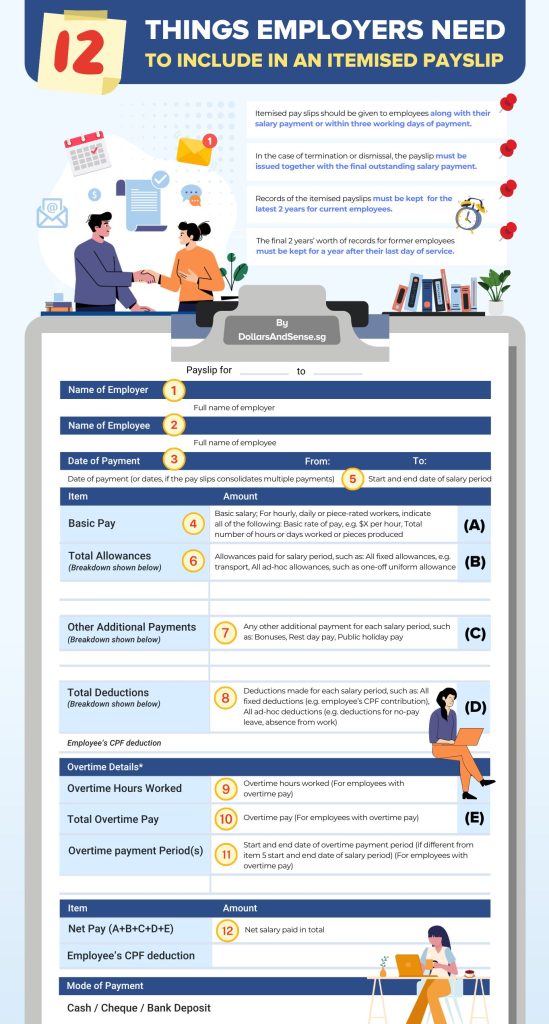
According to MOM, itemised pay slips should be given to employees along with their salary payment or within three working days of payment. In the case of termination or dismissal, the payslip must be issued together with the final outstanding salary payment.
Itemised payslips can be issued in both hard and/or soft copy (including handwritten copies). There is no requirement for the pay slips to be issued digitally or have a digital record. However, employers must keep a record of all payslips issued.
The records of the itemised payslips must be kept for the latest 2 years for current employees and the last 2 years for employees no longer with the company. These final 2 years’ worth of records for former employees then need to be kept for a year after their last day of service.
Read Also: Minimum Requirements For Key Employment Terms (KETs) On Employees Contracts
What Must Be Included In An Itemised Payslip?
Salary payments must be made at least once a month and their corresponding itemised payslips issued at the same time (or within 3 working days).
If the salary is paid more than once a month (e.g. once every fortnight), employers can consolidate payslips. The consolidated payslip must contain details of all payments made since the last payslip.
In general, here’s the information that a payslip need to contain:
| No. | Item description |
| 1 | Full name of employer |
| 2 | Full name of employee |
| 3 | Date of payment (or dates, if the pay slips consolidates multiple payments) |
| 4 | Basic salary; For hourly, daily or piece-rated workers, indicate all of the following: Basic rate of pay, e.g. $X per hour, Total number of hours or days worked or pieces produced |
| 5 | Start and end date of salary period |
| 6 | Allowances paid for salary period, such as:All fixed allowances, e.g. transportAll ad-hoc allowances, e.g. one-off uniform allowance |
| 7 | Any other additional payment for each salary period, such as:BonusesRest day payPublic holiday pay |
| 8 | Deductions made for each salary period, such as:All fixed deductions (e.g. employee’s CPF contribution)All ad-hoc deductions (e.g. deductions for no-pay leave, absence from work) |
| 9 | Overtime hours worked (For employees with overtime pay) |
| 10 | Overtime pay (For employees with overtime pay) |
| 11 | Start and end date of overtime payment period (if different from item 5 start and end date of salary period) (For employees with overtime pay) |
| 12 | Net salary paid in total |
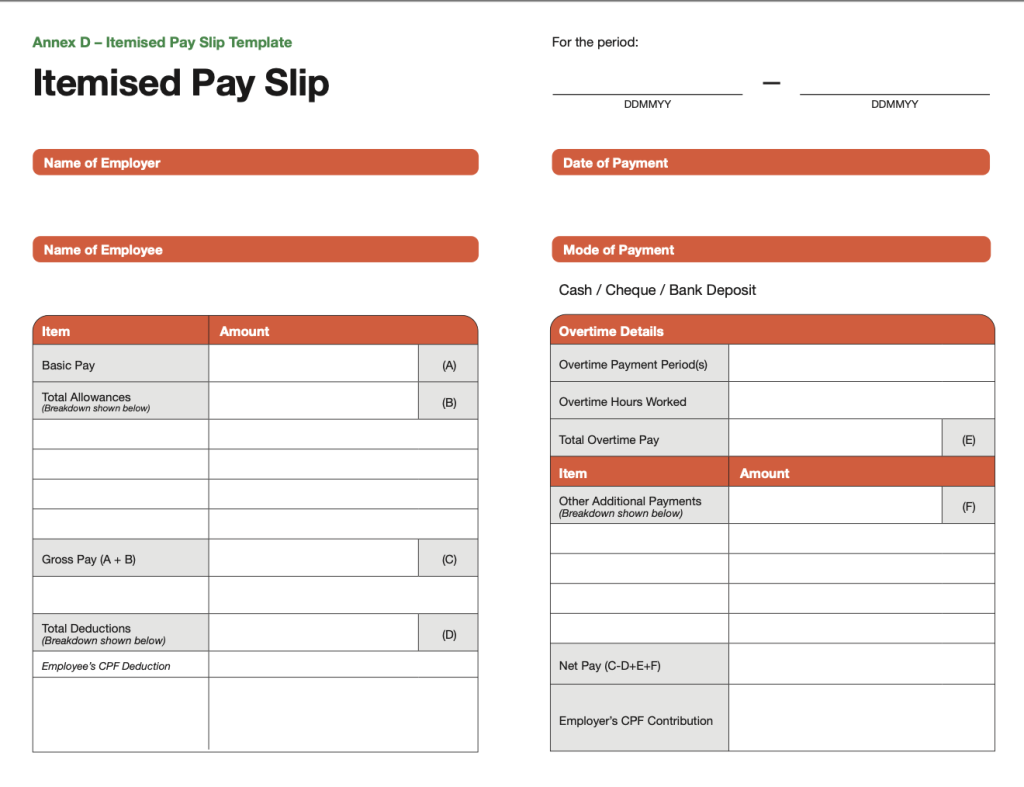
To help employers, MOM has a sample payslip template on their website. Depending on the needs of your business, you may not be required to fill in all fields, such as overtime or additional payments.
An Itemised Payslip Protects Employers And Employees From Disputes
Having a clear breakdown of the various salary components (including allowances and deductions) is important not just for records but also for dispute settlement.
As the payslip is itemised, employees also have a clear idea of whether a variation in their salary is due to extra allowances, overtime, additional payments or deductions. In the case of salary overpayment, an itemised payslip can provide written proof of the salary that is due to the employee.
Read Also: What Happens When You Accidentally Overpay Your Employees In Singapore?
You can refer to this infographic for a quick summary on the things you need to take note of in an itemised payslip:
Subscribe To The DollarsAndSense Business Pass
Enjoy what you are reading and want more? Join The DollarsAndSense Business Pass and unlock access to valuable tools, exclusive networking opportunities, and tap into the wisdom of industry experts to fuel your business expansion!


