It is easy to take for granted the digitalisation we experience readily in Singapore with QR codes, PayNow and other various digital tools that consumers and businesses use daily. However, the digital economy we live in does not exist in a vacuum, Singapore is entwined with the rest of Southeast Asia (SEA) which is also experiencing a rapid wave of digitalisation.
According to e-Conomy SEA 2022 report, about 100 million of the 460 million internet users in SEA have come online in the past 3 years.
Here’s what businesses need to know about Southeast Asia’s growing digital economy.
Digital Adoption Is Maturing
After years of rapid growth, the rate of digital adaption growth is normalising. E-commerce is almost at full adoption for digital users in urban SEA while food delivery is a close second.

This means that businesses cannot just rely on the rapid growth in digital adoption to drive their own growth as the market starts to saturate. instead, there needs to be better product and service differentiation for businesses to stand out in the digital economy.
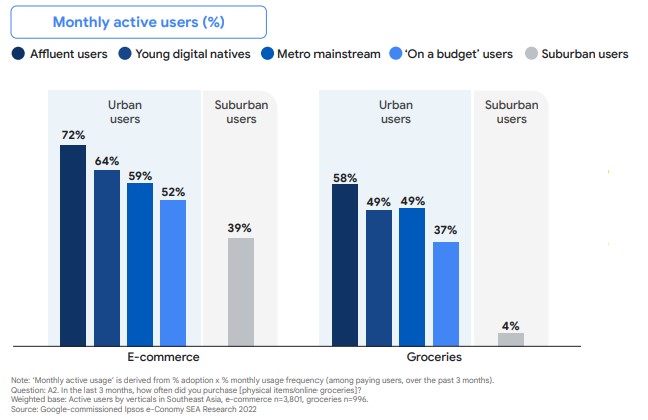
Additionally, businesses can consider targeting new user groups who have yet to adopt digital services. For example, suburban users which are defined as those in Tier 3 cities, form about 41% of the total digital population. However, aside from e-commerce, their adoption of other digital services is relatively low.

E-commerce Is Expected To Continue Growth
Already the top digital service adopted by SEAsians, e-commerce is expected to continue growing and reach $211 billion in annual GMV in 2025, even with an expected return to in-store spending. However, the report also predicts that e-commerce players will move towards improving profitability and user engagement instead of emphasising acquisition.
Specifically, online groceries are an area of growth as there is a significant usage gap between the urban and suburban users. However, existing barriers such as delivery options and product variety are issues that need to be addressed.
Food Delivery And Online Media, Including Entertainment And Gaming, Are Returning To Pre-Pandemic Trendline Growth
The restriction of movement and activities had caused food delivery, online media, online entertainment and gaming to spike and peak during the early period of the pandemic. This also led to above-the-trendline growth in these digital services that are now normalising to their pre-pandemic growth rate.
As people return to offices and dining out, demand for food delivery is normalising. Additionally, rising prices have also caused people to cut down on food delivery. Suburban users remain the smallest group of users for food delivery and transport at 18% while 70% of affluent users spend on food delivery and transport and spend nearly twice more than the median.
7 in 10 gamers are spending the same or less time playing now than during the pandemic while growth in online media GMV has slowed to 9% in 2022

Online Travel Will Benefit From ‘Revenge Travel’
The easing of border restrictions has also renewed interest in travel. This is shown in the increase in travel-related search interest which has reached or exceeded pre-pandemic levels. Consumers have also indicated intention to travel, with Singaporeans and Malaysians most likely to act on them with actual flights taken.
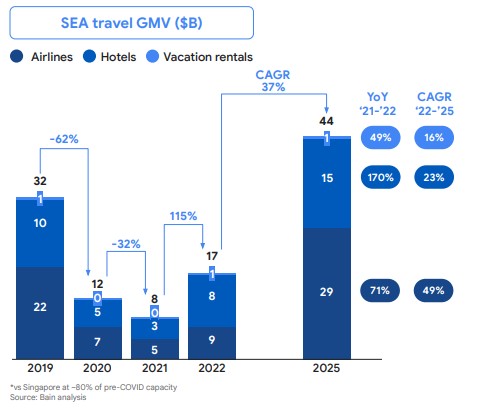
Hotels in SEA are back to about 80% of pre-pandemic GMV. Domestic travel has also regained about 60% and 70% of passenger traffic in 2019 in Malaysia and Indonesia, respectively. International flights in Singapore also rebounded to 80% of pre-pandemic capacity. However, China which forms a major source of tourists, remains closed off and may hamper the swift recovery of the sector.
Digital Financial Services Are Growing Post-Pandemic As People Move Online
The accelerated shift to digitalisation has also extended to digital financial services. All sub-sectors of digital financial services (including payments, remittance, lending, investment and insurance) have benefited from the shift.
Of the different business models of digital financial services, digibanks have garnered a lot of attention. As traditional banks also continue digitalise, digibanks have to move quickly to capture market share.
Mass and unbanked consumers are most likely to switch to digibanks. Regions, where there are higher proportions of underbanked or unbanked consumers, are more likely to see higher uptake of digibanks.

However, Singapore is a mature market with well-established financial institutions which are also digitalising rapidly. This means that there are fewer unbanked and underbanked consumers for digibanks to gain a foothold. In comparison, digibanks have a higher chance of succeeding in Indonesia, the Philippines and Vietnam where there’s a significant proportion of the unbanked and underbanked and the incumbent banks are slower to digitalise.
Subscribe To The DollarsAndSense Business Pass
Enjoy what you are reading and want more? Join The DollarsAndSense Business Pass and unlock access to valuable tools, exclusive networking opportunities, and tap into the wisdom of industry experts to fuel your business expansion!