
We live in a multi-racial and multi-religious society in Singapore. This allows us to enjoy a diverse array of cuisines, and for some of us, we take it a notch further with our self-proclamation as foodies as we go on food hunts.
For the Muslim community, the Halal certification makes it easy for consumers to identify and be assured that the food and beverage (F&B) businesses meet the requirements by the Muis Halal Certification.
The global Halal food market was estimated to be around US$2.3 trillion in 2022, and as the world’s Muslim population is expected to grow, may increase to 7.5 trillion by 2032. Here’s what F&B businesses that intend to serve this growing market need to know about applying for Halal certification in Singapore.
What Does “Halal Food” Mean?
“Halal” is the Arabic word for lawful or allowable. All Halal foods and beverages are permissible for Muslims to enjoy unless they are clearly forbidden (haram) in the Quran (holy book of Islam) and Hadith (prophetic sayings).
For example, here’s a short (non-exhaustive) list of Halal and non-Halal animals.
| Halal Animals | Non-Halal Animals (Haram) |
| All domestic birds | Birds of prey. E.g. falcons, eagles, owls |
| All cattle | Meat of swine (pig) including all its by products |
| Sheep | Meat of an animal that was not blessed with the name of Allah at the time of slaughter |
| Goats | Reptiles, snakes, crocodiles |
| Fish | Carnivorous animals with fangs. E.g. dogs, lions, tiger |
The animals that are considered Halal, with the exception of fish, will only be considered Halal when they are slaughtered according to certain guidelines. This includes the slaughter man being a Muslim and invoking the name of Allah or reciting some prayers prior to the slaughter of the animal. There are also guidelines on how the arteries of the animal must be severed to render the meat Halal.
Given that it is a religious dietary requirement for Muslims to consume only Halal food, F&B businesses planning to cater to the Muslim community should apply for the Halal certificate, which gives greater assurance to the Muslim consumers about the food served.
What Is Halal Certification?
In Singapore, the Majlis Ugama Islam Singapura (Muis), also known as the Islamic Religious Council of Singapore, is the only organisation with the vested legal powers under the Administration of Muslim Law Act (AMLA) to issue Halal certificates.
Before applying, you should read through the conditions for Halal certification, and pass a Halal Competency Assessment (HCA). This is mandatory for Owner Representatives and Muslim Personnel under the Eating Establishment Category, and Halal Team Leader and Halal Assurance Office for all other categories. This will cost $125 (before GST), and is SkillsFuture Credit claimable, and will be valid for 5 years.
Thereafter, you should note that there are 3 types of requirements in the Halal application process. The first requirement is the Halal requirement, which requires all raw materials used to be Halal and substantiated with supporting documents. The second requirement is the staffing requirement, where at least 2 (or 3 for Catering or Central Kitchen application) Muslim staff are employed in each premises applying for Halal certification. The third and last is the systems requirement, whereby the applicant must comply with the 10 principles of the Singapore Muis Halal Quality Management System (HalMQ).
Additionally, there will be a series of desktop and site audits to determine if the company is capable of maintaining and complying with Muis Halal conditions and requirements. Furthermore, unannounced periodic checks will be conducted post-certification.
Read Also: Guide To Start A Hawker Stall Business In Singapore
What Types of Businesses Can Apply For Halal Certification?
There are 7 types of Halal certification schemes that come under Muis that caters to the various categories of food and food-related industries. They are:
#1 Eating Establishment Scheme
Issued to retail food establishments such as restaurants, school canteen stalls, snack bars, bakery shops, stalls in foodcourt or temporary stalls in bazaars.
#2 Endorsement Scheme
Issued to imported or exported products that have been certified in the country of origin by Muis-recognised Halal certification bodies.
#3 Food Preparation Area Scheme
Issued to catering establishments and central kitchen facilities.
#4 Product Scheme
Issued to products which are manufactured or partly manufactured/processed in Singapore.
#5 Storage Facility Scheme
Issued to stationary and mobile storage facilities, such as warehouses and coldrooms.
#6 Whole Plant Scheme
Issued to manufacturing facilities and all products manufactured therein.
#7 Poultry Abattoir Scheme
Issued to poultry abattoirs for their freshly slaughtered poultry.
Based on the available certification schemes, the Eating Establishment (EE) Scheme is most relevant to retail F&B businesses like restaurants or food stalls.
Halal Requirement For All Ingredients And Food Products
One of the first requirements that applicants need to fulfill is the halal requirement. Under the EE scheme, several conditions must be met to obtain the Halal certificate. We highlight some of the key conditions regarding the Halal requirement for ingredients and food products.
- First, applicants must be adequately licenced by competent food safety authority, which is the Singapore Food Agency (SFA).
- The applicant needs to ensure there is no cross-mixing of Halal and non-Halal food and ingredients.
- The applicant can only order, purchase, receive, store, prepare, cook, offer to sell and sell Halal food and ingredients that have been declared to Muis.
- Applicants must ensure that all ingredients are labelled in English with the required information for traceability purpose.
- Applicant must ensure that equipment and utensils used in the handling of Halal-approved food and ingredients do not come into contact with pork or its derivatives.
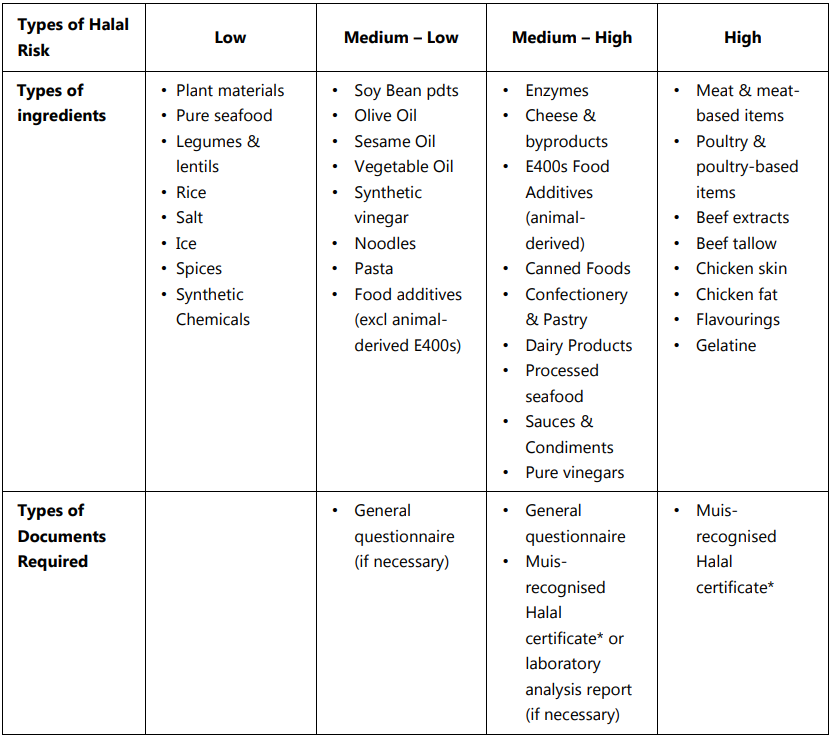
- Lastly, all ingredients and food products prior to purchase must be substantiated with product specifications or labels. Moreover, ingredients and food products which are categorised as Medium-low, Medium-high and High Halal risk (as highlighted below), will require additional documents for approval.
Staffing Requirement – Halal Training
Foundation Programme
As part of the Halal-certification, it is mandatory for 2 staff – with at least one of them being a Muslim representative – from the Halal team within the Halal-certified premise to attend the level 1: Halal Foundation Programme conducted by Muis-appointed training provider, Warees Halal Limited. Participants will understand the definition and basic concepts of Halal certification, be better prepared to comply with Muis Halal requirements, and gain an overview of the principles of HalMQ.
There are two levels for the foundation programme*. One is the supervisory level, which is meant for those holding a supervisory or managerial role or a is a Halal Team Leader and the other is at the operational level meant for those holding an operational role or is a Halal team member.
Operational Level
For the operational level course, the Learner can choose between two courses depending on their language proficiency.
If they are proficient in the Malay language, they can choose the Halal Foundation (Virtual Classroom) Malay Language. It costs $280 (before GST).
If the Learner is proficient in English, then they can choose the Halal Foundation (Blended Learning) – Synchronous & Asynchronous E-Learning Course. It costs $310 (before GST) but as it is a WSQ-course, companies can tap on the Skills Development Fund (SDF) training grant that is available for eligible Singaporeans and PRs.
Supervisory Level
For the supervisory level course, there are also two options for Learners depending on their ability for self-directed full online learning.
If the Learners are not comfortable with online learning, they can opt for the Halal Foundation (for Supervisors) – Synchronous & Asynchronous E-Learning & Classroom. The class, which is conducted in English, will be a mix of online and virtual classroom. It costs $310, and despite not being a WSQ-course, participants can still claim their SkillsFuture Credit.
For Learners who are comfortable with full online learning, they can sign up for the Halal Foundation (for Supervisors) Full Online Learning. It costs $280, and there is no training grant available. [Do note that this course has been ceased for revision until further notice].
*Information is sourced from Warees Halal Limited and is accurate as of 13 April 2022.
Level 2: Developing & Implementing the Singapore Muis Halal Quality Management System (HalMQ)
After completing the level 1 course, companies can also send their staff for the level 2 course – Developing & Implementing the Singapore Muis Halal Quality Management System (HalMQ) – that is available under the certification programme. The course explains the basic concepts and requirements of HalMQ, teaches participants how to prepare and document HalMQ procedures, gives an overview of internal audit and assessment techniques.
The course, which is conducted in English over two days, costs $535 and is strongly recommended for Halal team leaders or members within Halal-certified premises.
System Requirement – Singapore Muis Halal Quality Management System (HalMQ)
The third requirement for the Halal certification is the Singapore Muis Halal Quality Management System. It is a system-based and proactive approach that businesses need to comply with in order to achieve Halal certification.
There are 10 principles of HalMQ (pronounced as “Hallmark”) that were benchmarked against internationally recognised standards such as ISO and HACCP.

How To Apply For Halal Certification
Here’s a quick overview on the Muis Halal Certification Process.

Here’s a detailed flowchart of the Halal application process.

Source: EE Scheme
Step-By-Step Process For Application Of New Halal Certification
Once you have understood the conditions and requirements required for the Halal certificate and you’re familiar with the overall application process, it’s time to apply now.
#Step 1: To submit a new Halal application, apply through LicenceOne portal: https://licence1.business.gov.sg.
#Step 2: Login
#Step 3: Select “Apply for New License”
#Step 4: Select Halal Certification
#Step 5: Click “Next” after verifying the auto-populated information
#Step 6: Select “Express” or “Normal” Application, Select multiple schemes if necessary. Verify premises details, input Halal team members details, upload supporting documents (e.g. Menu/Product list, Ingredient list, floor plan, labels, etc) & Click “Next”
#Step 7: General Declaration & click “Submit” and “Proceed”
#Step 8: Review information entered, select check-box after reading and agreeing to the declarations & Click “Submit”
#Step 9: Application submission notification appears onscreen
Application & Certification Fees
Depending on whether you have selected an “Express” or “Normal” application, the processing time for the application would differ.
For new applications, if you selected “Normal”, the application would take under 14 working days from the date of payment of the application fee to process. Otherwise, if you had selected “Express”, it would take under 7 working days for the application to process.
You would need to pay:
Stage 1: 100% Application Fee + 40% Certification Fee
Stage 2: 60% Certification Fee
Here’s a quick breakdown on the EE schemes application fees based on the Halal fees schedule.
| Type of Scheme | Description | Application Fees (before GST) | Remarks |
| EE-Hakwer | Issue of a halal certificate for a period of one year for any food or hawker stall or any stall selling uncooked food with a total floor area not exceeding 13 square metres | $350 | Applicable to stall selling cooked and uncooked food |
| EE-Hakwer | Issue of a halal certificate for a period of one year for any food or hawker stall or any stall selling uncooked food with a total floor area exceeding 13 square metres | $565 | Applicable to stall selling cooked and uncooked food |
| Snack Bar / Confectionary / Bakery | Issue of a Halal certificate for a period of one year for any snack bar, confectionery or bakery (other than in a petrol station) | $710 | Applicable to takeaway snack, confectionery or bakery shop with no dining area |
| EE-Restaurant | Issue of a halal certificate for a period of one year for any restaurant with a total floor area not exceeding 186 square metres | $775 | Applicable to food shop with self-managed dining area |
| EE-Restaurant | Issue of a halal certificate for a period of one year for any restaurant with a total floor area exceeding 186 square metres | $1,140 | Applicable to food shop with self-managed dining area |
| School Canteen Stall | Issue of a Halal certificate for a period of one year for any canteen stall in a government school | $60 | Applicable to food stall operating in government schools |
| Short Term Stall | Issue of a halal certificate to any certificate holder to operate other than its certified premises for a period not exceeding 7 consecutive days in any bazaar, fair, trade exposition or other similar activity or event | $75 | Applicable to temporary food stall at a bazaar, expositions, etc for which its principal Premises/ central kitchen is Halal-certified |
| Food Station | Issue of a Halal certificate for a period of one year for any food station in a restaurant | $560 | Applicable to food station located in a restaurant that (i) conducts minimal cooking and (ii) has an external Halal-certified kitchen |
| Staff canteen stall | Issue of a halal certificate for a period of one year for any canteen stall in a staff canteen | $710 | Applicable to food stall operating in staff canteen |
| Food Kiosk | Issue of a Halal certificate for a period of one year for any snack bar, confectionery or bakery in a petrol station | $364 | Applicable to takeaway food kiosk at petrol station |
Post Certification And Subsequent Renewal
The Halal certifications are issued between 1 and 2 years, and during the period of validity, the restaurant must adhere to the Muis Halal Certification Conditions at all times. The Muis and/or its appointed agents will conduct unannounced periodic inspections during the validity period and if non-compliance is detected, the certificate holder must carry out rectification measures or other required actions within the stipulated deadline.
Halal certificate holders must submit their renewal application 60 to 120 days before the expiry date of their halal certificate, or they can opt for auto renewal submission.
Each renewal costs 100% of the certification fees that are applicable to the certification scheme. The certification cost is split as 40% for stage 1 and 60% for stage 2.
Read Also: [2025 Edition] Price Guide For Cooked Food Hawker Stall Rentals
Subscribe To The DollarsAndSense Business Pass
Enjoy what you are reading and want more? Join The DollarsAndSense Business Pass and unlock access to valuable tools, exclusive networking opportunities, and tap into the wisdom of industry experts to fuel your business expansion!


