Since 2018, with the introduction of the Open Electricity Market (OEM), consumers (both households and businesses) have the choice to acquire their electricity from various retailers instead of SP Group.
According to OpenElectricityMarket.sg, as of 30 April 2021, about half (47%) of business accounts have switched to buying electricity from a retailer of their own choice.
While most people are familiar with OEM for households, businesses (especially new or smaller business owners) may not be aware that you can acquire your electricity supply from a non-SP Group provider. However, there are some restrictions for businesses, especially for those in Management Corporation Strata Title (MCST) buildings.
Here is what you need to know about Open Electricity Market (OEM) for businesses, whether you can switch your electricity provider from SP Group and how much you can save by switching.
Read Also: How To Use The Productivity Solutions Grant (PSG) To Buy Laptops For Your Business
Electricity Options For Businesses
In general, there are 3 options for businesses to buy their electricity.
#1 Buying from SP Group at the regulated tariff. This is the default electricity retailer that every business and household buys from if there is no action taken to switch.
#2 Buying from various electricity retailers. There are two main price plans if you buy from electricity retailers: fixed price plans and discount off regulated tariff plans.
- If your business electricity consumption is less than 2,000kWh, you can buy from the Open Electricity Market (OEM).
- If your business electricity consumption is 2,000kWh and above, you can buy from any licensed retailer.
#3 Buying from the Wholesale Electricity Market. This option is riskier as wholesale electricity price can change every half an hour, depending on market demand and supply conditions.
Regardless of which purchase option you choose, the electricity is still supplied by SP Group as they operate the national power grid. If there is a disruption to your electricity supply, you will still have to contact SP Group for assistance.
Current Options When Faced With Soaring Electricity Prices
Unfortunately, in the current market of rising electricity prices, some retailers have closed down operations and others have stopped offering fixed price plans and discount off regulated tariff plans. While existing business customers will continue to be serviced by their retailers, other businesses may be at the mercy of fluctuating electricity prices. According to MTI, only around 1% of consumers buy electricity directly from Singapore Wholesale Electricity Market and are exposed to volatile prices. As the volatile gas and electricity prices, and risk of PNG disruptions, have limited the retailers’ ability to offer fixed price contracts, some large businesses were facing difficulties in renewing their contracts or obtaining new contracts.
To support businesses with large electricity demands, the Energy Market Authority (EMA) introduced the Temporary Electricity Contracting Support Scheme (TRECS) in December 2021. Under TRECS,
participating gencos are able to draw on EMA’s Standby LNG Facility (SLF) to offer monthly retail contracts to large electricity consumers with average monthly electricity consumption of 4 megawatt-hour (MWh) or more. EMA has also worked with gencos to offer additional retail
plans with significant fixed price components.
Businesses can sign up for the fixed price plans under TRECS from 17 June 2022 to 27 June 2022. For the month of July 2022, the fixed electricity rate under TRECS is capped at 37.558 cents/kWh. It does not include third-party charges such as transmission charges by SP Group and market charges by the Energy Market Company.
For consumers with average monthly consumption of at least 4,000kWh: PacificLight Energy Pte Ltd will offer fixed electricity rate capped at 37.558 cents/kWh under TRECS.
For consumers with average monthly consumption of 4,000kWh – 50,000kWh: Sembcorp Power Pte Ltd will offer fixed price plans.
For consumers with average monthly consumption of at least 4,000kWh: retailers will also offer price plans with a significant fixed price component.
1. Geneco (by Seraya Energy)
2. Flo Energy
3. Senoko Power Supply Pte Ltd
Check Whether You Can Make The Switch
Independent Electricity Supply
If you are your own landlord (i.e. you own the building that your business is operating from) or you are in a building where you are the only tenant, you are most likely to be eligible for Open Electricity Market (OEM). Basically, if you own the master meter, you can switch your electricity retailer relatively easily.
To be eligible to switch, you will need to change your current cumulative meter to an Advanced Metering Infrastructure (AMI) meter. This smart meter allows your electricity consumption to be measured every 30 mins and is a requirement to switch electricity retailer.
The estimated cost of installing a smart meter is about $40.
Shared Electricity Supply (Master-Sub Metering Arrangement)
For most businesses in malls and commercial buildings, you probably share your electricity supply with other tenants even if you have your own unit meter. The building owner will most likely arrange the electricity retailer to use.
If you are in an MCST building, most likely you are in a building that has a master-sub metering arrangement, this means that your options to buy electricity are restricted to the En-Bloc Contestability Scheme or the Demand Aggregation Scheme.
Under the En-Bloc Contestability Scheme, the MCST or the master-metered account holder will buy electricity for the entire premises on behalf of all its tenants. This means that you would have to convince not just your landlord to switch but also all the other tenants under the same master-metered account.
If you are able to convince your landlord to switch but not able to get the agreement of all other tenants, you can still switch electricity retailer under the Demand Aggregation Scheme. Under this scheme, the MSCT can configure a common service load with you as the consenting tenant under a sub-meter. The consumption under this sub-meter can then be used to purchase electricity from a retailer. However, this may require additional electrical works from the MSCT and all the tenants under the same sub-meter must agree to the switch.
Given the additional effort on the part of the master-metered account holder, it may be difficult to convince your landlord to switch electricity retailer. However, the chances of doing so may be higher under the Demand Aggregation Scheme, especially if you are an anchor tenant.
Look For An Electricity Retailer
Once you are eligible to purchase from the Open Electricity Market, you can start looking for suitable price plans. There are two main types: fixed price and discount off regulated tariff.
Fixed price plans offer certainty over future electricity prices. For businesses that require certainty and want to minimise any variability in prices, this will be the preferred option.
For businesses that can accept price variability but want a better deal than SP Group’s regulated tariff rates, discount off regulated tariff may be the better option. Especially, if electricity tariff rates trend downwards, such plans will offer you better savings.
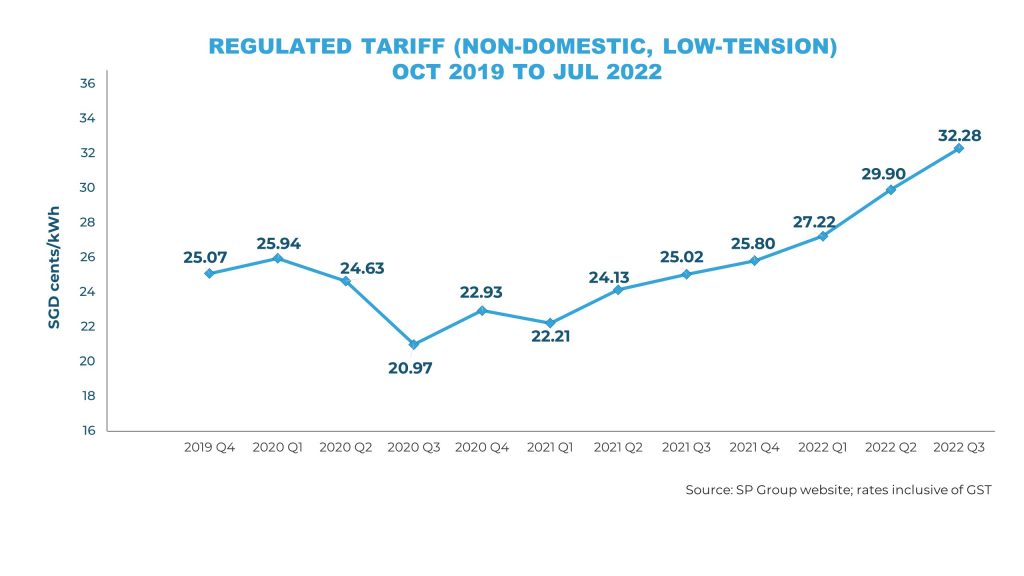
For reference, the regulated tariff rates are now trending upwards. This would benefit fixed-priced subscribers more.
Open Electricity Market: Fixed Price Plans
Currently, there are no available options for fixed price plans.
Open Electricity Market: Discount Off Regulated Tariff Plans
Currently, there are no available options for discount off regulated tariff plans.
Read Also: The Ultimate Business Owners’ Guide To The HDB Home Office Scheme
Choose A Plan That Suits Your Business Needs
In the end, the electricity plan should suit your business needs. If your business electricity consumption is relatively low, it may not be worth your while to negotiate with your landlord to switch your electricity retailer just to save small amount. In some buildings, the master tenant or building owner also has an incentive to seek the cheapest electricity provider.
However, if your electricity consumption is high, making the switch can make much more sense, especially if you are the master meter account holder.
This article was first published on 15 December 2020 and has been updated with the latest information.
Subscribe To The DollarsAndSense Business Pass
Enjoy what you are reading and want more? Join The DollarsAndSense Business Pass and unlock access to valuable tools, exclusive networking opportunities, and tap into the wisdom of industry experts to fuel your business expansion!