It might seem contradictory at first.
Why would both job vacancies and the unemployment rate increase at the same time? After all, more job openings should logically mean more people getting hired, not more people out of work.
But according to the Ministry of Manpower’s Labour Market Report for the first quarter of 2025, this simultaneous rise reflects a more complex labour market. While the job market continues to expand, the pace of growth has slowed considerably. In Q1 2025, total employment rose by just 2,400, down sharply from 7,700 in the previous quarter. This suggests that while employers are still adding jobs, they are doing so more cautiously, likely in response to persistent global uncertainties such as potential tariffs and evolving business conditions.
Yet, even as employment growth slows, job vacancies have also increased, from 77,500 in December 2024 to 81,100 in March 2025. This raises the job vacancy rate from 3.1% in December 2024 to 3.2% in March 2025.
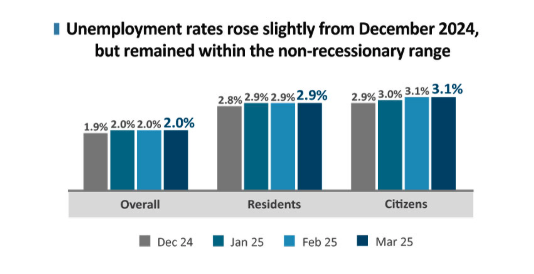
On the surface, this should be good news for job seekers. However, the resident unemployment rate still increased slightly to 2.9%, and long-term unemployment also rose modestly.
A Mismatch Between Jobseekers & Job Openings
This apparent contradiction often points to a mismatch between jobseekers (and their expectations) and job openings. Many of the vacancies in today’s market require either specialised qualifications or a willingness to take on roles that may be physically demanding or less desirable. For instance, non-resident employment grew primarily in roles like bus and truck drivers, positions that tend to be harder to fill with resident workers.
On the other end, jobs that are more likely to appeal to residents, such as health and social services, may not meet the expectations of jobseekers in terms of salary, flexibility, or career prospects. There’s also the skills gap: some unemployed residents may not possess the specific training or experience required to take on these roles, particularly in sectors that are rapidly evolving with technology.
In this way, the labour market is active, but not necessarily well-aligned. Employers are still hiring, but not always finding the right candidates. Jobseekers are looking, but may not be applying for the opportunities that are available.
Low Turnover Means Fewer Openings to Replace
Adding to the complexity is the fact that labour turnover remains low.
Both recruitment and resignation rates have stayed subdued, as employees appear to be holding onto their current roles amid economic uncertainty. With fewer people leaving their jobs voluntarily, the availability of replacement roles drops, limiting opportunities for others to enter or re-enter the workforce.
Ultimately, the rise in both job vacancies and unemployment is not a sign of a deteriorating economy, but rather a sign of a labour market in transition. As industries shift and demand for certain skillsets evolves, jobseekers may need to adapt through reskilling or recalibrating expectations, while employers continue to fine-tune how they attract and retain the talent they need.
Read Also: Can A Singapore Employee (On Work-From-Home Or Work-From-Anywhere) Move To Malaysia?
Subscribe To The DollarsAndSense Business Pass
Enjoy what you are reading and want more? Join The DollarsAndSense Business Pass and unlock access to valuable tools, exclusive networking opportunities, and tap into the wisdom of industry experts to fuel your business expansion!