
To be clear, we are not suggesting for anyone to stop self-employment if it’s suiting them. If the financial remuneration is reasonable and you enjoy the flexibility of working as a self-employed person, it makes sense to continue doing so. Whether you are working for yourself or someone else, it’s never easy to find a job that you like.
However, if you have been thinking about getting a full-time job for some time, but previously, you could not find one, and you end up taking on freelance and gig economy work for an extended period, 2021 could be a good year to consider switching back to full-time employment.
Let us explain why.
Record Level Of Job Vacancies In Singapore
Here’s a piece of statistics that may shock you. According to MOM’s latest statistics, job vacancies (seasonally adjusted) are currently at a record high of 68,400, exceeding the last high of 65,500 in March 2015. In other words, in spite of the COVID-19 pandemic, there are more available jobs in Singapore right now than ever.
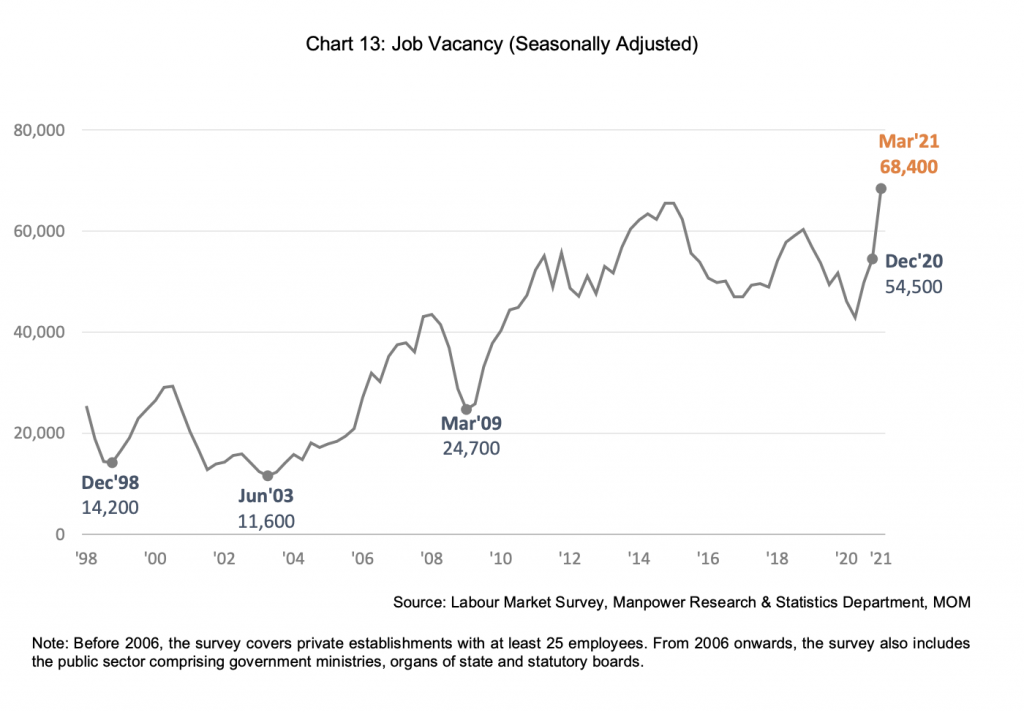
If you are wondering why, the reason is simple. Due to border restrictions, it’s hard and expensive to bring in foreign workers. This applies not just to low-wage foreign workers on work permits, but also S-Pass workers and Employment Pass workers.
Regardless of your personal views about whether you think some companies deliberately prefer hiring foreigners over locals, or that some industries just can’t attract the locals they need, the truth is that Singapore companies are no longer in the driver seat where they can choose easy access to foreign workers over hiring locals.
For anyone who is eying a full-time position, it’s worth noting which are the sectors that are hiring and which are not. For example, it doesn’t make sense to say that you want to join the airline industry or the travel-retail sector.
The question is, would these jobs be filled, or would they remain unoccupied until borders are open again to foreign labour.
Government Continues To Encourage Full-Time Hiring Via The Jobs Growth Incentive (JGI)
For those who are unaware, the Jobs Growth Incentive (JGI) was introduced in August 2020 to promote local hiring. Under this salary support scheme, Singapore companies can get 25% or 50% salary support, depending on the age, for new local employees hired between September 2020 to September 2021.
This applies to both Singapore Citizens and Singapore Permanent Residents (PRs) for the first $5,000 of gross monthly wages paid to the new local hires under 40, and first $6,000 of gross monthly wages paid to new local hires 40 and above, or who is a person with disabilities or an ex-offender.
The salary support for the Jobs Growth Incentive (JGI) is:
- 50% for local workers aged 40 and above,
- 50% for local workers who is 1) a person with disabilities (PwD) or 2) an ex-offender, and
- 25% for local workers who are below the age of 40.
In other words, Singapore companies enjoy significant wage subsidies from the government for hiring a local during this employment period, which ends on September 2021. It also means that for many companies that may have previously outsourced work to a freelancer or third-party agency, it might make financial sense for them to attempt to bring some of these roles in-house.
For example, a company that previously outsources graphics design work may find it more worthwhile to utilise the JGI as an opportunity to bring the freelancer who is working for them onboard as a full-timer.
If you are an individual who has been plying your services to clients that you have enjoyed working with over the past years, 2021 could be a good time to consider moving into a full-time position if the opportunity arises.
Read Also: Guide To Understanding The Jobs Growth Incentive (JGI) For Companies Hiring Local Workers
Remote Working Is Here To Stay
For a large group of freelancers and gig economy workers, the flexibility of working from home, without needing to adhere to fixed working hours, could have been why they prefer freelance and gig works over full-time employment.
For better or worse, COVID-19 has disrupted the regular workplace. Many companies have transitioned to largely a work-from-home environment or a hybrid work arrangement. Showing up daily in the office at 9 am is now the exception, rather than the norm for some companies.
The means that workers who may have previously avoided full-time employment because they could not commit to fixed working hours in the office can now consider again if they can secure full-time, largely work-from-home positions. This may appeal to the likes of stay-at-home moms looking to re-join the workforce or even those with a disability that makes it difficult for them to travel to the office daily.
It’s important to note that working from home won’t make these jobs any easier. Whether you are working from home or in the office, a stressful, fast-paced job will remain as such – stressful and fast-paced. What working-from-home change is that it makes these jobs more accessible for a greater pool of workers to perform by allowing them more flexibility to juggle other important areas of their lives, while still being able to hold down full-time employment.
Read Also: The Reason Why Work-From-Home Is So Productive: Non-Instantaneous Communication
Subscribe To The DollarsAndSense Business Pass
Enjoy what you are reading and want more? Join The DollarsAndSense Business Pass and unlock access to valuable tools, exclusive networking opportunities, and tap into the wisdom of industry experts to fuel your business expansion!